










Shri Jagdamba Polymers H1 profit rose 54% as sales grew
Key highlights
- Shri Jagdamba Polymers' H1 FY27 standalone revenue from operations rose 37.6% to Rs 345.59 crore.
- Shri Jagdamba Polymers' H1 FY27 standalone net profit rose 54.1% to Rs 35.66 crore.
- Shri Jagdamba Polymers' H1 FY27 EBITDA margin increased 183 basis points to 16.46%.
- Shri Jagdamba Polymers' trade receivables rose to Rs 168.07 crore at 30 September 2026 from Rs 114.51 crore at March-end.
powered by IRIS
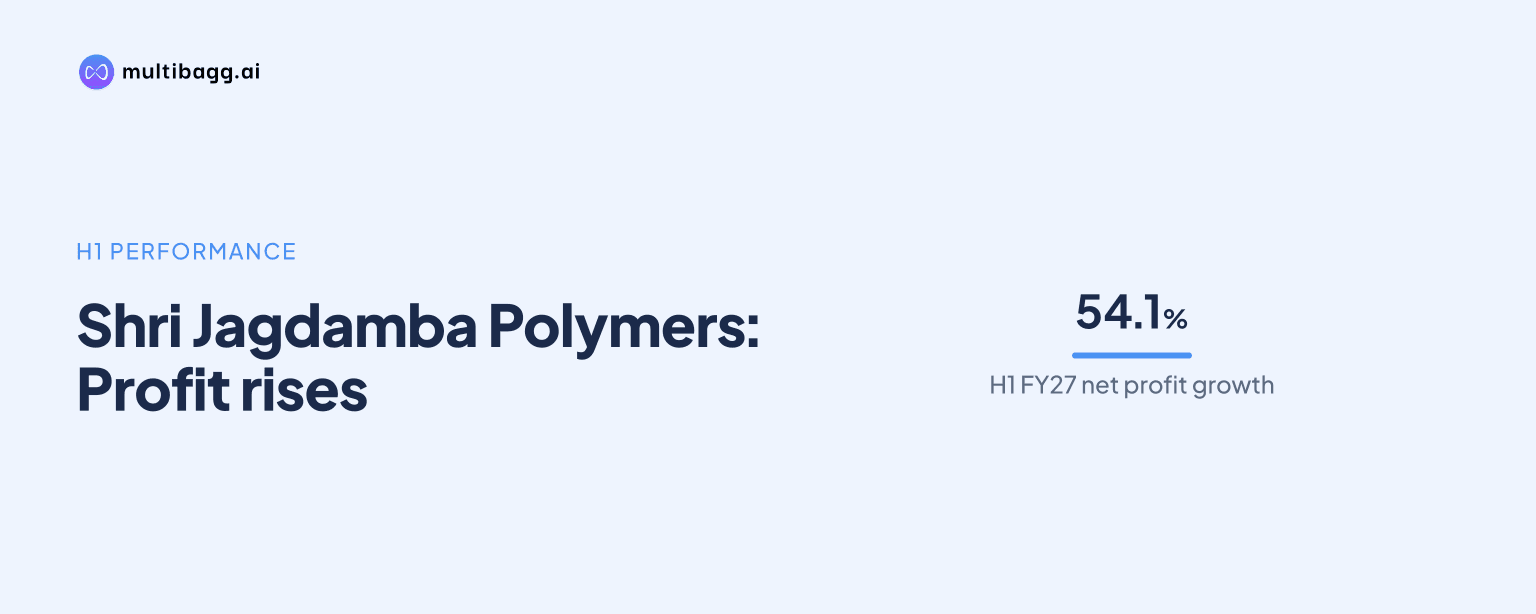
Shri Jagdamba Polymers Limited increased standalone H1 FY27 net profit 54.1% to Rs 35.66 crore for the half year ended 30 September 2026, while revenue from operations rose 37.6% to Rs 345.59 crore. Shri Jagdamba Polymers attributed the outcome to tight polymer supply, higher delivered prices, lower-cost inventory realisation and plants operating at about 95% utilisation.
Know Shri Jagdamba Polymers inside out
Results, valuation, peers and who's buying, in one view.
Why did Shri Jagdamba Polymers' H1 revenue rise?
Shri Jagdamba Polymers increased H1 FY27 revenue by fulfilling additional orders during polymer shortages and reflecting higher costs in delivered selling prices. Revenue from operations reached Rs 345.59 crore, compared with Rs 251.12 crore in H1 FY26. Management said the Iran war tightened polymer supply and lifted container freight by about four times, while disciplined raw-material buying kept its production lines supplied as competitors faced shortages.
Both FY27 quarters contributed to the half-year increase, although the second quarter was lower than the first. Q1 FY27 revenue was Rs 180.92 crore and Q2 FY27 revenue was Rs 164.67 crore, a sequential decline of about 9%. Q2 FY27 revenue was nevertheless 49.1% above Rs 110.46 crore in Q2 FY26 and remained above every FY26 quarter disclosed, including the prior year's highest quarterly revenue of Rs 140.70 crore in Q1 FY26.
Manufactured goods accounted for Rs 335.10 crore, or 97%, of H1 FY27 revenue, while traded goods contributed Rs 10.50 crore. The revenue rise was therefore principally generated by manufactured products. The presentation also reported plant utilisation of around 95% through both quarters, which supported the additional order fulfilment described by management.
How did Shri Jagdamba Polymers turn sales growth into profit?
Shri Jagdamba Polymers converted the revenue increase into H1 FY27 earnings before interest, tax, depreciation and amortisation, or EBITDA, of Rs 56.89 crore, up 54.83% from Rs 36.74 crore. Net profit after tax increased 54.1% to Rs 35.66 crore from Rs 23.14 crore, while earnings per share rose to Rs 40.72 from Rs 26.42 on a Rs 1 face-value share.
The reported year-on-year comparison includes a prior-year exceptional item. H1 FY26 included a pre-tax exceptional gain of Rs 2.86 crore, whereas H1 FY27 had no exceptional item. Profit before tax before exceptional items rose 65.1% to Rs 48.01 crore from Rs 29.09 crore, exceeding the 50.3% increase in reported profit before tax to Rs 48.01 crore from Rs 31.95 crore.
Q2 FY27 net profit rose faster than EBITDA because finance costs fell from the prior-year quarter. Q2 EBITDA increased 38.5% to Rs 26.37 crore from Rs 19.04 crore, while net profit rose 63.4% to Rs 16.70 crore from Rs 10.22 crore. Finance costs declined to Rs 0.54 crore from Rs 2.14 crore, although other income fell to Rs 0.45 crore from Rs 1.10 crore.
Got a follow-up? Ask IRIS
Why did Shri Jagdamba Polymers' EBITDA margin increase despite costlier polymer?
Shri Jagdamba Polymers raised its H1 FY27 EBITDA margin to 16.46% from 14.63% because employee and other expenses grew more slowly than revenue, offsetting a higher material-cost ratio. The margin expansion was 183 basis points, with one basis point equal to one-hundredth of a percentage point. Management also cited better realisations on older, lower-cost inventory and marginal foreign-exchange gains from a depreciating rupee.
Material cost rose to 59.0% of revenue from 57.8%, an increase of 112 basis points that reflected higher polymer prices. However, gross contribution, defined in the presentation as revenue less material cost, increased 34% to Rs 141.80 crore. Management linked this outcome to higher selling prices and its ability to pass through higher costs in delivered prices during the supply disruption.
Costs outside materials grew more slowly than the 37.6% revenue increase. Employee benefits were nearly flat at Rs 20.30 crore, compared with Rs 19.90 crore, reducing their share of revenue to 5.9% from 7.9%. Other expenses increased 30% and declined as a revenue share to 19.4% from 20.5%, while finance costs fell to 0.9% of revenue from 1.2%.
What changed in Shri Jagdamba Polymers' working capital and funding?
Shri Jagdamba Polymers funded a larger working-capital requirement as higher polymer prices and higher sales values increased inventories and receivables at 30 September 2026. Inventories rose to Rs 55.93 crore from Rs 33.04 crore at 31 March 2026, while trade receivables increased to Rs 168.07 crore from Rs 114.51 crore. The presentation attributed the inventory increase to higher polymer prices and larger import lots purchased when cheaper options were available.
Core working capital, defined as inventories plus receivables less trade payables, increased to Rs 202 crore from Rs 133.30 crore at March-end. Trade payables rose to Rs 21.91 crore from Rs 14.28 crore, while cash and equivalents declined to Rs 9.39 crore from Rs 30.63 crore. Management said cash and higher use of bank limits funded the build-up, with working-capital-limit utilisation high as raw-material prices increased.
Total borrowings rose Rs 6.36 crore to Rs 56.92 crore, and net debt increased to Rs 47.52 crore from Rs 19.93 crore. The balance-sheet page reported net debt to equity of 0.13 times at 30 September 2026, compared with 0.06 times at 31 March 2026; the working-capital page separately reported 0.15 times for September. Net worth increased to Rs 368.00 crore from Rs 333.22 crore and the current ratio rose to 4.3 times from 3.5 times.
Conclusion
Shri Jagdamba Polymers paired a 37.6% rise in H1 FY27 revenue with a 183-basis-point expansion in EBITDA margin, resulting in a 54.1% increase in standalone net profit to Rs 35.66 crore. Management attributed the result to supply availability, higher delivered prices, lower-cost inventory realisation and cost growth outside materials that trailed revenue growth.
The next result will show whether the H1 conditions persist as polymer prices, container freight, exchange rates and global trade conditions remain identified risks in the presentation. Working capital is also an unresolved operating matter, with receivables of Rs 168.07 crore and inventories of Rs 55.93 crore at 30 September 2026, while plants were already operating at about 95% utilisation.