










Shri Jagdamba Polymers Ltd working capital reaches ₹202 crore
Key highlights
- Shri Jagdamba Polymers’ core working capital increased to ₹202 crore at 30 September 2026 from ₹133.3 crore at 31 March 2026.
- Trade receivables rose by ₹53.56 crore to ₹168.07 crore, while inventories increased by ₹22.89 crore to ₹55.93 crore.
- Net debt increased by ₹27.59 crore to ₹47.52 crore as cash and equivalents declined to ₹9.39 crore.
- Shri Jagdamba Polymers’ standalone H1 FY27 revenue increased 37.6% to ₹345.59 crore.
powered by IRIS
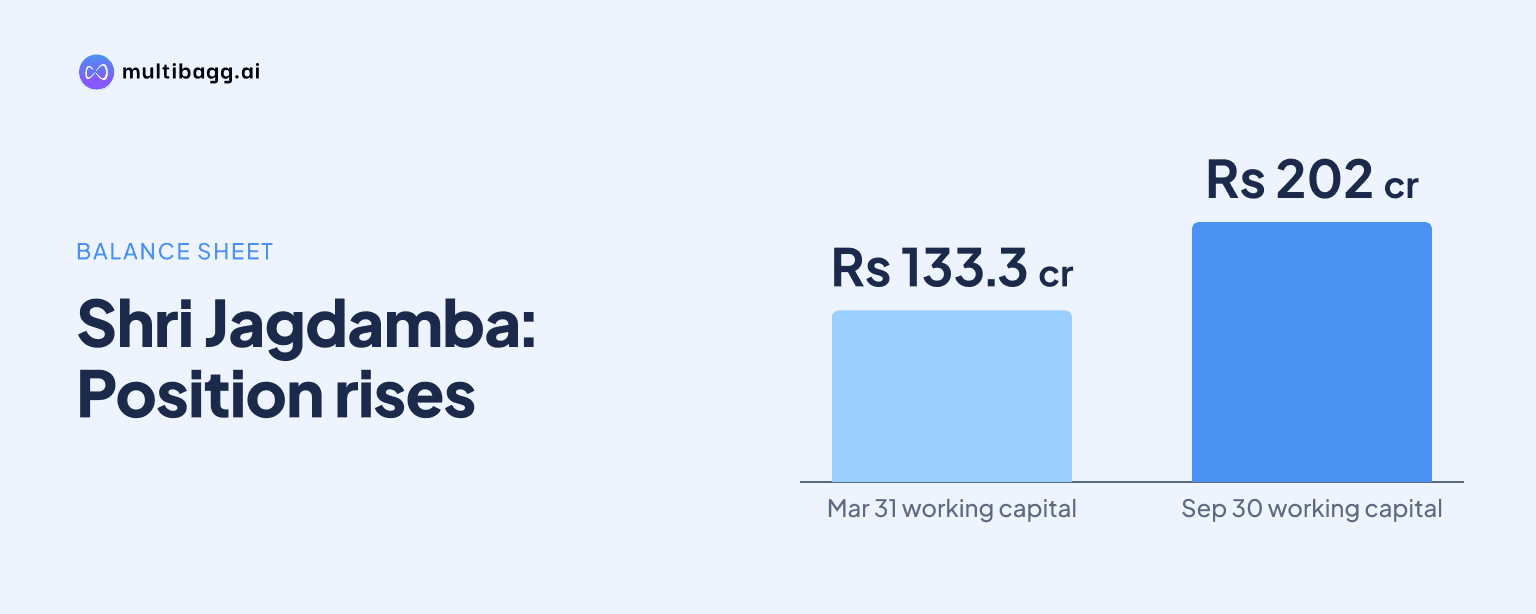
Shri Jagdamba Polymers Ltd had core working capital of ₹202 crore at 30 September 2026, up from ₹133.3 crore at 31 March 2026, as receivables increased by ₹53.56 crore and inventories by ₹22.89 crore during the first half (H1) of FY27, when standalone revenue rose 37.6% to ₹345.59 crore.
Know Shri Jagdamba Polymers inside out
Results, valuation, peers and who's buying, in one view.
Why did Shri Jagdamba Polymers’ working capital reach ₹202 crore?
Shri Jagdamba Polymers’ core working capital rose by ₹68.7 crore to ₹202 crore at 30 September 2026 from ₹133.3 crore at 31 March 2026. The presentation defines core working capital as inventories plus trade receivables less trade payables, and identifies elevated raw-material prices and high utilisation of working-capital limits during the build-up.
Trade receivables were the largest component, reaching ₹168.07 crore from ₹114.51 crore six months earlier. The company attributed the 47% rise to higher sales values at elevated delivered prices, while H1 FY27 standalone revenue from operations increased 37.6% year on year from ₹251.12 crore to ₹345.59 crore.
The movement in receivables exceeded the increase in inventories in absolute terms. Trade payables rose by ₹7.63 crore to ₹21.91 crore, partly offsetting the ₹76.45 crore combined increase in inventories and receivables, but not enough to prevent the expansion in core working capital.
What caused Shri Jagdamba Polymers’ inventory build-up?
Shri Jagdamba Polymers’ inventory increased 69% to ₹55.93 crore because polymer prices were higher and the company bought larger import lots when cheaper options were available. Inventory stood at ₹33.04 crore at 31 March 2026, making the reported increase over the six-month period ₹22.89 crore.
The build-up coincided with a higher material-cost ratio. Material cost represented 59.0% of H1 FY27 revenue, compared with 57.8% in H1 FY26, an increase of 112 basis points, while gross contribution rose 34% to ₹141.8 crore. The presentation defines material cost as materials consumed, purchases of traded goods and changes in inventories.
Production activity also remained high through the period. The company said its lines operated at about 95% capacity utilisation in both the first and second quarters of FY27, after it took additional orders from customers whose other suppliers faced polymer shortages. This places the inventory purchases alongside both higher polymer prices and near-full plant utilisation.
How did Shri Jagdamba Polymers fund the working-capital increase?
Shri Jagdamba Polymers funded the working-capital increase through lower cash and higher use of bank limits. Total borrowings increased by ₹6.36 crore to ₹56.92 crore at 30 September 2026, while cash and equivalents fell by ₹21.24 crore to ₹9.39 crore.
Net debt consequently increased by ₹27.59 crore to ₹47.52 crore from ₹19.93 crore at 31 March 2026. The increase in net debt was larger than the change in total borrowings because cash declined from ₹30.63 crore over the same six-month period.
Net worth increased by ₹34.78 crore to ₹368.00 crore, while total assets rose by ₹49.05 crore to ₹467.66 crore. Standalone profit after tax was ₹35.66 crore in H1 FY27, compared with ₹23.14 crore in H1 FY26, a 54.1% increase that was broadly similar to the rise in reported net worth.
Got a follow-up? Ask IRIS
What do Shri Jagdamba Polymers’ reported ratios show?
Shri Jagdamba Polymers reported a current ratio of 4.3 times at 30 September 2026, compared with 3.5 times at 31 March 2026. It reported net debt to equity of 0.13 times on the balance-sheet page, compared with 0.06 times in March.
The working-capital page separately states that total debt was ₹56.9 crore, up from ₹50.5 crore, and gives net debt to equity as 0.15 times. The presentation does not reconcile the difference between its 0.13-times balance-sheet disclosure and its 0.15-times working-capital disclosure.
Interest cover for H1 FY27 was reported at 17.5 times, calculated as earnings before interest, tax, depreciation and amortisation (EBITDA) divided by finance costs. Standalone EBITDA was ₹56.89 crore and finance costs were ₹3.24 crore, compared with EBITDA of ₹36.74 crore and finance costs of ₹3.05 crore in H1 FY26.
What will Shri Jagdamba Polymers do in the second half?
Shri Jagdamba Polymers says it will seek to release working capital in the second half by reducing limit utilisation as polymer prices ease. Management did not disclose a target for year-end inventories, receivables, cash, debt or core working capital.
The company also plans to keep its own plants near full utilisation and increase production capacity at Global Polyweave Pvt Ltd by March 2027. Global Polyweave, an 80% subsidiary, was operating at 60% utilisation, and management is targeting 70% utilisation by March 2027, compared with about 95% at Shri Jagdamba Polymers’ own lines in both quarters of H1 FY27.
Management cautioned that inventory gains, freight gains and freight-driven pricing may normalise if polymer supply and shipping conditions return to normal. Its stated procurement plan is to remain opportunistic on polymer imports to protect supply and cost, but the presentation provides no forecast for polymer prices, receivable collections or cash generation.
Conclusion
Shri Jagdamba Polymers’ rapid H1 FY27 revenue expansion required more funding in receivables and inventory. Core working capital reached ₹202 crore, while cash fell to ₹9.39 crore and net debt rose to ₹47.52 crore; at the same time, standalone revenue reached ₹345.59 crore and net worth increased to ₹368.00 crore.
The next disclosed item to watch is management’s plan to reduce working-capital-limit utilisation as polymer prices ease. The other scheduled marker is March 2027, when Global Polyweave is targeted to reach 70% utilisation from 60%, while the company has flagged potential normalisation in inventory, freight and pricing gains.