










Shringar bridal jewellery reaches 10% of manufacturing volume
Key highlights
- Shringar said bridal jewellery reached approximately 10% of manufacturing volume within six months.
- Shringar reported H1 FY27 sales volume of 968 kilograms, up 10% year on year.
- H1 FY27 revenue from operations rose 58.7% year on year to Rs 1,367.2 crore.
- Corporate chain stores account for around 51% of Shringar's business, versus 35% at its initial public offering.
powered by IRIS
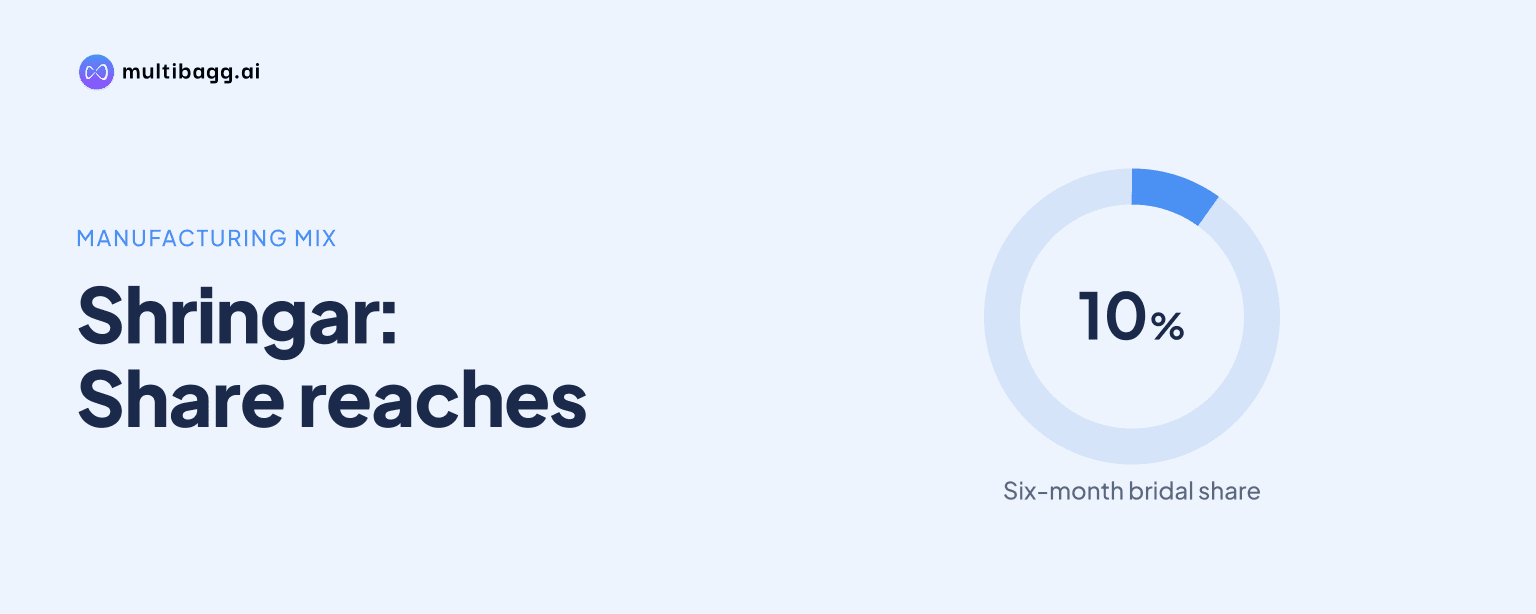
Shringar said bridal jewellery reached about 10% of its manufacturing volume within six months, a scale-up measured across outright sales and customer-gold job work. The disclosure came alongside H1 FY27 sales volume of 968 kilograms, up 10% year on year, but Shringar did not disclose bridal revenue because customer-supplied gold is excluded from top-line sales.
Know Shringar House of Mangalsutra inside out
Results, valuation, peers and who's buying, in one view.
How large is Shringar's bridal jewellery business?
Shringar's bridal jewellery business accounts for approximately 10% of its total manufacturing operations by volume, management said during the H1 FY27 call. The company said it reached that share in the six months after entering the category, compared with its 60-year operating history in mangalsutras.
The 10% figure covers the entire manufacturing operation rather than only products sold outright. Shringar uses two models, outright sales and advance-gold arrangements, and management said the volume measure includes bridal pieces manufactured under both models. It also said it had established tie-ups with three or four companies for the new segment.
Management did not provide bridal jewellery kilograms, piece counts, Q2 FY27 revenue or H1 FY27 revenue. An analyst asked whether approximately 10% of Q2 revenue of Rs 818.7 crore came from bridal jewellery, but management said it had supplied the data only on a volume basis and could calculate the value contribution separately.
Why does bridal jewellery volume differ from reported revenue?
Bridal jewellery volume differs from reported revenue because Shringar records labour charges, rather than the value of gold, when customers provide metal under an advance-gold or job-work arrangement. In an outright sale, the jewellery and gold value are included in sales; in job work, customer gold is converted into a finished item without the same top-line value being recorded.
Shringar described a retail recycling mechanism in which a consumer exchanges old gold for new jewellery, the retailer refines accumulated old gold into bars, and those bars are supplied for manufacturing. The company said Tanishq's business is currently 100% job work, while Malabar may use either job work or outright purchases depending on circumstances, including gold-price movements.
This accounting distinction means the 10% manufacturing share cannot be applied to reported H1 FY27 revenue of Rs 1,367.2 crore. Management said reported top line would be significantly higher if it included the value of customer gold processed in job-work arrangements, but it did not disclose the amount of gold or the theoretical revenue value involved.
How does bridal jewellery compare with Shringar's overall growth?
Shringar added bridal jewellery while overall sales volume increased 10% year on year in both Q2 FY27 and H1 FY27. Quarterly volume was 577 kilograms and first-half volume was 968 kilograms, showing that the new bridal line was introduced alongside continued growth in the wider manufacturing base.
Revenue rose faster than the disclosed volume figures in both periods. Q2 FY27 revenue increased 54.8% year on year to Rs 818.7 crore, while H1 FY27 revenue increased 58.7% to Rs 1,367.2 crore; management's explanation for the revenue-volume difference includes the treatment of customer gold in job work.
Profit after tax rose 73.2% year on year to Rs 39.5 crore in Q2 FY27 and 43.1% to Rs 73.5 crore in H1 FY27. These company-wide figures do not establish bridal profitability, because Shringar did not disclose bridal segment margins, labour charges, order value, capacity or a separate profit-and-loss statement for the category.
Got a follow-up? Ask IRIS
What is Shringar's plan for bridal jewellery?
Shringar plans to expand bridal jewellery through its corporate-chain customer base, and management said the segment could potentially become comparable with its core business in two to two-and-a-half years. Management presented that timeframe as an expectation, not as a formal financial target or a forecast of revenue.
The company linked the plan to the scale of the addressable category. Management said bridal jewellery accounts for 60% of the total market and that mangalsutras form part of bridal jewellery, allowing Shringar to use its existing design and manufacturing experience in a larger product segment.
Shringar said more than 90% of its business comes from repeat customers, with showroom stock replenished after products are sold. That replenishment model, together with the three or four bridal tie-ups already cited, is the mechanism management identified for extending the bridal range, though it gave no separate bridal order book or capacity-addition timetable.
How could corporate customers affect Shringar's bridal expansion?
Corporate chain stores account for around 51% of Shringar's business, up from 35% at the time of its initial public offering, and management is targeting a 65% share in the coming days. It said the shift supports bridal expansion because larger chains can place broader orders and offer more structured payment and inventory cycles.
Management said higher corporate business should improve the business rolling cycle by at least 1.5 times, citing faster payments and lower inventory turnaround. That is management's stated operational expectation, rather than a disclosed cash-flow target, and the company did not provide a date by which the 65% corporate mix would be achieved.
The cash-flow objective is material because an analyst cited approximately Rs 152 crore of additional working capital over the preceding six months, including about Rs 49 crore more inventory and Rs 121 crore more trade receivables. Management said reducing ready inventory, accelerating collections and increasing advance-gold or cash business were its main levers for making cash flow positive.
Does Shringar's proposed subsidiary include bridal jewellery?
Shringar said its proposed wholly owned subsidiary will not include its existing 22-karat and 18-karat mangalsutra or bridal jewellery operations. Instead, management said the entity will pursue products and materials not currently handled by Shringar, including 9-karat gold, silver, platinum, chemical-vapour-deposition diamonds and real diamonds.
The board approved the subsidiary one day before the call, and management expected incorporation, portal development, design creation and brand registrations to take two to three months. Management said it would initially focus on online sales, while keeping both business-to-business and business-to-consumer channels available.
Management indicated initial funding of Rs 2 crore to Rs 5 crore and products around the Rs 50,000 price point. It said the new entity was designed to avoid conflict with the existing business, which remains focused on 22-karat and 18-karat mangalsutras and bridal jewellery, and described the new products as a separate growth initiative.
Conclusion
Shringar's disclosure establishes that bridal jewellery has become a meaningful manufacturing line in a short period, reaching about one-tenth of output while overall H1 FY27 volume rose to 968 kilograms. The revenue contribution remains unresolved because job work can produce substantial volume and labour income without recording the value of customer-provided gold in sales.
The next indicators are whether Shringar supplies the requested bridal revenue calculation, converts its three or four tie-ups into disclosed volume, and moves corporate-chain business from 51% toward management's 65% objective. Management also expects to complete the subsidiary's initial setup within two to three months and sees a two-to-two-and-a-half-year path for further bridal scaling.