










Shringar enters bridal jewellery as market nears Rs 4.2 lakh crore
Key highlights
- Shringar entered the bridal jewellery segment in 2026.
- India’s bridal jewellery market is projected to reach Rs 4.2 lakh crore by 2028E, from Rs 3.059 lakh crore in 2023.
- Shringar’s FY26 production rose to 2,286 kilograms from 1,725 kilograms in FY25.
- Shringar invested approximately Rs 15 crore from internal accruals in its new manufacturing facility.
powered by IRIS
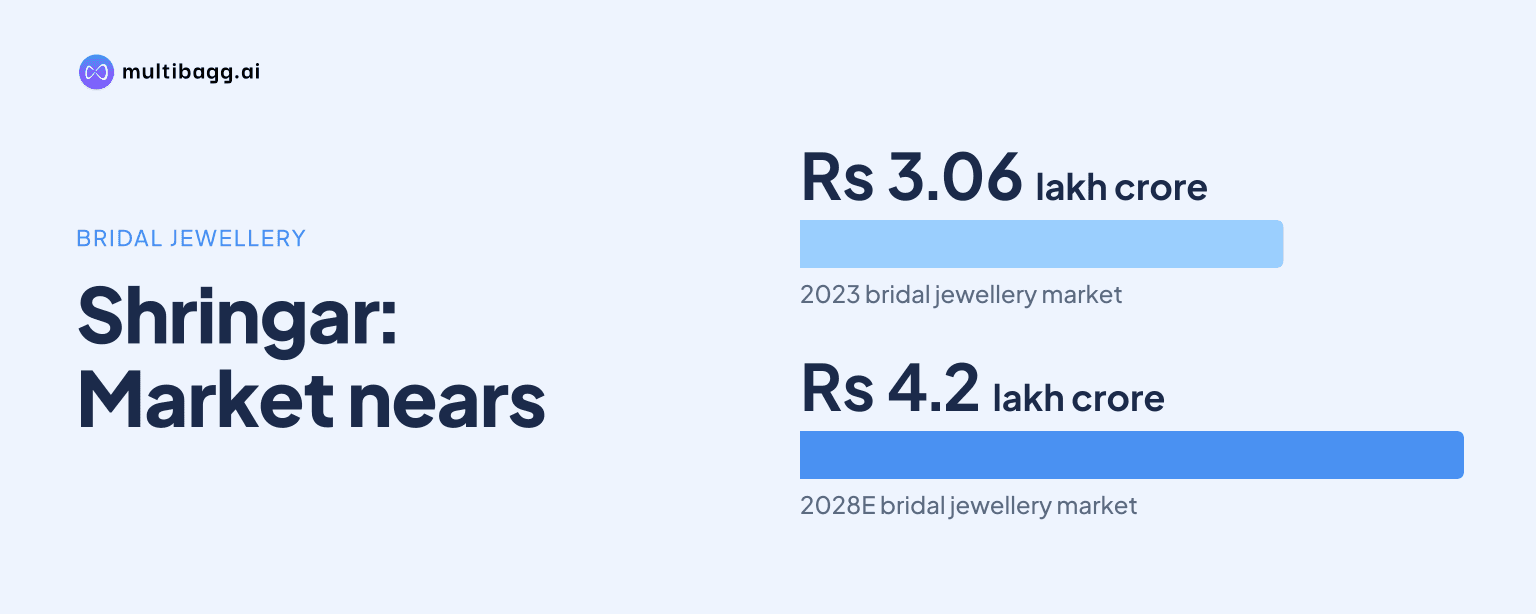
Shringar House of Mangalsutra Private Limited entered bridal jewellery in 2026, expanding beyond mangalsutras into an Indian market projected to reach Rs 4.2 lakh crore by 2028E, from Rs 3.059 lakh crore in 2023. Shringar cites its design base, retailer relationships and expanded manufacturing capacity as the foundations for the move.
Know Shringar House of Mangalsutra inside out
Results, valuation, peers and who's buying, in one view.
How large is the bridal jewellery opportunity for Shringar?
Shringar is entering a bridal jewellery market projected to grow at 5.6% a year to Rs 4.2 lakh crore in 2028E from Rs 3.059 lakh crore in 2023. The presentation, citing the Redseer Industry Report on the Jewellery Market in India, places the market at Rs 2.438 lakh crore in 2018 and Rs 2.504 lakh crore in 2021.
The increase from 2021 to 2023 was Rs 0.555 lakh crore, compared with Rs 0.066 lakh crore between 2018 and 2021. The presentation forecasts a further Rs 1.141 lakh crore increase between 2023 and 2028E, although this is an industry estimate rather than a Shringar sales target.
Shringar describes bridal wear as the second-largest expense in Indian weddings and says bridal jewellery accounts for the highest share, at 23% to 25%, of total wedding costs. It estimates that marriages consume 30 grams to 250 grams of gold across bangles, mangalsutras, nose rings and necklaces, with average costs of Rs 15 lakh to Rs 13 lakh.
What supports Shringar’s expansion beyond mangalsutras?
Shringar says its design expertise in chains, bracelets and rings enables its move into bridal jewellery. Its design and production base comprises 30 in-house designers, 316 skilled in-house karigars, and 73 additional karigars engaged through long-term partnerships.
The company lists more than 15 curated collections and more than 10,000 active stock-keeping units, or SKUs. Its stated style coverage includes bridal, contemporary, antique, Indo-western and daily wear, while its specialised concepts include Ring Bracelet, God Edition and Divine Edition.
Shringar also points to relationships with institutional jewellery brands as part of its rationale for serving high-ticket bridal purchases. Its presentation lists 15-year partnerships with Waman Hari Pethe Jewellers and Kudbe Jewellers Private Limited, 14-year relationships with Joyalukkas India Limited and Arundhati Jewellers Private Ltd, and 13-year relationships with Titan Company, Reliance Retail, P N Gadgil Jewellers Limited and Kalamandir Jewellers Limited.
The company says customers prefer trusted corporates for high-value purchases, which management presents as an advantage in bridal jewellery. This is a positioning statement rather than evidence of bridal sales, as the presentation provides no bridal revenue, order value, margin or customer-level sales data.
Got a follow-up? Ask IRIS
Which bridal jewellery products does Shringar identify?
Shringar identifies a Bridal Collection in its portfolio alongside Kolkatta, Temple, Kalki, Long Classic, Neon, Micro, Sentos, Classic, Fio CZ, Glam and Vertical Mala collections. The supplied presentation does not identify four new bridal collections, name individual bridal lines, or describe them as lightweight gold products.
The material establishes a 2026 entry into bridal jewellery and displays a Bridal Collection, but does not provide launch dates, product weights or pricing for bridal designs. It also does not disclose the number of bridal SKUs within its total of more than 10,000 active SKUs.
Shringar’s existing operations include jewellery in 18-karat, 22-karat and 24-karat gold for business-to-business clients. The company also identifies American diamonds, cubic zirconia, pearl, mother-of-pearl and semi-precious stones as materials used in its product detailing.
Its manufacturing methods combine three-dimensional wax sculpting, computer numerical control, or CNC, machinery and traditional hand-finishing. Shringar says it uses X-ray fluorescence, or XRF, machines and steel pin detectors for purity and safety checks, but supplies no separate quality or production information for the bridal range.
How much manufacturing capacity can Shringar use for bridal jewellery?
Shringar reported installed capacity of 4,000 kilograms in FY26, up from 2,500 kilograms in FY25, after capacity was added in February 2026. Actual production increased by 561 kilograms to 2,286 kilograms in FY26 from 1,725 kilograms in FY25.
The FY26 installed-capacity figure reflects an addition late in the financial year. Shringar reports blended full-year capacity of 2,625 kilograms and actual capacity utilisation of 87% for FY26, rather than utilisation against the 4,000-kilogram year-end capacity.
Commercial production at the current facility resumed on 23 February 2026, and Shringar says output is expected to ramp up in coming quarters. The company says it complements in-house output with outsourced production to meet demand, although it does not disclose outsourced volumes or any capacity specifically assigned to bridal jewellery.
Shringar invested approximately Rs 15 crore from internal accruals in the new facility for capacity expansion, machinery upgrades and efficiency improvements. It says newly hired karigars and designers at the factory are dedicated to mangalsutras and bridal jewellery, linking the facility investment to both its core category and the new segment.
Conclusion
Shringar’s 2026 bridal jewellery entry combines an industry market projected at Rs 4.2 lakh crore in 2028E with an existing platform of 30 designers, 389 in-house and partner karigars, and FY26 output of 2,286 kilograms. The presentation frames the expansion as an extension of its design, manufacturing and institutional-relationship base beyond mangalsutras.
The next disclosed item to watch is the production ramp-up following the 23 February 2026 resumption of commercial operations at the current facility. Shringar has disclosed 4,000 kilograms of installed capacity and approximately Rs 15 crore of facility investment, but has not set a bridal revenue target or disclosed bridal sales, production allocation or order volumes.