










Shringar raises installed capacity to 4,000 kg in fiscal 2026
Key highlights
- Shringar increased installed in-house capacity to 4,000 kg in FY26 from 2,500 kg in FY25.
- FY26 reported production was 2,286 kg, compared with 1,725 kg in FY25.
- The February 2026 capacity addition produced FY26 blended capacity of 2,625 kg and disclosed utilisation of 87%.
- Shringar invested approximately ₹15 crore from internal accruals for expansion, machinery and efficiency improvements.
powered by IRIS
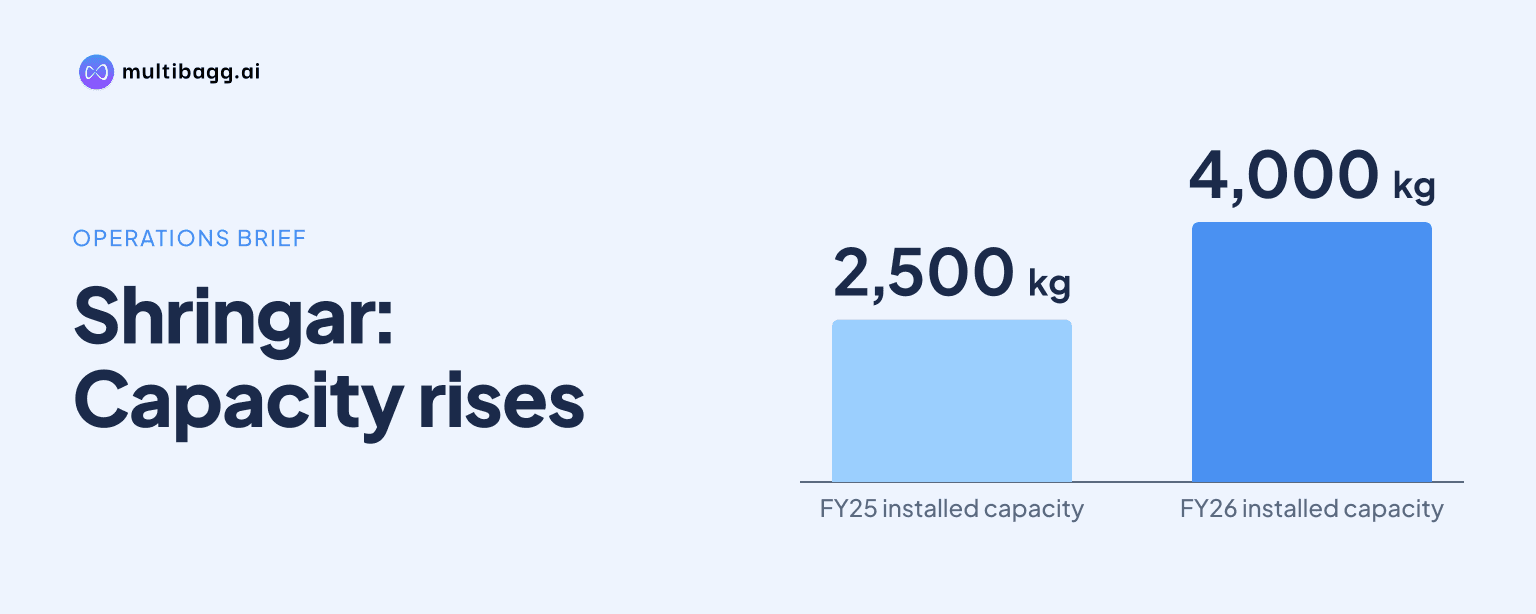
Shringar House of Mangalsutra raised installed manufacturing capacity to 4,000 kg in FY26 after adding capacity in February 2026, compared with 2,500 kg in FY25. Shringar reported FY26 production of 2,286 kg and utilisation of 87% against blended full-year capacity of 2,625 kg, rather than the year-end capacity figure.
Know Shringar House of Mangalsutra inside out
Results, valuation, peers and who's buying, in one view.
How much manufacturing capacity did Shringar add?
Shringar added 1,500 kg of installed capacity from FY25 to FY26, taking its annual in-house production ceiling from 2,500 kg to 4,000 kg. The company says the new capacity was added in February 2026, so the 4,000 kg figure represents capacity available after that addition rather than throughout FY26.
Measured against FY23 installed capacity of 1,850 kg, FY26 capacity of 4,000 kg was more than twice as large. The closer comparison is FY25, from which capacity rose 60% to 4,000 kg. Shringar attributes the expansion to meeting growing demand and says outsourced production also supplements its in-house capacity.
The 4,000 kg figure needs to be read alongside the FY26 timing note. Since the addition occurred in February 2026, Shringar states that blended capacity for the full year was 2,625 kg. That is the basis for its disclosed utilisation of 87%, instead of a calculation based on the 4,000 kg year-end capacity.
How did Shringar’s production change before and after expansion?
Shringar’s reported production increased to 2,286 kg in FY26 from 1,725 kg in FY25, an increase of 561 kg after output had declined by 25 kg from 1,750 kg in FY24. FY26 production therefore exceeded both FY24 and FY25 levels even though the added capacity became available only in February 2026.
Installed capacity rose from 1,850 kg in FY23 to 2,500 kg in FY24, while actual production increased from 1,236 kg to 1,750 kg in the same period. Capacity then remained at 2,500 kg in FY25, when production was 1,725 kg. The FY26 increase was therefore the first disclosed installed-capacity expansion since FY24.
Shringar does not disclose a separate production target for the 4,000 kg facility. It says commercial production resumed from the current capacity on 23 February 2026 and is expected to ramp up in coming quarters. Future output will depend on the pace of that ramp-up and the company’s continued use of outsourced production.
When did Shringar’s new manufacturing facility begin commercial production?
Shringar says commercial production from its current capacity resumed on 23 February 2026 following relocated operations. Management expects production to ramp up in coming quarters, while the presentation identifies February 2026 as the month in which the new capacity was added.
The company funded the expansion with approximately ₹15 crore of internal accruals. According to the presentation, the spending covered capacity expansion, machinery upgrades, efficiency improvements and meeting growing demand. The source does not provide a break-up of the ₹15 crore among these uses.
The facility’s operating model covers conceptualisation, design, manufacturing and sales through integrated operations. Shringar says external manufacturers supplement internal output when needed. This means the 4,000 kg measure specifically refers to in-house installed capacity rather than total production available through internal and outsourced manufacturing.
Got a follow-up? Ask IRIS
What will Shringar manufacture with its added capacity?
Shringar says the facility will produce mangalsutras and bridal jewellery, with newly hired karigars and designers creating contemporary designs for customer preferences across India. Its mangalsutra range is made in 18k, 22k and 24k gold purity for business-to-business clients.
The bridal-jewellery initiative adds a category alongside Shringar’s mangalsutra operations. The presentation lists Kolkata, Temple, Kalki, Long Classic, Neon and Bridal collections, as well as Micro, Sentos, Classic, Fio CZ, Glam and Vertical Mala collections. It does not disclose separate capacity, revenue or production figures for bridal jewellery.
Shringar says each piece is checked at every stage using XRF machines and steel pin detectors. Its high-purity mangalsutras carry a Hallmark Unique Identification, or HUID, number. The company presents these controls and its integrated manufacturing process as mechanisms for product authenticity, durability and quality control.
Why does the expansion matter for Shringar’s operating model?
The expansion gives Shringar a higher in-house production ceiling while retaining outsourced manufacturing as a complement to internal capacity. In FY26, reported output of 2,286 kg was below the 4,000 kg year-end capacity but represented 87% of the 2,625 kg blended capacity that accounts for the February 2026 commissioning date.
Shringar’s product plan combines established mangalsutra production with entry into bridal jewellery. Shringar cites design expertise in chains, bracelets and rings, an in-house karigar base and relationships with institutional jewellery brands as factors supporting the bridal category. These are management-presented reasons for the expansion, not forecasts for sales or profitability.
Conclusion
Shringar’s FY26 capacity change was material in two comparisons: installed capacity increased by 1,500 kg from FY25 to 4,000 kg, and it more than doubled from the 1,850 kg reported in FY23. Reported production reached 2,286 kg in FY26, while the 87% utilisation calculation uses blended annual capacity because the new capacity arrived in February 2026.
The next measure to watch is the production ramp-up following the 23 February 2026 resumption of commercial production. Management says output is expected to rise in coming quarters, while the internally funded ₹15 crore investment is intended to support machinery upgrades, efficiency and production of mangalsutras and bridal jewellery.