










Shringar more than doubled FY23-FY26 revenue as margins rose
Key highlights
- Shringar’s FY26 revenue from operations was Rs 2,245.8 crore, versus Rs 950.2 crore in FY23.
- Shringar’s EBITDA margin increased to 7.1% in FY26 from 4.0% in FY23.
- FY26 working-capital changes used Rs 408.0 crore and operating cash flow was negative Rs 281.7 crore.
- Corporate-client revenue reached Rs 1,100 crore, representing 49% of FY26 sales mix.
powered by IRIS
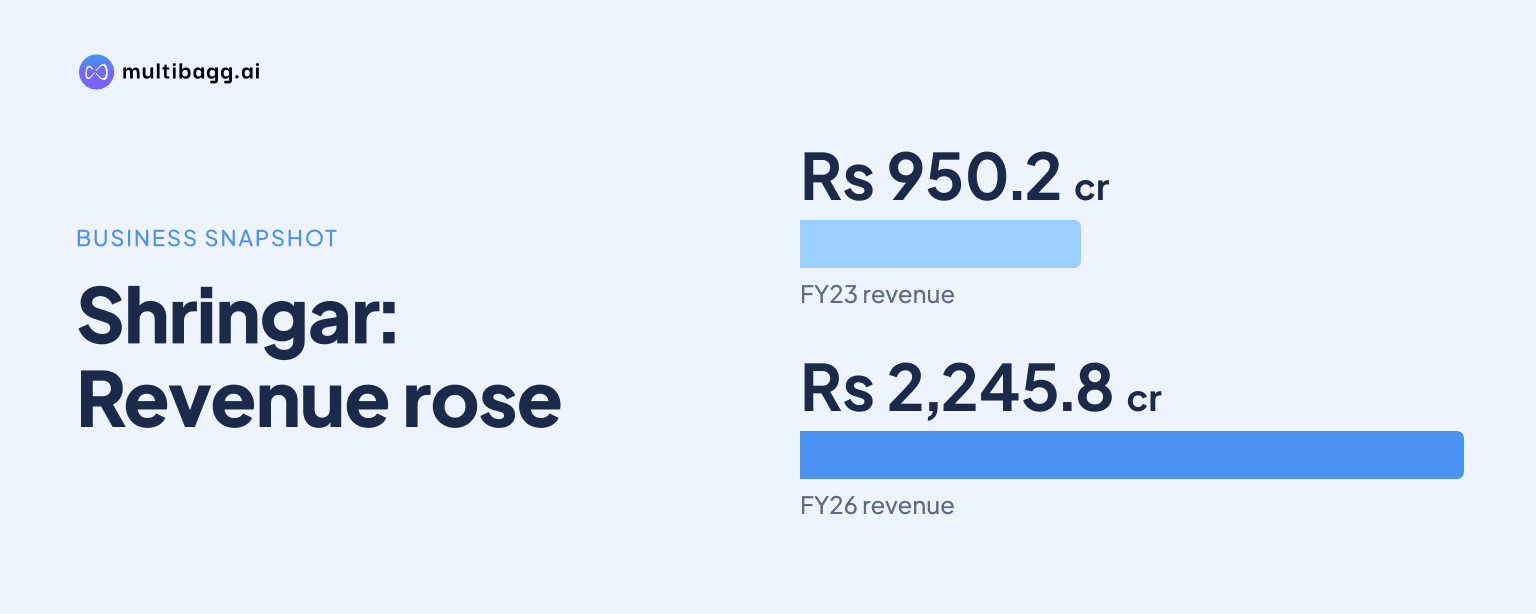
Shringar House of Mangalsutra Limited more than doubled revenue from operations to Rs 2,245.8 crore in FY26 from Rs 950.2 crore in FY23, while earnings before interest, tax, depreciation and amortisation (EBITDA) margin increased to 7.1% from 4.0%. The growth period also ended with a Rs 408.0 crore working-capital outflow in FY26.
Know Shringar House of Mangalsutra inside out
Results, valuation, peers and who's buying, in one view.
How did Shringar’s revenue and operating profit change?
Shringar’s revenue from operations rose by Rs 1,295.6 crore between FY23 and FY26. Revenue increased in each reported year, from Rs 950.2 crore in FY23 to Rs 1,101.5 crore in FY24, Rs 1,429.8 crore in FY25 and Rs 2,245.8 crore in FY26. FY26 revenue was therefore more than twice the FY23 level.
EBITDA increased to Rs 158.7 crore in FY26 from Rs 37.8 crore in FY23, while the margin expanded by 3.1 percentage points to 7.1%. EBITDA was Rs 49.6 crore in FY24 and Rs 92.3 crore in FY25. Profit after tax rose to Rs 115.5 crore in FY26 from Rs 23.4 crore in FY23, with its margin increasing to 5.1% from 2.5%.
Profit before tax increased to Rs 152.3 crore in FY26 from Rs 31.4 crore in FY23, and its margin rose to 6.8% from 3.3%. Tax expense was Rs 36.8 crore in FY26, compared with Rs 8.1 crore in FY23. These reported profit measures increased alongside revenue across all four financial years.
What changed in Shringar’s margins and costs?
Shringar’s gross margin increased to 9.4% in FY26 from 5.6% in FY23, as gross profit rose by Rs 158.5 crore to Rs 212.1 crore. The margin was 6.1% in FY24 and 8.0% in FY25, showing an increase in each reported year before EBITDA margin reached 7.1% in FY26.
Raw-material cost rose to Rs 2,046.5 crore in FY26 from Rs 872.1 crore in FY23, while purchases of finished goods increased to Rs 218.8 crore from Rs 26.3 crore. The presentation records a negative Rs 231.5 crore change in stocks in FY26, compared with negative Rs 1.7 crore in FY23, within the bridge to gross profit.
Employee cost reached Rs 15.9 crore in FY26 from Rs 7.5 crore in FY23, while other expenses rose to Rs 37.5 crore from Rs 8.2 crore. Finance cost declined to Rs 7.5 crore in FY26 from Rs 8.2 crore in FY25, although it remained above the Rs 5.6 crore reported in FY23.
How much working capital did Shringar require in FY26?
Shringar reported Rs 408.0 crore of cash used by changes in working capital in FY26, compared with Rs 83.1 crore in FY25 and Rs 17.0 crore in FY23. The FY26 movement converted operating profit before working-capital changes of Rs 161.5 crore into negative Rs 246.5 crore of cash generated from operations.
After direct taxes paid of Rs 35.2 crore, net cash from operating activities was negative Rs 281.7 crore in FY26. That compared with positive Rs 13.1 crore in FY23, negative Rs 14.1 crore in FY24 and negative Rs 7.1 crore in FY25, despite profit after tax rising from Rs 23.4 crore to Rs 115.5 crore over the four-year period.
Inventory stood at Rs 439.4 crore at FY26-end, up from Rs 228.1 crore at FY25-end and Rs 103.8 crore at FY23-end. Trade receivables rose to Rs 235.7 crore from Rs 87.8 crore a year earlier and Rs 47.0 crore in FY23; together, inventory and receivables were Rs 675.1 crore in FY26 versus Rs 315.9 crore in FY25.
Got a follow-up? Ask IRIS
How did Shringar fund FY26 asset growth?
Shringar reported a Rs 410.3 crore cash inflow from financing activities in FY26, compared with Rs 9.0 crore in FY25 and Rs 12.1 crore in FY24. Investing activities used Rs 103.4 crore in FY26, against Rs 3.0 crore in FY25. These flows, together with negative operating cash flow, resulted in a Rs 25.2 crore increase in cash and cash equivalents.
Cash and cash equivalents ended FY26 at Rs 26.2 crore, up from Rs 1.0 crore at FY25-end and Rs 5.8 crore at FY23-end. Bank balances other than cash and cash equivalents were Rs 101.1 crore in FY26, compared with Rs 2.1 crore in FY25. Total assets increased to Rs 891.7 crore from Rs 375.7 crore in FY25 and Rs 211.5 crore in FY23.
Current borrowings were Rs 179.3 crore at FY26-end, compared with Rs 118.5 crore in FY25 and Rs 72.1 crore in FY23. Shringar reported no non-current borrowings in FY26, versus Rs 2.6 crore in FY25 and Rs 17.1 crore in FY23. Equity share capital was Rs 96.4 crore and other equity was Rs 581.4 crore in FY26.
What sales mix and products accompanied Shringar’s growth?
Shringar’s revenue from corporate clients reached Rs 1,100 crore in FY26 from Rs 287 crore in FY23, while their share of total revenue in the sales-mix disclosure increased to 49% from 30%. The presentation defines corporate clients as leading jewellery brands with their own retail-store chains in India and overseas.
Non-corporate clients represented 51% of FY26 revenue, down from 70% in FY23, as the corporate share rose through 32% in FY24 and 34% in FY25. The presentation says leading brands plan to add an estimated 400 to 440 retail outlets in domestic and global markets in the near to mid-term, citing the CareEdge Report. Management states that its corporate clients’ expansion plans will drive additional product demand.
In 2026, Shringar launched four lightweight gold-jewellery collections, Aura, Shimmer, Imperia and Prism, at IIJS Bharat Premiere 2026. The company described the launch as an expansion beyond its core mangalsutra portfolio into the broader gold-jewellery segment. This product development followed the FY26 financial period.
Conclusion
Shringar’s FY23-to-FY26 record combines revenue growth from Rs 950.2 crore to Rs 2,245.8 crore with expansion in gross, EBITDA, profit-before-tax and profit-after-tax margins. At the same time, the increase in FY26 inventory and receivables coincided with a Rs 408.0 crore working-capital outflow, negative Rs 281.7 crore operating cash flow and Rs 410.3 crore financing inflow.
The next disclosed developments to watch are corporate clients’ estimated addition of 400 to 440 retail outlets and the contribution from the four collections launched at IIJS Bharat Premiere 2026. The historical presentation does not establish how further revenue growth will affect working-capital movements or operating cash generation.