










Shringar says Rs 6.5 crore job work excludes gold value
Key highlights
- Shringar said approximately Rs 812 crore of outright sales compared with approximately Rs 6.5 crore of job-work revenue.
- Job-work revenue excludes customer-supplied gold and records labour and manufacturing charges only.
- Management illustrated a 6% outright-sales margin versus 4.5% to 5% when customers supply gold.
- Shringar said mangalsutras reached 10% of total turnover within four to six months before job work was included.
powered by IRIS
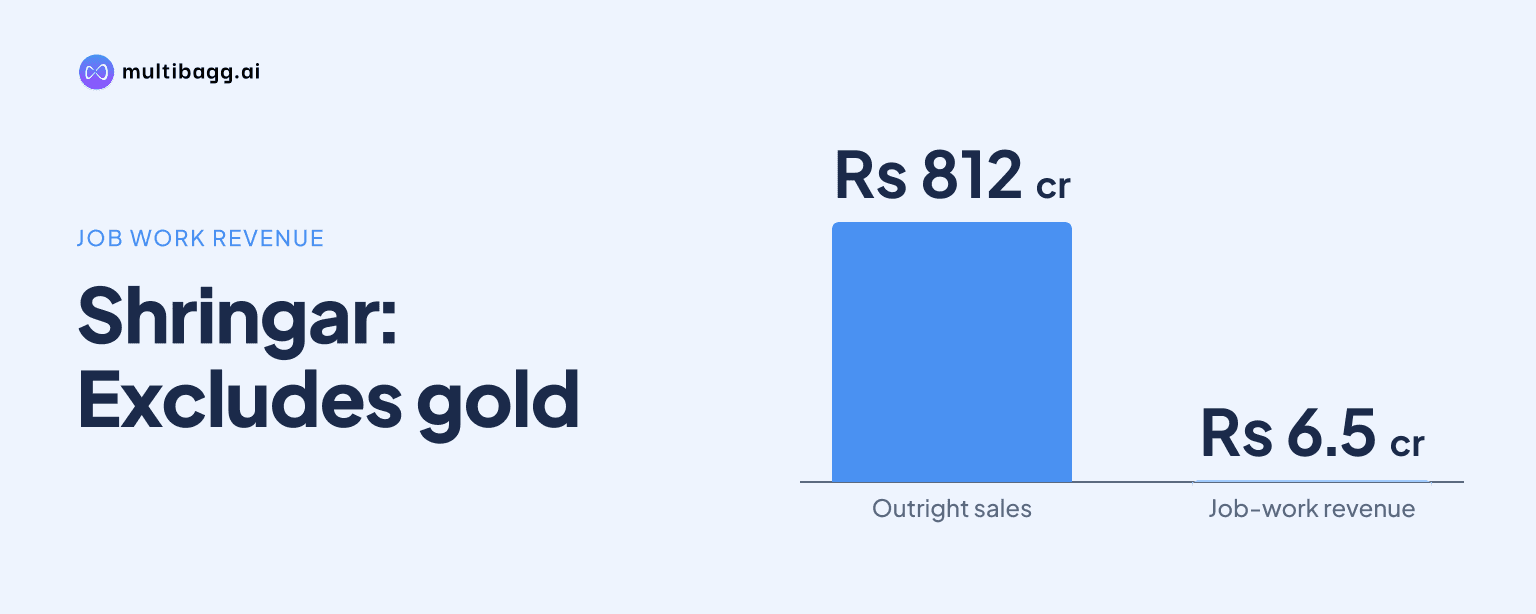
Shringar House of Mangalsutra Limited said approximately Rs 6.5 crore of job-work revenue reflects labour charges only, while approximately Rs 812 crore of outright sales includes the value of gold and other materials. Management said customers supply gold in advance for job work, eliminating the company’s need to fund that metal.
Know Shringar House of Mangalsutra inside out
Results, valuation, peers and who's buying, in one view.
Why is Shringar’s job-work revenue only Rs 6.5 crore?
Shringar’s job-work revenue is approximately Rs 6.5 crore because it records only the manufacturing or labour charge when a customer provides the gold. Management contrasted this with approximately Rs 812 crore of outright sales, where the reported sale includes the finished jewellery and its material value. The difference therefore reflects the revenue model rather than only the amount of production performed.
In a job-work order, Shringar receives gold from the client, manufactures the jewellery and delivers the finished product. Management illustrated the mechanism with 100 grams of gold: 100 grams enter production and 100 grams are manufactured and delivered. Since the gold belongs to the client, its value does not pass through Shringar’s job-work revenue.
The Rs 6.5 crore figure is therefore not a measure of the gold value processed under job work. Management did not disclose the quantity of customer gold processed, the value of that gold or the volume mix between job work and outright sales. It did state that job-work revenue excludes metal and gold material costs.
How does customer-supplied gold change Shringar’s risk?
Customer-supplied gold reduces Shringar’s metal-price and funding exposure because the client provides the raw material in advance. Management said the company does not need to invest its own capital in gold for such orders, unlike an outright sale that requires Shringar to fund material procurement and production. The customer retains ownership of the gold through the manufacturing cycle.
Shringar separately said it uses gold metal loans and hedging on the Multi Commodity Exchange, or MCX, for its own gold exposure. Management said it maintains hedging in the range of 30% to 35% and described advance gold as a hedge because the gold received is converted and delivered in the same production flow. Job work consequently avoids adding company-owned gold exposure to that order.
The distinction matters alongside the working-capital figures raised by an analyst for the six months discussed on the call. The analyst cited approximately Rs 152 crore of additional working capital on roughly Rs 1,357 crore of sales, including an approximately Rs 49 crore inventory increase, approximately Rs 121 crore higher trade receivables and an approximately Rs 18 crore fall in payables. Management said increasing advance gold, reducing ready inventory and accelerating customer payments were central to its cash-flow plan.
What margin trade-off does Shringar make on job work?
Shringar accepts a lower percentage margin when a customer supplies gold because it avoids the capital and interest costs of funding the metal. Management gave an illustration in which a product sold at a 6% margin under the company-funded model could be supplied at a 4.5% to 5% margin when the client provides the raw material. It said the interest cost avoided is effectively passed to the client as a discount.
This comparison concerns percentage margins, not absolute profit per order or return on capital employed. Management did not disclose profit by revenue model, interest expense avoided on job work, or job-work volume for the period. The call nevertheless establishes that the lower billed percentage is linked to lower capital use and no need to finance the customer’s gold.
Got a follow-up? Ask IRIS
How does job work fit Shringar’s growth and cash-flow plans?
Job work can support Shringar’s production expansion without requiring the same raw-material funding as company-owned sales. Management said its bridal initiative started gradually in Q1 with 20 artisans and subsequently increased to 40 artisans. It said that reaching a scale of 300 artisans working on mangalsutras would significantly increase output, requiring more designers and technicians.
Employee cost in the quarter discussed was Rs 6.7 crore, compared with Rs 4 crore a year earlier and Rs 4.9 crore in the preceding quarter, according to the analyst on the call. Management attributed the increase to hiring designers and staff for bridal jewellery and new segments. Customer-provided gold does not remove those labour costs, but it avoids a parallel increase in company-funded metal for applicable orders.
Shringar said mangalsutras reached 10% of total turnover within four to six months, before job-work operations were included. Management said the share could have been higher than 10% had job-work figures been included, because turnover records only labour income where the customer provides gold. This shows why product turnover percentages may understate manufacturing activity conducted on customer-owned material.
What does Shringar’s retailer base mean for this model?
Shringar said large chain stores account for 51% of its business, compared with a customer base that was entirely individual unorganised jewellery stores 30 years ago. Management cited a 15- to 17-year relationship with Tanishq that developed from supplier to vendor, vendor partner and strategic vendor. It said its business grows as these customers expand their businesses.
Management also said more than 90% of business comes from repeat customers, with replenishment orders generated after products sell at partner showrooms. It did not disclose which customers use job work, their contract terms, or the proportion of the Rs 6.5 crore job-work revenue linked to chain retailers. The retailer data therefore describes Shringar’s broader customer base rather than a disclosed job-work customer split.
Conclusion
Shringar’s approximately Rs 6.5 crore job-work revenue is far below its approximately Rs 812 crore of outright sales because job work captures labour income rather than the value of customer-owned gold. Management’s illustrative margin comparison shows the trade-off: a 4.5% to 5% customer-supplied-gold margin instead of 6% for a company-funded sale, in exchange for avoiding metal funding and related price exposure.
The next indicator is whether Shringar can increase advance-gold orders while reducing ready inventory and accelerating collections, which management identified as its cash-flow priorities. Management also said it expected better results in the March balance sheet and is adding bridal and mangalsutra capacity after expanding that category from 20 to 40 artisans.