










Sigma Advanced Systems Limited Q2 revenue rises to Rs 417 crore
Key highlights
- Sigma reported Q2 FY27 revenue from operations of Rs 417 crore, compared with Rs 374 crore in Q1 FY27.
- Aerospace contributed Rs 296 crore of Sigma's Rs 417 crore Q2 FY27 operating revenue.
- Sigma reported Q2 FY27 PAT of Rs 52 crore, up from Rs 38 crore in Q1 FY27.
- The detailed consolidated table showed EBITDA margin of 20.6% in Q2 FY27, versus 16.3% in Q1 FY27.
powered by IRIS
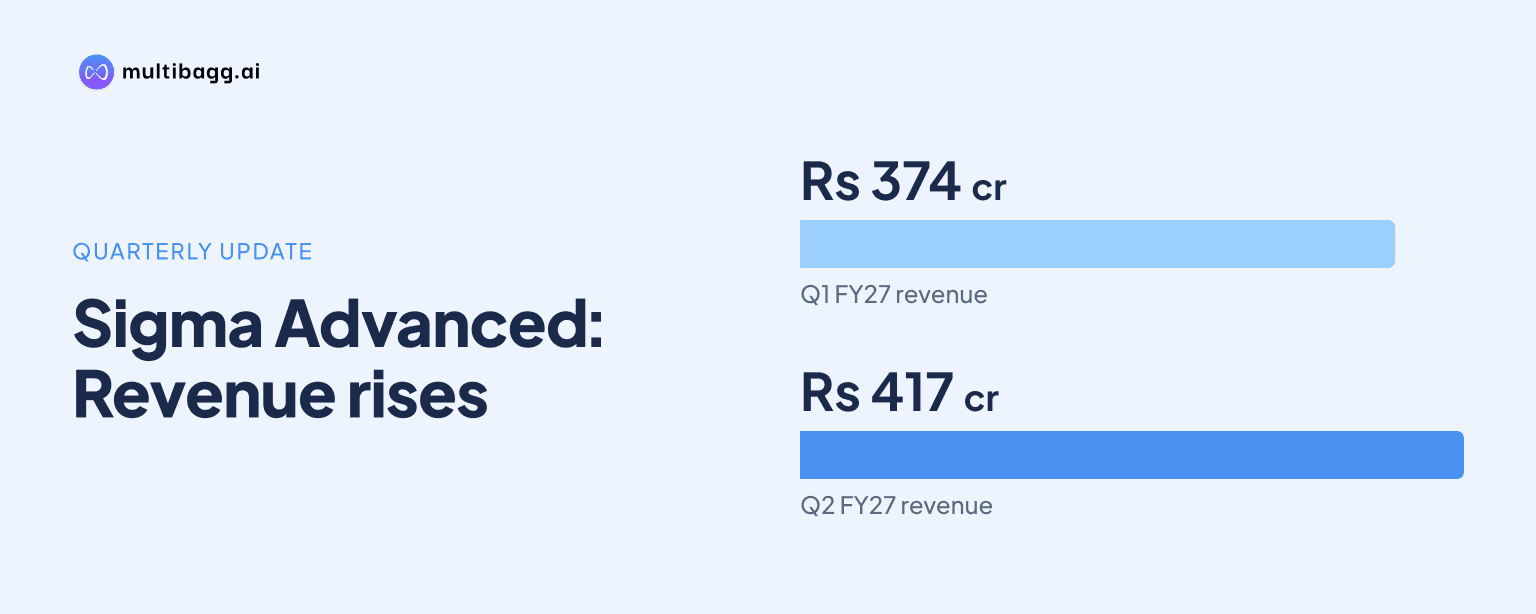
Sigma Advanced Systems Limited reported Q2 FY27 revenue from operations of Rs 417 crore, up from Rs 374 crore in Q1 FY27, with aerospace contributing Rs 296 crore, or the largest share of quarterly revenue. The company also reported higher profitability and outlined a margin-improvement plan linked to its UK-India manufacturing strategy.
Know Sigma Advanced System inside out
Results, valuation, peers and who's buying, in one view.
What did Sigma report for Q2 FY27?
Sigma reported operating revenue of Rs 417 crore for Q2 FY27, compared with Rs 374 crore in Q1 FY27. The increase followed sequential growth in all three reported verticals, with aerospace remaining the company’s largest business by revenue.
The supplied financial highlights put operational EBITDA at Rs 82.2 crore for the quarter, up 35.06% quarter-on-quarter from Rs 61 crore. This panel showed an operational EBITDA margin of 19.7%. Separately, the detailed consolidated financial-performance table listed Q2 FY27 EBITDA at Rs 86 crore and an EBITDA margin of 20.6%, against Rs 61 crore and 16.3% in Q1 FY27.
Profit before tax increased to Rs 70 crore from Rs 49 crore sequentially. Profit after tax rose to Rs 52 crore from Rs 38 crore, while PAT margin increased to 12.68% from 10.16%.
Which business segments drove Sigma’s quarterly revenue?
Aerospace drove Sigma’s Q2 FY27 revenue, contributing Rs 296 crore of the Rs 417 crore operating-revenue total. Defence exports generated Rs 74 crore, while domestic defence contributed Rs 47 crore.
The three vertical figures add up to the stated quarterly operating revenue. Aerospace represented about 71% of Q2 revenue based on those disclosed amounts, confirming its position as the largest reported revenue vertical during the period.
For comparison, Sigma reported Q1 FY27 revenue of Rs 374 crore, comprising Rs 229 crore from aerospace, Rs 104 crore from defence exports and Rs 41 crore from domestic defence. The sequential revenue increase in Q2 was therefore accompanied by a higher aerospace contribution, while defence-export revenue was lower than the Q1 figure.
Why are the EBITDA figures reported in two ways?
The supplied materials show two Q2 FY27 operational EBITDA figures, Rs 82.2 crore in the financial-highlights panel and Rs 86 crore in the detailed consolidated financial-performance table. Both sources use Rs 61 crore as the Q1 FY27 comparison figure, but they present different Q2 values and margins.
On the financial-highlights basis, Sigma’s operational EBITDA margin was 19.7%. On the detailed-table basis, the margin was 20.6%, compared with 16.3% in Q1 FY27. The detailed-table comparison indicates a sequential margin improvement of 4.3 percentage points.
The materials provided do not explain the reason for the difference between the Rs 82.2 crore and Rs 86 crore figures. Investors assessing profitability would need to distinguish between the financial-highlights measure and the detailed consolidated-table measure, rather than treating them as directly identical metrics.
The underlying direction across both presentations is consistent: revenue increased sequentially, EBITDA was higher than Q1 FY27, and margins improved from the Q1 level. But the difference in reported operational EBITDA means the company’s final financial disclosures and notes remain important for evaluating the precise measure used.
Got a follow-up? Ask IRIS
How does Sigma plan to improve margins through FY28?
Sigma plans to improve EBITDA margins by 2% to 4% by the end of FY27 and by a further 4% to 6% by the end of FY28. Management has linked this target to transferring work to India, activating dual sourcing, and improving UK operations through automation and process optimisation.
The company is pursuing a dual UK-India manufacturing strategy. Its stated plan includes transfers of low-cost manufacturing work to its 23-acre Sri City facility, while also seeking efficiency improvements in its UK operations.
The strategy matters because Q2 FY27 already showed higher margins on the detailed consolidated table. The reported 20.6% EBITDA margin was 4.3 percentage points above the Q1 FY27 level of 16.3%, although the company’s longer-term targets are framed as planned improvements through the end of FY27 and FY28.
The supplied information also refers to the Bromford Precision Solutions acquisition and potential transfer of Rolls-Royce work to Sri City. However, it does not provide quantified UK revenue, cost, customer-relationship or approval-timing details for these matters. Those remain areas where further company disclosures would be needed.
What does the Q2 update mean for investors and operations?
The Q2 update shows that Sigma’s reported revenue mix was led by aerospace, while profitability improved sequentially from Q1 FY27. Revenue increased by Rs 43 crore quarter-on-quarter, PAT increased by Rs 14 crore, and the detailed-table EBITDA margin rose by 4.3 percentage points.
For investors, the principal reported operating factors are the aerospace contribution of Rs 296 crore, the company’s UK-India manufacturing plan, and the difference between the two disclosed Q2 operational EBITDA figures. The source also refers to an order book of more than Rs 10,000 crore, but does not disclose the portion expected to convert into revenue in FY27 or FY28.
Sigma’s board was scheduled to meet on 6 November 2026 to consider Q2 FY27 results for the July-September 2026 quarter. The company had previously reported Q1 FY27 revenue of Rs 374 crore and an operating margin of 16.3%, providing the immediate base for the Q2 comparisons.
The 14 October 2026 announcement of a strategic memorandum of understanding with Munitions India Limited concerned co-development and local manufacturing of 155 mm artillery course-correction fuzes. The supplied material does not quantify the financial effect of that memorandum on Q2 FY27 revenue or profit.
Conclusion
Sigma’s Q2 FY27 figures indicate sequential growth in operating revenue to Rs 417 crore, with aerospace accounting for Rs 296 crore. Profit before tax and PAT also rose from Q1 FY27, while both disclosed EBITDA presentations point to improved operating profitability, despite reporting different absolute EBITDA values for Q2.
The next areas to watch are the company’s disclosures on conversion of its more than Rs 10,000 crore order book, the execution of manufacturing transfers to Sri City, and progress against its FY27 and FY28 EBITDA-improvement targets. Clarification of the difference between the Rs 82.2 crore and Rs 86 crore Q2 operational EBITDA figures would also help investors assess the reported margin trend.