










Singer India starts Bhiwadi on Nov 23, plans 13.08 lakh units
Key highlights
- Singer India will begin commercial manufacturing and assembly at Bhiwadi on November 23, 2026.
- Singer India proposes 13.08 lakh units of annual Bhiwadi capacity over two to three years.
- The Bhiwadi plan includes 9.48 lakh sewing-machine units and 3.60 lakh home-appliance and fan units annually.
- Singer India disclosed Rs 11 crore of first-phase investment, excluding land and building, with self-funding and equity.
powered by IRIS
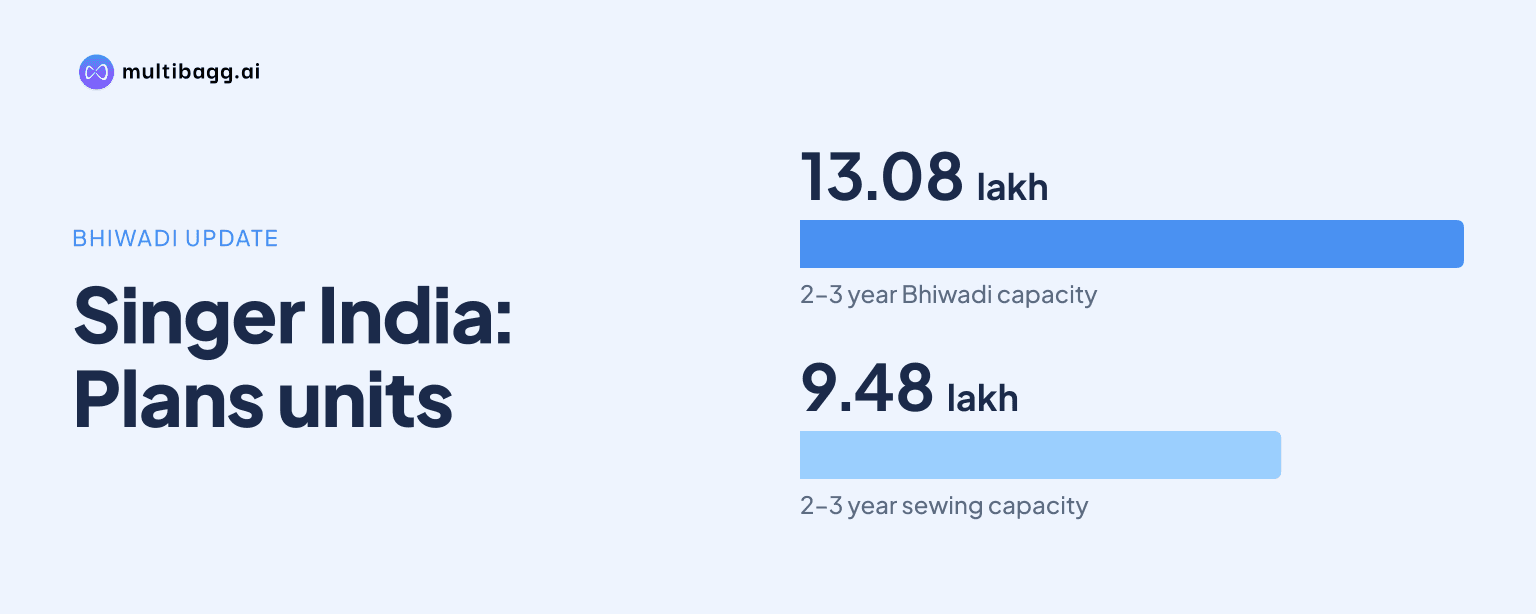
Singer India Limited will begin commercial manufacturing and assembly at Bhiwadi on November 23, 2026, while planning to add 13.08 lakh units of annual capacity there over two to three years. The proposed capacity includes 9.48 lakh sewing-machine units and 3.60 lakh home-appliance and fan units annually.
Know Singer India inside out
Results, valuation, peers and who's buying, in one view.
When will Singer India begin Bhiwadi manufacturing operations?
Singer India will begin commercial manufacturing and assembly operations at its new Bhiwadi facility on November 23, 2026. The company disclosed the commencement date in its November 21, 2026 filing under Regulation 30 of the listing regulations.
The facility is located at E-1229, RIICO Industrial Area, Ghatal, Bhiwadi, in Rajasthan's Khairthal-Tijara district. Singer India described the site as a new manufacturing unit and said the commencement covers both manufacturing and assembly, without identifying a single product line scheduled to begin on the first operating day.
The November 23 start date and the two-to-three-year capacity-addition period are separate disclosures. Commercial operations are scheduled to begin in November 2026, while Singer India has stated that the full proposed addition of 13.08 lakh units a year will be added over two to three years.
Singer India did not disclose a phased output schedule, a first-year production target or a plant-utilisation target for Bhiwadi in the November 21 announcement. Its filing instead identifies the facility's proposed product capacity, first-phase investment and financing mode, which set out the planned expansion after operations commence.
How much capacity will Singer India add at Bhiwadi?
Singer India proposes to add 13.08 lakh units of annual capacity at the Bhiwadi plant over two to three years. Of this total, sewing machines account for 9.48 lakh units a year, while home appliances and fans account for the remaining 3.60 lakh units a year.
The planned sewing-machine capacity represents about 72% of the 13.08 lakh-unit Bhiwadi addition, based on the disclosed figures. The 3.60 lakh-unit allocation for home appliances and fans represents about 28%, combining two categories for which Singer India did not provide separate annual capacity figures.
Singer India has put the first-phase investment at Rs 11 crore, excluding land and building. The company said this phase will be financed through self-funding and equity, without disclosing a debt amount, the total investment for all phases, or a split of the Rs 11 crore between sewing machines and home appliances and fans.
Got a follow-up? Ask IRIS
How does Bhiwadi compare with Singer India's current capacity?
Singer India's proposed Bhiwadi addition of 13.08 lakh units a year is more than twice its disclosed existing capacity of 6.30 lakh units a year. If the entire addition is completed, the combined stated capacity would be 19.38 lakh units a year, calculated by adding the existing and proposed figures.
The existing unit was operating at 22% capacity utilisation when disclosed, compared with no utilisation figure for the Bhiwadi site. Applying the reported 22% rate to existing capacity gives equivalent utilisation of about 1.39 lakh units a year, but Singer India did not report actual production volumes, sales volumes or the period to which this utilisation measure relates.
The announced addition is 2.08 times the present 6.30 lakh-unit annual capacity. It does not establish how quickly the new capacity will be used, since the filing gives a two-to-three-year addition window but no annual ramp-up plan, demand forecast or Bhiwadi production guidance.
Why is Singer India building capacity at Bhiwadi?
Singer India said the Bhiwadi project is intended to expand domestic sewing-machine manufacturing across its product categories in line with the Make in India initiative. The 9.48 lakh-unit annual sewing-machine component is the larger of the two disclosed capacity segments, exceeding the 3.60 lakh-unit allocation for home appliances and fans.
For home appliances and fans, Singer India said the expansion supports development of new home-appliance ranges and the scaling of its recently launched fans business. The filing specifies that the 3.60 lakh-unit capacity will cover both home appliances and fans, so it does not quantify the capacity reserved for either category individually.
Management also described Bhiwadi as a strategic manufacturing and engineering hub. Singer India said co-locating manufacturing operations with engineering and research and development is intended to support faster product development, cross-functional collaboration and shorter time to market for new products and technologies.
Those are stated strategic rationales rather than disclosed operating outcomes. The November 21, 2026 announcement does not provide targets for new-model launches, engineering staffing, product-development time or sales from the Bhiwadi facility, leaving execution measures beyond the 13.08 lakh-unit capacity plan unspecified.
Conclusion
Singer India's Bhiwadi announcement sets out a manufacturing start on November 23, 2026 and a capacity plan that is large relative to the existing 6.30 lakh-unit annual base. The proposed addition spans 9.48 lakh units of sewing machines and 3.60 lakh units of home appliances and fans, while the current unit's disclosed utilisation is 22%.
The disclosed plan calls for the full 13.08 lakh units of annual capacity to be added within two to three years, supported initially by Rs 11 crore excluding land and building. Subsequent disclosures may show the Bhiwadi capacity ramp, utilisation, the allocation between home appliances and fans, and funding used in later phases.