










Singer says non-government sales must replace fading order
Key highlights
- Singer reported Q2 FY26-27 revenue of Rs 185.2 crore, up 34% year on year.
- Singer said its government sewing-machine order is largely complete, with only a small residual tail remaining.
- Sewing-machine revenue grew 34% in Q2 FY26-27 and the trade channel grew by more than 30%.
- Singer aims to bring Make in India sewing-machine sales close to 100% over the next two quarters.
powered by IRIS
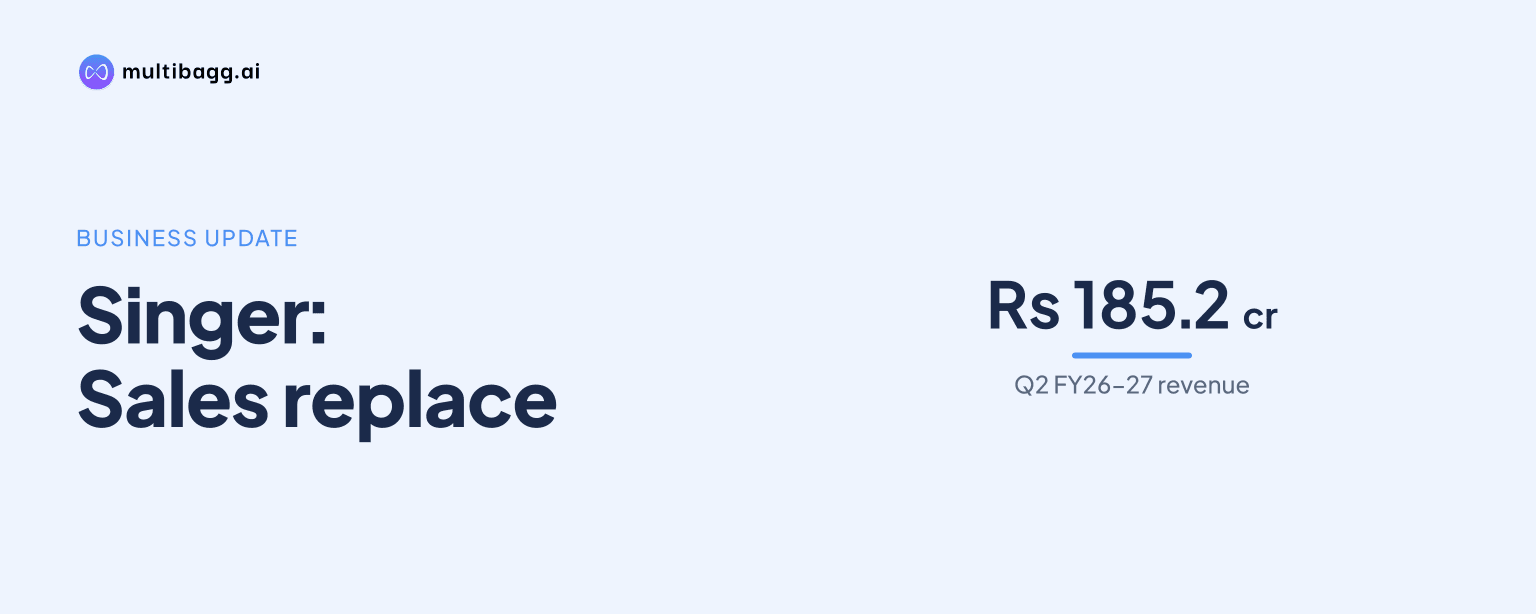
Singer India Limited said its government sewing-machine order was largely complete in Q2 FY26-27, leaving non-government channels to underpin subsequent growth after quarterly revenue rose 34% year on year to Rs 185.2 crore and profit before tax increased 79% to Rs 9.4 crore.
Know Singer India inside out
Results, valuation, peers and who's buying, in one view.
What is the status of Singer’s government sewing-machine order?
Singer said on its November 16, 2026 investor call that the government order was “more or less over,” with only a very small residual tail left. Managing Director Rakesh Khanna gave that assessment after an investor asked whether the order was completed in Q2 FY26-27 or would extend into Q3 or Q4.
Singer did not disclose the residual order value or the exact Q2 revenue contribution, describing detailed product and channel disclosures as competition-sensitive. An investor cited an October 29 credit report that referred to Rs 67 crore of government order yet to be completed; Chief Financial Officer Anuj Kumar Vasdev said this was a full-year order, part of which had been fulfilled in earlier quarters, with some rollover into Q3.
The difference matters because management said part of recent growth came from a large government order but that contribution was limited. Khanna said investors should remove government-order revenue when assessing ongoing growth, while adding that some sales cannibalised by the programme could return as the order ends.
Can Singer sustain growth without the government order?
Singer said it expects its non-government sales momentum to continue, although management gave no revenue target and did not commit to repeating Q2 FY26-27’s 34% growth rate. Khanna said the company had performed well in non-government sales in the preceding quarter and hoped to sustain this in future quarters through dealer relationships, roadshows and product demonstrations.
The reported Q2 FY26-27 figures establish the scale of that transition. Revenue was Rs 185.2 crore, up 34% year on year, while earnings before interest, tax, depreciation and amortisation, or EBITDA, rose 85% to Rs 10.9 crore. Profit before tax, or PBT, increased 79% to Rs 9.4 crore.
Sewing-machine revenue grew 34% in Q2 FY26-27, while the trade channel grew by more than 30%, according to management. Zig-Zag machines grew more than 25%, and industrial sewing-machine sales grew approximately 24% or more, although Singer did not quantify these businesses’ revenue excluding government sales.
Singer also linked higher trade receivables partly to increased revenue and partly to a temporary relaxation in e-commerce terms. Management said it had been more liberal with e-commerce customers for a period to secure quick gains, but expected this to normalise after the Big Billion Days.
Which products and channels can support Singer’s sales?
Singer identified dealer-led trade, e-commerce, Zig-Zag machines, industrial sewing machines and premium appliances as sources of growth beyond the government order. In Q2 FY26-27, the appliances business recorded revenue growth of around 35%, driven by trade and e-commerce channels, portfolio expansion and the fan business.
Management said appliances improved gross-margin value by more than 55% in Q2 despite commodity-price inflation. However, the segment result was Rs 9 lakh below the prior-year Q2, which Singer attributed to extended producer responsibility, or EPR, costs and investment in organisational capacity for market expansion.
The fan business grew around 240% in Q2, albeit from a small base, and management said dealers had responded encouragingly to the expanded range. Singer is listing additional products on e-commerce platforms and intends to reduce dependence on modern trade, which management described as a high-cost channel.
Singer said it has no current plan to enter the air-purifier category because of unpredictable sales through the year and potentially high inventory build-up. That position contrasts with the company’s e-commerce expansion in appliances, where it is using additional listings to improve brand visibility and pursue sales growth.
Got a follow-up? Ask IRIS
How is Singer changing its sewing-machine product mix?
Singer said Zig-Zag machines represented approximately one-fourth of total revenue at the current run rate, while industrial sewing machines accounted for a little more than 10% of sewing-machine revenue. Management described industrial machines’ steady run rate as around 10% to 12%, with the balance of sewing-machine revenue coming from accessories and Blackhead machines.
Management sees a transition from Blackhead machines to modern Zig-Zag machines as a potential household sewing-machine growth driver over the next three to five years. Khanna said nearly 3 million sewing machines sold in India are still Blackhead models, while the company expects a shift to newer machines to lift the average selling price.
Singer has introduced 10 Make in India Zig-Zag models and said they had received good acceptance from trade partners and consumers. Management said Singer is India’s sole active Bureau of Indian Standards, or BIS, licensed manufacturer of Zig-Zag machines, and that the newly introduced models began contributing gradually from the previous quarter.
Singer aims for Make in India machines to approach 50% of sales during November 2026 and to reach close to 100% over the following two quarters. This is a management target rather than reported sales performance, and the company said some revenue from those machines was already included in results through September 2026.
What operational plans could affect Singer’s next quarters?
Singer plans to begin pilot production at its Bhiwadi, Rajasthan factory in December 2026, subject to government and BIS approvals. The facility is intended initially to manufacture Zig-Zag machines and may later assemble and manufacture industrial sewing machines and selected consumer appliances.
The Bhiwadi plan supports management’s objective of expanding domestic manufacturing, but Singer gave no commercial-production date, capital-spending figure or capacity target. The company said its ability to manufacture high-precision Zig-Zag machines supports its future ability to make industrial high-speed machines in India.
Singer is already selling industrial sewing machines, but management said domestic manufacturing would depend on government policies that encourage local production and on the related cost advantages. Khanna said the company would work toward Indian manufacture when policy conditions support it, without providing a launch date.
Management also said exporting appliances through its parent group was conceptually possible but not an immediate plan. This leaves domestic trade, e-commerce and product expansion as the disclosed near-term routes for appliances growth, rather than an export-led contribution in the next year.
Conclusion
Singer’s Q2 FY26-27 results included Rs 185.2 crore of revenue, up 34%, but management has made clear that the largely completed government sewing-machine order should not be treated as a recurring growth source. The next measure of performance will be whether dealer trade, e-commerce, Zig-Zag machines, industrial machines and appliances maintain momentum as the small remaining order tail runs off.
The next disclosed milestones are the planned December 2026 Bhiwadi pilot-production start, subject to approvals, and management’s aim to bring Make in India sewing machines close to 100% of sales over the next two quarters. Investors can also watch whether e-commerce credit terms normalise as management expects while non-government revenue continues to expand.