










Singer Targets Near-100% Local Zig-Zag Mix Within Two Quarters
Key highlights
- Singer targets Make-in-India Zig-Zag machines at close to 100% of the relevant sales mix within two quarters.
- Singer expected the Make-in-India Zig-Zag mix to approach 50% during November 2026 before targeting 70%.
- Zig-Zag machines contribute approximately 25% of Singer's total revenue at the current run rate.
- Industrial sewing machines grew by more than 24% in the quarter and contribute roughly 10% to 12% of sewing-machine revenue.
powered by IRIS
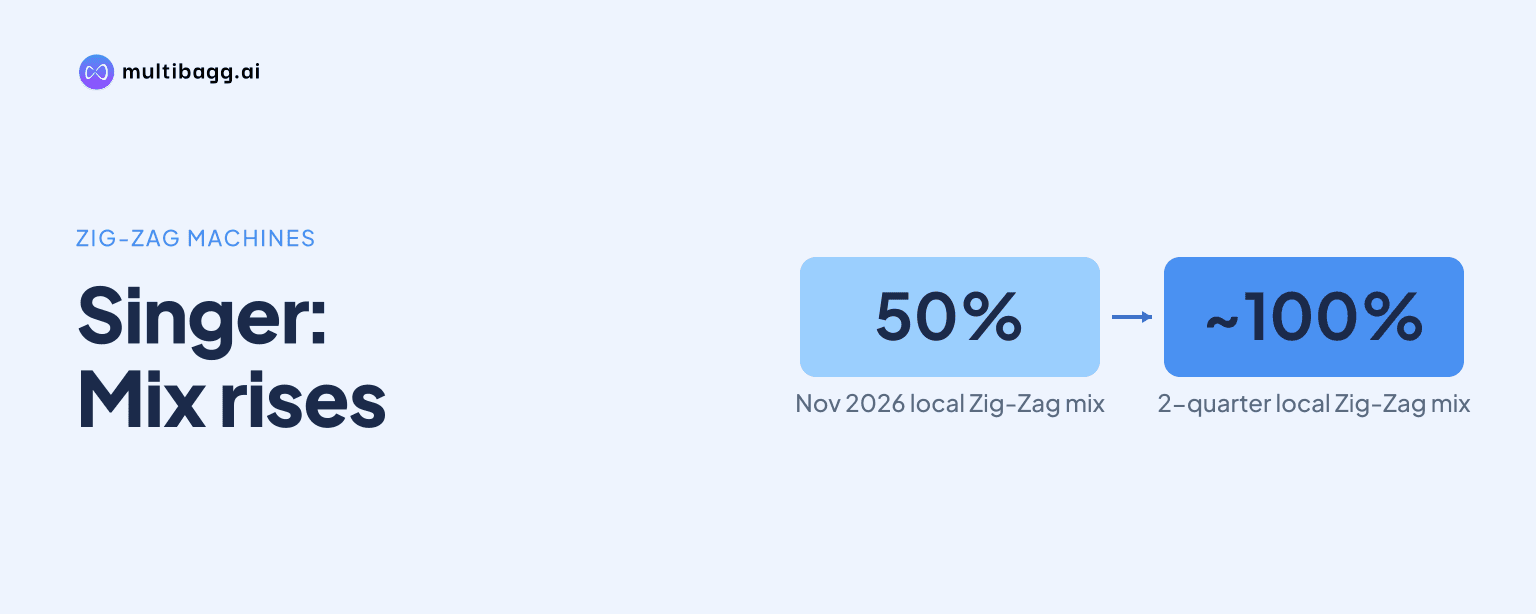
Singer India aims to take Make-in-India Zig-Zag sewing machines to close to 100% of the relevant sales mix within two quarters of its November 16, 2026 call, after targeting close to 50% during that month. Management said local-machine sales had begun gradually in the preceding quarter and were building steadily.
Know Singer India inside out
Results, valuation, peers and who's buying, in one view.
How quickly will Singer localise Zig-Zag machine sales?
Singer plans to bring the Make-in-India Zig-Zag sewing-machine mix close to 100% in the next two quarters. Management said the locally made range had started contributing gradually from the previous quarter, was expected to approach 50% during November 2026, and would then be targeted at 70% before reaching close to 100%.
The stated target applies to the newer Zig-Zag range, not to all sewing-machine sales. Zig-Zag machines accounted for approximately one-fourth of Singer's total revenue at the current run rate, according to management. Industrial sewing machines, accessories and Blackhead machines made up the remaining sewing-machine mix, making the local Zig-Zag transition relevant to a category already contributing about 25% of total revenue.
Management did not provide unit volumes, product-level revenue or a date for the 70% stage. It did say the Make-in-India machines had already contributed some sales by September 2026, countering the suggestion that no local-machine revenue had been recorded by then. The disclosed sequence therefore points to a sales-mix ramp rather than a future product launch.
What supports Singer's local Zig-Zag production plan?
Singer's Bhiwadi, Rajasthan factory is intended to support local Zig-Zag production, with pilot production planned from the month after the November 16, 2026 call. Management said that timetable remains subject to government approvals and approval from the Bureau of Indian Standards, or BIS.
The Bhiwadi facility will primarily manufacture Zig-Zag machines, while also being capable in due course of assembling and manufacturing industrial sewing machines and selected consumer appliances. Management said Singer is India's sole active BIS-licensed manufacturer of Zig-Zag machines. That status is relevant because management also cited policy attention to BIS requirements, quality-control orders and Make-in-India manufacturing.
Singer showcased 10 new Make-in-India Zig-Zag models during dealer engagement trips to Singapore, Sri Lanka and Jaipur. Management said the newly launched machines had received good acceptance from trade partners and consumers, but it did not disclose model-wise volumes, pricing or revenue. The local range had begun selling gradually from the previous quarter, while the Bhiwadi pilot-production plan remains conditional on approvals.
Why does Singer see Zig-Zag machines as a household growth driver?
Singer sees the conversion of Blackhead machines to modern Zig-Zag machines as its principal household sewing-machine opportunity for the next three to five years. Management said nearly 30 lakh sewing machines are sold in India, with a large share still consisting of Blackhead machines, while such machines have more or less become obsolete globally.
Management expects the shift toward modern machines to change the average selling price because Zig-Zag products offer a different configuration from basic Blackhead machines. This is management's view rather than a formal revenue forecast. It also cautioned that complete and authoritative market surveys are unavailable, and that much of the available market data consists of estimates.
Sewing-cum-embroidery machines are the second household driver identified by management. Singer said these products could move sewing from a basic utility use toward crafting and hobbies, potentially supporting higher spending on machines and accessories. The company did not give a target for embroidery-machine sales, a market-size estimate or a timetable for the category's contribution.
Local manufacturing is also linked to costs, although Singer did not quantify savings. Asked whether Indian production of White sewing machines would be cheaper than imports, management said it should progressively become cheaper. Management instead emphasised the skills it is building through domestic manufacturing and said that approach could support market-share gains.
Got a follow-up? Ask IRIS
How does Zig-Zag localisation compare with Singer's other businesses?
Singer's Zig-Zag business is larger than its industrial sewing-machine contribution on the disclosed run-rate measures. Zig-Zag machines account for approximately 25% of total revenue, while industrial sewing machines contribute a little more than 10% of sewing-machine revenue, with management describing their steady run rate as roughly 10% to 12%.
Industrial sewing machines nevertheless grew by more than 24% in the quarter discussed on the November 16, 2026 call. Management described Zig-Zag localisation as the segment where most of the conversion is expected to occur, whereas industrial machines are a separate expansion area requiring further groundwork. The figures use different revenue bases, total company revenue for Zig-Zag and sewing-machine revenue for industrial machines.
Singer attributed the 0.6 percentage-point year-on-year increase in sewing-machine segment margin to product mix, a greater share of higher-configuration and less price-sensitive products, channel mix, and supplier-cost negotiations. Management did not disclose product-level margins or precise channel revenue, describing those details as competition-sensitive. It also said most of a government order was complete, leaving a small residual to flow into the following quarter.
Will Singer manufacture industrial sewing machines in India?
Singer says it can pursue Indian manufacturing of industrial sewing machines, but management made the move conditional on government policies encouraging domestic production. It said the company had gained significant skills from making Zig-Zag machines in India and believed industrial-machine manufacturing would not be much more challenging, while requiring further skills and investment.
For now, Singer sells industrial sewing machines rather than manufacturing them locally. Management said it would begin working toward domestic industrial production when supportive policies emerge, citing potential cost advantages. This makes industrial localisation distinct from the Bhiwadi Zig-Zag programme, where pilot production is planned from the month after the November 2026 call, subject to approvals.
Management named household sewing machines, industrial sewing machines and premium appliances as three parallel growth areas and said none could be deprioritised. In appliances, Singer said it has no current plan to enter air purifiers because of unpredictable annual sales and high inventory build-up. It said other appliance-expansion options were being planned but did not identify products or launch dates.
Conclusion
Singer's plan is to move the Make-in-India Zig-Zag range from a close-to-50% sales mix during November 2026 to close to 100% within two quarters. The target matters because Zig-Zag machines represent about one-fourth of total revenue at the reported run rate, and management views replacement of Blackhead machines as the main household sewing-machine conversion opportunity over the next three to five years.
The next disclosed milestones are pilot production at Bhiwadi from the month after November 16, 2026, subject to government and BIS approvals, followed by the stated 70% and near-100% local Zig-Zag mix targets. Management has not set a timetable for local industrial-machine production, saying that decision depends on government policies encouraging manufacturing in India.