










Smarten Baddi plant reaches 80% utilisation as sales rise
Key highlights
- Smarten’s Baddi lead-acid battery plant was operating at about 80% of its 8,000-batteries-per-month capacity in H1 FY27.
- Battery sales reached Rs 59.43 crore in H1 FY27, compared with Rs 72.97 crore for the full FY26 year.
- Battery sales rose from Rs 49.19 crore in FY24 to Rs 63.91 crore in FY25 and Rs 72.97 crore in FY26.
- Smarten expects Jhajjar production by the end of FY27, with planned capacity of 1,200 units per day.
powered by IRIS
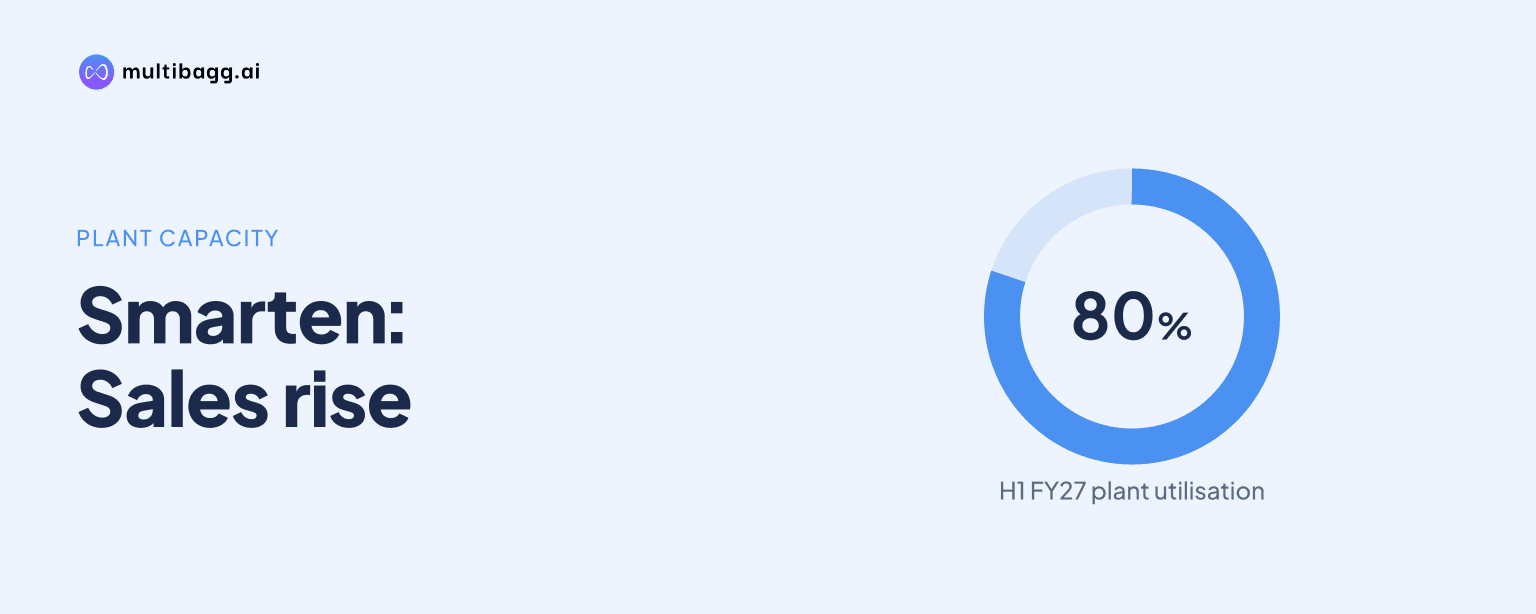
Smarten’s Baddi, Himachal Pradesh, lead-acid battery plant was operating at about 80% of its installed capacity in H1 FY27, when battery sales reached Rs 59.43 crore. The April-to-September 2026 sales figure was Rs 13.54 crore below the Rs 72.97 crore reported for the full FY26 year.
Know Smarten Power Systems inside out
Results, valuation, peers and who's buying, in one view.
How close is Smarten’s Baddi battery plant to capacity?
Smarten’s Baddi plant is operating at about 80% of its installed capacity of 8,000 batteries per month. The Himachal Pradesh facility is the acquired lead-acid battery manufacturing plant that underpins Smarten’s stated backward-integration initiative.
The Baddi site occupies 32,234 square feet of owned land, described in the presentation as 3 Bigha and 14 Biswa. Its product capacity range is 20 amp hours to 250 amp hours, or AH, while Smarten lists tubular batteries from 35 AH to 200 AH and solar tall tubular batteries from 150 AH to 350 AH.
At the disclosed utilisation rate, about 20% of the monthly 8,000-battery nameplate capacity remains unutilised. Smarten does not disclose Baddi production volumes, monthly sales volumes, unit manufacturing costs or the date on which it acquired the plant, so the presentation does not quantify the unused capacity in batteries produced.
How quickly have Smarten battery sales grown?
Smarten’s battery sales rose from Rs 49.19 crore in FY24 to Rs 72.97 crore in FY26, then reached Rs 59.43 crore in H1 FY27. H1 FY27 covers six months from April to September 2026, making it a partial-year figure rather than a full-year result.
Battery sales increased by Rs 14.72 crore between FY24 and FY25, followed by a further Rs 9.06 crore increase in FY26. H1 FY27 sales were about 81% of FY26’s full-year Rs 72.97 crore, but the presentation provides no full-year FY27 sales target or forecast.
Battery sales as a share of revenue from operations rose from 25.29% in FY24 to 31.68% in FY25, then declined to 30.07% in FY26 and 29.06% in H1 FY27. Smarten says battery trading revenue has grown significantly in absolute terms and as a share of total sales, although the disclosed revenue shares are below the FY25 level in the later periods.
Got a follow-up? Ask IRIS
What does backward integration change for Smarten?
Smarten says in-house lead-acid battery manufacturing strengthens its battery portfolio and supports margins through cost efficiencies, supply control and quality control. These are management-described effects of backward integration, and the presentation does not disclose a realised margin increase, procurement saving or cost per battery.
The Baddi operation is identified as a lead-acid battery plant, while Smarten also offers lithium-ion batteries ranging from 12.8 volts to 51.2 volts. Smarten describes the lithium-ion range as having fast-charging capability and robust safety, whereas the Baddi factory is specifically identified with lead-acid battery manufacturing.
Smarten’s battery portfolio operates alongside its home uninterruptible power supply, or UPS, systems, solar inverters, charge controllers and solar panels. Its Bravo UPS range spans 500 volt-amperes, or VA, to 20 kilovolt-amperes, or kVA, and its solar panels range from 40 watts at 12 volts to 600 watts at 24 volts, although the presentation does not quantify battery cross-selling through these product lines.
What capacity and market developments should investors watch?
Smarten expects production at a separate Jhajjar, Haryana, manufacturing facility to commence by the end of FY27, with planned production capacity rising from 600 to 1,200 units per day. Baddi’s 8,000 batteries-per-month capacity and the Jhajjar daily unit measure are separate disclosed capacity measures and should not be treated as directly comparable.
The Jhajjar project’s pre-engineered building was 90% complete and civil works were 60% complete when reported. Smarten also plans automated printed circuit board, or PCB, testing and automated final testing on the assembly line, with manual fallback under development; the end-FY27 production start is the company’s stated expectation.
Smarten also disclosed a Rs 1.75 crore government order for 4,000 solar power conditioning units, or PCUs, which it said had been dispatched. The company identified Exide Industries Limited as an authorised channel distributor relationship covering Sprinter, Marathon and Sonnenschein products, adding an external battery distribution route alongside Baddi manufacturing.
Conclusion
Smarten’s disclosures show that the acquired Baddi lead-acid plant was already operating at about 80% of its 8,000-batteries-per-month capacity in H1 FY27. Battery sales reached Rs 59.43 crore in the six months to September 2026, after increasing from Rs 49.19 crore in FY24 to Rs 72.97 crore in FY26, while their revenue share moved from 31.68% in FY25 to 29.06% in H1 FY27.
The next disclosed points to watch are whether Baddi utilisation changes from about 80% and whether H1 FY27 battery sales convert into a full-year result above FY26’s Rs 72.97 crore. Smarten also expects Jhajjar production by the end of FY27, where it plans 1,200 units per day after reporting 90% pre-engineered-building completion and 60% civil-work completion.