










Smarten builds monitored solar pipeline beyond backup power
Key highlights
- Smarten’s RMS tracks eight measures, including battery SoC, solar generation, grid availability and charging status.
- Smarten’s current on-grid inverter range spans 3 kW to 25 kW for rooftop solar installations.
- Smarten states MPPT tracking efficiency above 99% on its in-house platforms.
- Smarten expects its 41,903-square-foot Jhajjar facility to start production by the end of FY27.
powered by IRIS
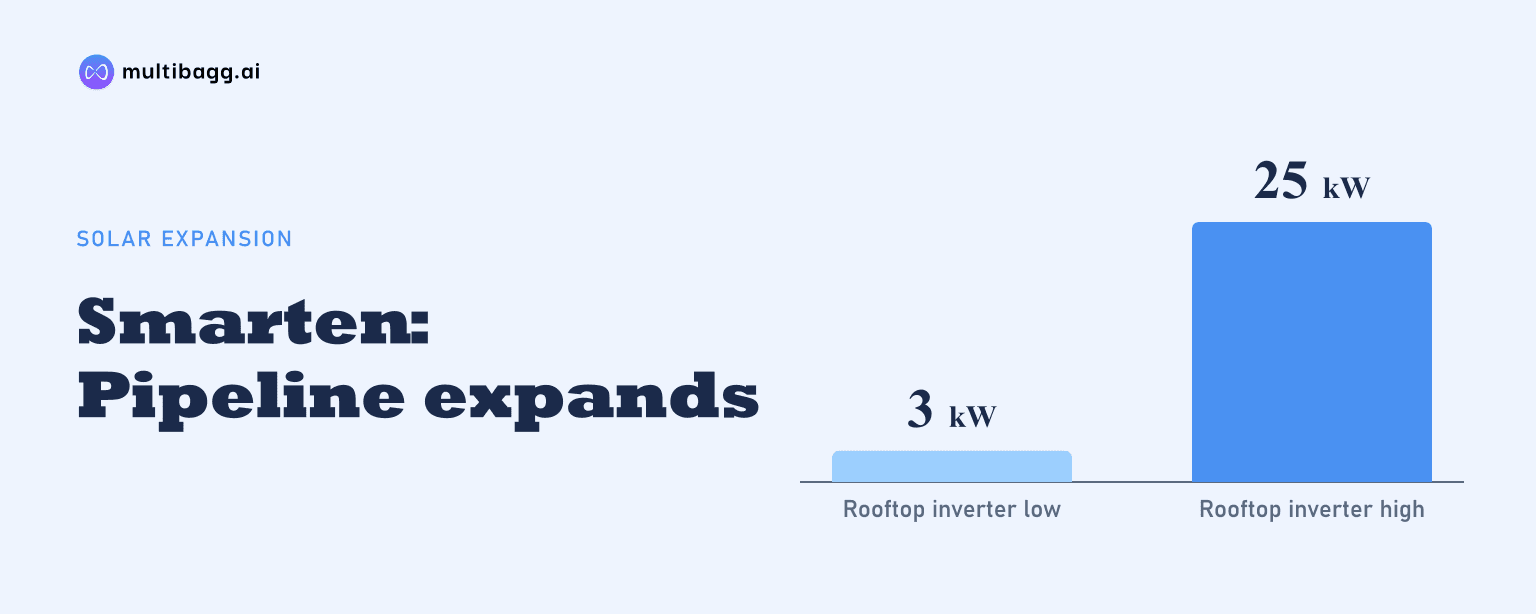
SMARTEN® is building beyond conventional backup power through an Internet of Things (IoT)-enabled solar inverter that tracks eight operating measures, alongside a development pipeline for retrofit hybrids, micro-inverters and three-phase grid-tie products. Smarten’s existing on-grid inverter range already spans 3 kW to 25 kW for residential and commercial rooftops.
Know Smarten Power Systems inside out
Results, valuation, peers and who's buying, in one view.
What does Smarten’s smart solar inverter monitor?
Smarten’s smart solar inverter monitors battery voltage, current, State of Charge (SoC), solar generation, load status, inverter operating mode, grid availability and charging status in real time. The integrated Remote Monitoring System (RMS) therefore covers the battery, solar input, connected load and grid conditions that determine how the unit is operating.
Smarten says RMS provides instant alerts for overload, low-battery and system-fault events. The system also supports data logging, performance analysis, remote diagnostics and preventive maintenance, while the product is described as an IoT-enabled inverter with lithium-ion battery management. This adds remote visibility and diagnostics to a solar-and-storage product, rather than only supplying backup power during an outage.
How does Smarten’s monitored inverter compare with its current products?
Smarten’s monitored product sits alongside hybrid and on-grid equipment with different operating roles. Its hybrid solar inverter combines solar, battery and grid functions in one unit and ranges from 4 kVA at 24 V to 12.5 kVA at 48 V, while a smart hybrid version includes RMS. Its on-grid range is grid-tied, spans 3 kW to 25 kW, and serves residential and commercial rooftop installations.
The solar power-conditioning-unit range is oriented toward battery-linked solar power management. Smarten’s Maximum Power Point Tracking (MPPT) Solar PCUs, sold in the Superb and Trendy series, range from 1.1 kVA to 20 kVA and 2.525 kVA to 10 kVA respectively; the company states that MPPT enhances energy efficiency by 30%. In contrast, the 3 kW to 25 kW on-grid range is designed for rooftop systems connected to the grid.
Smarten also identifies Helix and Helio solar inverters, Everon home uninterruptible power supply products, plus hybrid and on-grid inverters as its new-generation range. Helix covers 1.1 kVA to 1.25 kVA and Helio covers 1.5 kVA to 2.5 kVA. The company describes these additions as extending its portfolio from backup power into grid-connected and storage-ready solar.
What technology does Smarten develop in-house?
Smarten says it owns 100% of the intellectual property for firmware and front-end software, hardware circuits and printed circuit board design, mechanical design and architecture, and engineering decisions, bill of materials and costing. It says this work is supported by an eight-member core research-and-development team and 12 years of field-tested products.
The company lists changeover in less than 10 milliseconds, charging down to 90 V alternating-current input, and deep-discharged battery charging without an external charger among its platform features. Smarten says the sub-10-millisecond changeover is suited to information-technology equipment and critical loads, while charging at 90 V is intended for weak rural grids.
Smarten also reports MPPT tracking efficiency above 99% and compatibility with both lithium-ion and lead-acid batteries. Its lithium-ion battery range runs from 12.8 V to 51.2 V, compared with 35 Ah to 200 Ah for tubular lead-acid batteries manufactured at Baddi, Himachal Pradesh. Its solar tall tubular batteries span 150 Ah to 350 Ah, showing that the stated compatibility covers distinct battery chemistries and capacities.
Got a follow-up? Ask IRIS
Which solar products is Smarten developing next?
Smarten’s near-term product pipeline includes hybrid retrofit and conversion products intended to upgrade installed off-grid systems into hybrid Solar PCUs, as well as single-phase grid-tie inverters for residential rooftops. The company says the single-phase grid-tie products are being optimised for weak local grids, separating the retrofit route from new grid-connected household installations.
Its medium-term plan includes single-phase hybrid inverters that combine solar, battery and grid in one platform, plus smart micro-inverters with panel-level conversion and lithium-ion integration. Panel-level conversion differs from the 3 kW to 25 kW on-grid range because the planned micro-inverters would convert power at individual panels rather than through a shared central inverter.
In parallel, Smarten is developing three-phase grid-tie inverters for larger-capacity commercial and industrial users. It has also disclosed a 2-in-1 grid-tie inverter: grid-tie mode converts rooftop solar power for grid-connected operation, while off-grid, no-battery mode powers home appliances from solar when the grid is unavailable. Smarten states that all pipeline items are development plans, not commitments to product launches or dates, and remain subject to validation, certification and regulatory approval.
What resources support Smarten’s product expansion?
Smarten’s eight-member research-and-development team works on power conversion, inverter design, energy-storage systems, MPPT-based inverters, high-efficiency converters and charge controllers. The company also lists electronics testing and validation, three-dimensional product design and engineering, solar power-conditioning-unit kits and app-based monitoring among its development capabilities.
The product plan is linked to a new owned 41,903-square-foot facility in Jhajjar, Haryana, where Smarten expects production to commence by the end of FY27. The company presents the site as supporting an increase in production from 600 units a day to 1,200 units a day, alongside backward integration into lead-acid batteries at Baddi and a wider hybrid, on-grid and lithium-ion range.
Smarten reported 109 field service engineers, 44 service points nationwide, 427 domestic distributors and 32 international distributors across nine countries. About 95% of domestic revenue comes from North Indian states, according to the presentation. That service footprint is relevant to the remote-diagnostics model, while expansion into East, West and South India remains a stated strategy rather than a reported result.
Conclusion
Smarten’s product disclosures show a move across monitored solar operation, battery compatibility and grid-connected equipment. The eight-measure RMS platform, lithium-ion and lead-acid compatibility, and existing 3 kW to 25 kW on-grid range provide the current product base, while planned retrofit, hybrid, micro-inverter and three-phase products broaden the intended addressable applications.
The next points to watch are validation, certification and regulatory approval for the pipeline, since Smarten has not committed to launch dates. The company also expects its 41,903-square-foot Jhajjar facility to begin production by the end of FY27, with planned daily output rising from 600 to 1,200 units.