










Smarten sees 12%-15% margin from self-made batteries
Key highlights
- Smarten expects battery manufacturing margins of about 12%-15%, versus about 7%-8% from trading batteries.
- Battery sales were about Rs 60 crore in H1 FY’27, representing 29% of Smarten’s revenue from operations.
- Smarten reported an 8.3% EBITDA margin in H1 FY’27, compared with 5.9% in H1 FY’26 and 4.0% in H2 FY’26.
- Smarten said Jhajjar could double electronics capacity from 600 units a day to 1,200 units a day.
powered by IRIS
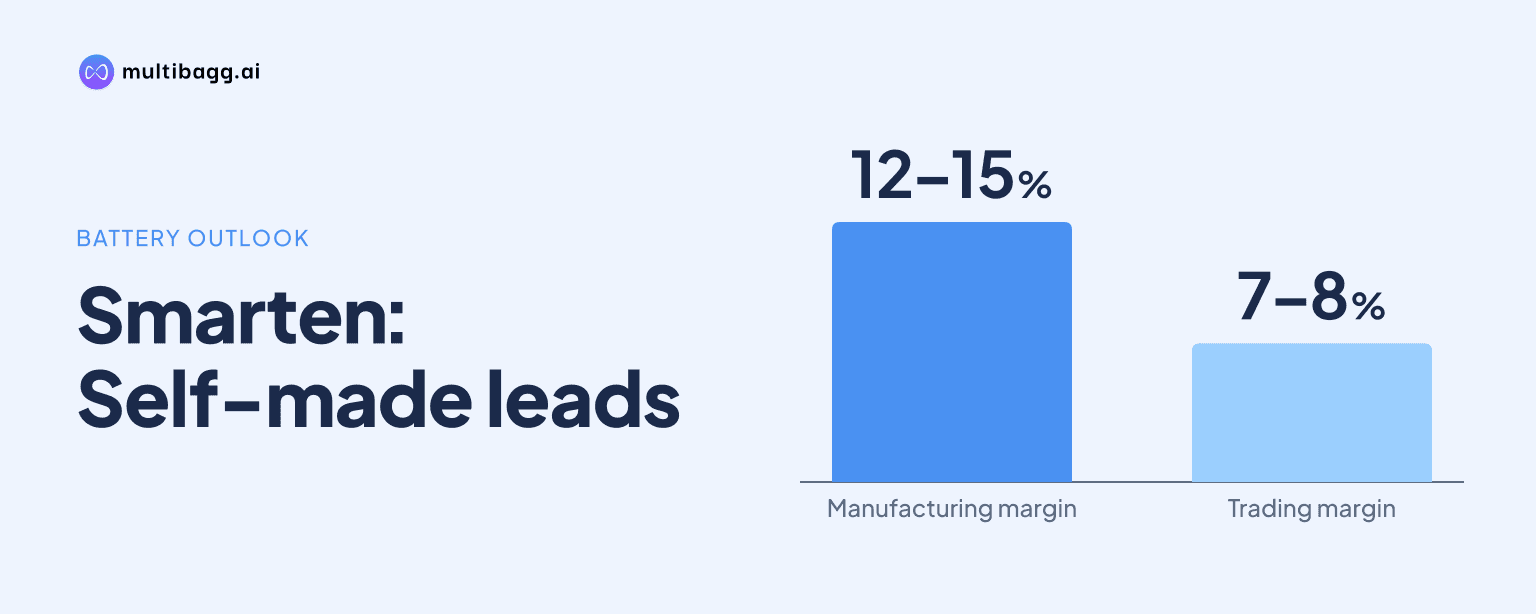
Smarten Power Systems Limited said on November 4, 2026 that battery manufacturing could deliver margins of about 12%-15%, compared with about 7%-8% from traded batteries, after work at its Baddi facility is completed. Batteries generated about Rs 60 crore, or 29%, of Smarten’s H1 FY’27 revenue from operations.
Know Smarten Power Systems inside out
Results, valuation, peers and who's buying, in one view.
What margin does Smarten expect from self-made batteries?
Smarten expects battery manufacturing margins of about 12%-15%, compared with about 7%-8% from battery trading. Management gave the comparison during its H1 FY’27 earnings call while discussing traded and self-made batteries. The indicated difference of 4 to 8 percentage points is a management expectation, not a reported margin outcome from the Baddi facility.
The Baddi operation is in its first year of manufacturing, according to management. Smarten said it took the plant during November and December of FY’26 and was still improving products, carrying out testing and installing equipment. Management said manufacturing margin was already higher than trading margin but was not yet at the intended level, with an increase expected in the next financial year after research and development and setup work.
Batteries have a substantial place in the revenue mix. Smarten reported battery sales of about Rs 60 crore in H1 FY’27, equal to 29% of revenue from operations, after batteries contributed about Rs 72 crore, or about 30% of revenue, in FY’26. That scale means a shift in battery sourcing from trading to manufacturing could affect the company’s aggregate margin mix.
How far has Smarten shifted from trading to manufacturing?
Smarten said manufacturing accounted for about 60% of sales and trading for about 40% at the time of the call. Within the manufacturing portion, management said electronics represented about 70% and battery manufacturing about 30%. The transcript does not disclose revenue produced specifically at Baddi, so the facility’s current contribution cannot be calculated.
The Baddi plant was not 100% operational, and management said it was working to increase capacity. In one response, management indicated that the mix could become 70-30 during the year, while consistently stating that manufacturing should rise and trading should decline. It did not specify whether that 70-30 indication referred to revenue, volume or a particular period.
Smarten’s broader integration plan also includes electronics. Management said the Jhajjar, Haryana facility was ready to double production capacity from 600 units a day to 1,200 units a day and was expected to commence by the end of FY’27. In a separate response on November 4, management said the inverter factory was expected to commence within three months; the call did not reconcile the two timelines.
Did H1 FY’27 results show a higher margin profile?
Yes, Smarten’s H1 FY’27 reported margins were higher than both H1 FY’26 and H2 FY’26, although management did not quantify the contribution from Baddi-made batteries. Revenue from operations was Rs 204.54 crore, up 77.5% year on year and 60.5% from H2 FY’26. Earnings before interest, tax, depreciation and amortisation, or EBITDA, rose 148.7% year on year to Rs 17.02 crore.
Gross margin recovered to 22.3% in H1 FY’27 from 19.1% in H2 FY’26 and matched H1 FY’26. Management described the 22.3% level as sustainable based on the preceding three to four years, while saying backward integration and newer renewable-energy products could increase margins. Profit after tax was Rs 11.99 crore, up 103.9% year on year and 310.6% from H2 FY’26.
Management attributed the prior-year pressure partly to lead-price disruption in January through March and the Middle East war situation. Lead is used in batteries, which carry a substantial share of revenue, so higher lead costs can reduce company margins when market conditions limit price pass-through. Management also said Smarten had about three months of planning against larger competitors’ six-month planning during that period.
Got a follow-up? Ask IRIS
What products could add to Smarten’s margin mix?
Smarten said its in-house hybrid inverters were in field trials and could enter mass production within one or two months from the November 4 call. Management said new technology products can offer more margin opportunity before becoming commodity products, but it did not provide a numerical margin target for hybrid or grid-tie inverters.
The company’s electronics work with both lead-acid and lithium batteries. Management said lithium adoption was increasing because of longer life, faster charging and lower maintenance, while lead-acid batteries remained relevant because lithium had a higher upfront price. This compatibility supports Smarten’s stated plan to provide solar, hybrid inverter, battery and monitoring combinations.
Smarten also discussed Internet of Things-enabled solar inverters and remote monitoring. Management said direct links with end users could help it track products within and outside warranty and offer after-sales service and annual maintenance contract offerings. It said this could raise after-sales revenue, but did not disclose a timetable, pricing model or forecast.
What must Smarten execute for the battery plan?
Smarten must complete Baddi’s product, testing and capacity work while increasing the manufacturing share of sales. Management said it planned about Rs 50 lakh to Rs 60 lakh for a minor expansion and additional machinery at the battery facility. It also cited about Rs 2 crore to Rs 3 crore of pending payments for Jhajjar and estimated total capital expenditure of around Rs 3.5 crore for the next year.
Supply-chain planning remains a stated consideration. Smarten said it depends on imported semiconductors for solar inverters, hybrid inverters, solar charge controllers and normal inverters. Management said war-related disruption had affected raw-material supply chains and that bare printed circuit board raw-material prices had almost doubled, requiring earlier procurement planning.
Management is targeting revenue of about Rs 375 crore in FY’27, describing the target as conservative, after Rs 204.54 crore in H1 FY’27. It also indicated a preliminary next-year plan of Rs 525 crore, but said financial planning becomes about 80%-90% accurate after FY’27 closes. Those are management plans rather than reported outcomes and depend on commissioning, capacity use and distribution expansion beyond Haryana and part of Uttar Pradesh.
Conclusion
Smarten’s disclosed battery strategy is based on management’s expected margin range of 12%-15% for manufacturing, against about 7%-8% for trading. H1 FY’27 showed EBITDA margin of 8.3%, up from 5.9% in H1 FY’26 and 4.0% in H2 FY’26, but Smarten has not separated the contribution of Baddi production from other factors affecting that improvement.
The next disclosed milestones are fuller Baddi operations following testing and equipment work, Jhajjar commissioning, and the planned mass production of hybrid inverters within one or two months of November 4, 2026. Management’s target of about Rs 375 crore in FY’27 revenue and its plan to increase manufacturing relative to trading provide the measurable context for those execution steps.