










Smarten plans hybrid inverter rollout to build AMC revenue
Key highlights
- Smarten plans in-house grid-tie and hybrid inverters across a portfolio of more than 372 SKUs.
- Management is targeting private rooftop projects sized at 50 kW, 100 kW and 500 kW.
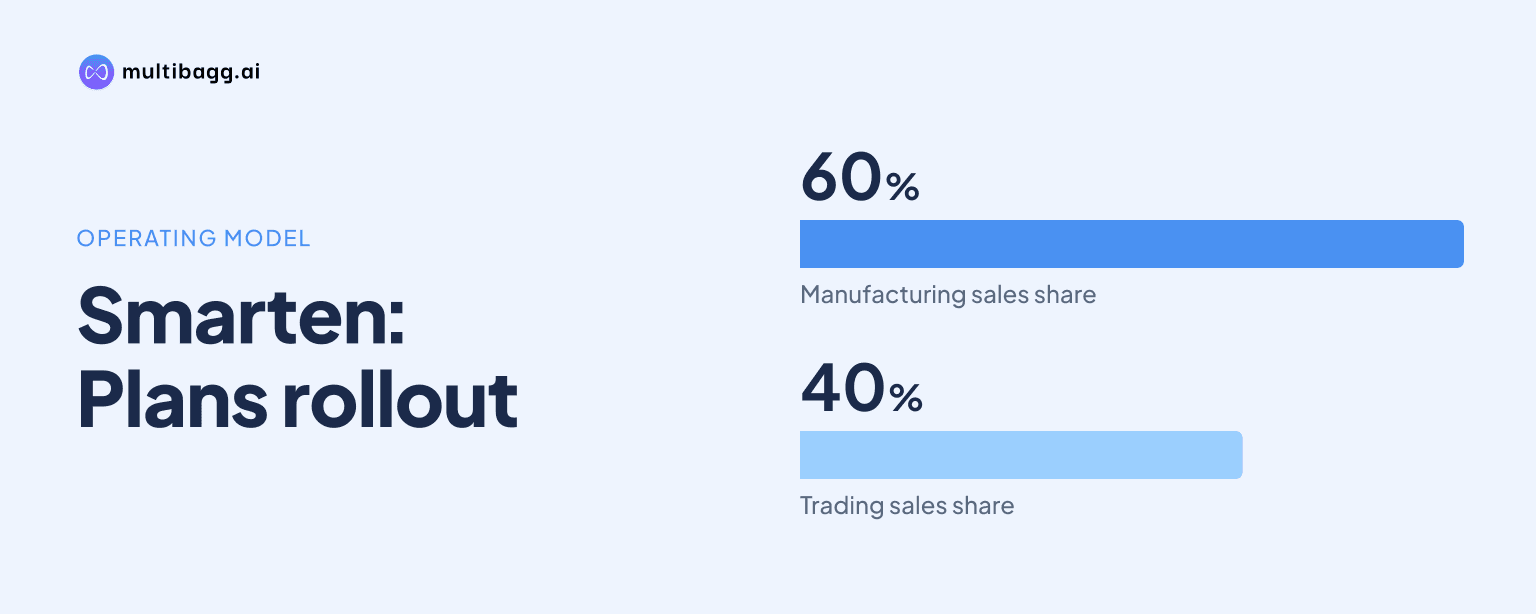
- Own manufacturing represents about 60% of sales, while trading represents about 40%.
- Smarten reported a first-half gross margin of 22.3% and an EBITDA margin of 8.3%.
powered by IRIS
Smarten Power Systems plans to develop in-house hybrid and grid-tie inverters and use remote monitoring to pursue annual maintenance contract, or AMC, revenue across a portfolio of more than 372 stock-keeping units. Management said connected products would give Smarten data on individual consumers, including whether equipment remains under warranty.
Know Smarten Power Systems inside out
Results, valuation, peers and who's buying, in one view.
What inverter products is Smarten developing?
Smarten is developing its own grid-tie and hybrid inverters as part of its renewable-energy product plan. Management said Smarten currently sells solar inverters, hybrid inverters, solar charge controllers and normal inverters, and typically introduces two or three new products each year.
The planned grid-tie product is intended to do more than export power to the grid. Management said its proposed configuration could operate home appliances when grid supply is unavailable, and said it believed this specification would be a first in the market. The call did not disclose a launch date, production capacity or expected sales contribution for the new system.
Management linked the hybrid-inverter plan to energy storage demand. It said grid-tie systems were initially popular under government schemes, but hybrid systems are gaining attention as storage becomes mandatory in certain schemes. Management also said no state had implemented peak tariffs, although it expects storage-linked demand could rise if evening peak pricing is introduced.
How will remote monitoring create AMC revenue for Smarten?
Smarten expects remote monitoring of solar inverters to create a direct consumer connection and support after-sales services and AMCs. Management said the company is not currently directly connected with end consumers because its traditional route is to sell to distributors, who supply dealers, with dealers completing installation.
Monitoring would allow Smarten to track each consumer's equipment status, including whether a product is within warranty or out of warranty, management said. It expects that information to support service offers after the warranty period and said after-sales revenue could increase as a result. Management did not disclose AMC pricing, a connected installed base or a timetable for service revenue.
The monitoring strategy has not been presented as a separately reported software segment. In response to a question on integrated solutions, management confirmed the opportunity but did not provide a split between hardware sales, monitoring income and maintenance revenue. The expected service contribution therefore remains unquantified.
Which rooftop projects and battery applications is Smarten targeting?
Smarten is focusing first on private rooftop projects of 50 kilowatts, 100 kilowatts and 500 kilowatts rather than directly entering government projects. Management said these installations could include factory rooftops and private residences, while government projects would be a later step.
This approach would change Smarten's role in selected installations. Under its established distribution model, products move from Smarten to distributors and then dealers, which handle final installation. For the cited 50 kW to 500 kW private projects, management said Smarten plans to undertake the projects itself, while continuing to execute tenders through third parties.
Smarten is also pursuing project-based battery applications through a distribution agreement with Exide Technologies from Europe, rather than Exide India. Management said the batteries are aimed at telecom, defence and data-centre projects instead of the general retail channel. It is working through approval and listing processes, including Defence Research and Development Organisation-related requirements, before operations begin.
Got a follow-up? Ask IRIS
How does in-house production support Smarten's strategy?
Smarten said own manufacturing represents about 60% of sales and trading about 40%, making in-house product development material to its strategy. Within manufacturing, electronics account for about 70% and battery manufacturing for about 30%, according to management.
Battery manufacturing is in its first year after Smarten took the plant in November or December of the prior financial year, management said. It is conducting product testing, enhancements and equipment work. Management estimated trading margins at about 7% to 8%, compared with about 12% to 15% for battery manufacturing, while saying the battery operation has not yet reached its intended level.
Smarten said its main imported dependency is semiconductors, while cabinet assembly, plastic products and some other materials are sourced in India. Management said about 80% of bare printed circuit board manufacturing raw material comes from overseas sources, with prices almost doubling amid supply disruption. Its stated response is to plan imports earlier to reduce supply-chain risk.
What did Smarten say about margins and expansion plans?
Management said the 22.3% gross margin reported for the first half was sustainable and consistent with the preceding three to four years. An analyst said the figure was flat year on year and 320 basis points above H2 FY26, while management attributed the prior pressure to temporary component and battery-lead volatility during war-related disruption.
Management said new renewable-energy products, including grid-tie and hybrid systems, and further backward integration are intended to raise margins. It expects H2 to replicate the first-half earnings before interest, tax, depreciation and amortisation, or EBITDA, result, but did not provide a numerical FY27 margin target.
Over the next three years, management said its first strategy is pan-India expansion. It said current revenue is concentrated in Haryana and half of Uttar Pradesh, and expects channel expansion to be the principal growth engine. Management also plans to establish project business and institutional sales as separate business units.
Conclusion
Smarten's product strategy combines in-house renewable-energy hardware with a planned post-installation service relationship. Hybrid and grid-tie inverters could broaden its product set, while remote monitoring could identify warranty status and support after-sales work and AMC offers. Direct execution of 50 kW to 500 kW private rooftop projects would also extend its role beyond the distributor and dealer chain.
Next, management's disclosed plans point to several execution markers: rollout details for the grid-tie and hybrid products, the scale of connected monitoring, and progress on defence and tender approvals for Exide Technologies batteries. Smarten also plans pan-India channel expansion from its current concentration in Haryana and half of Uttar Pradesh, alongside the creation of project and institutional-sales units.