










Smarten targets Rs 375 crore FY27 revenue after H1 growth
Key highlights
- Smarten reported H1 FY27 revenue from operations of Rs 204.54 crore, up 77.5% year on year.
- Management is targeting about Rs 375 crore of FY27 revenue after referring to a Rs 370 crore to Rs 380 crore range.
- H1 FY27 EBITDA was Rs 17.02 crore and EBITDA margin was 8.3%, compared with 4.0% in H2 FY26.
- Battery sales were about Rs 60 crore, or 29% of H1 FY27 revenue from operations.
powered by IRIS
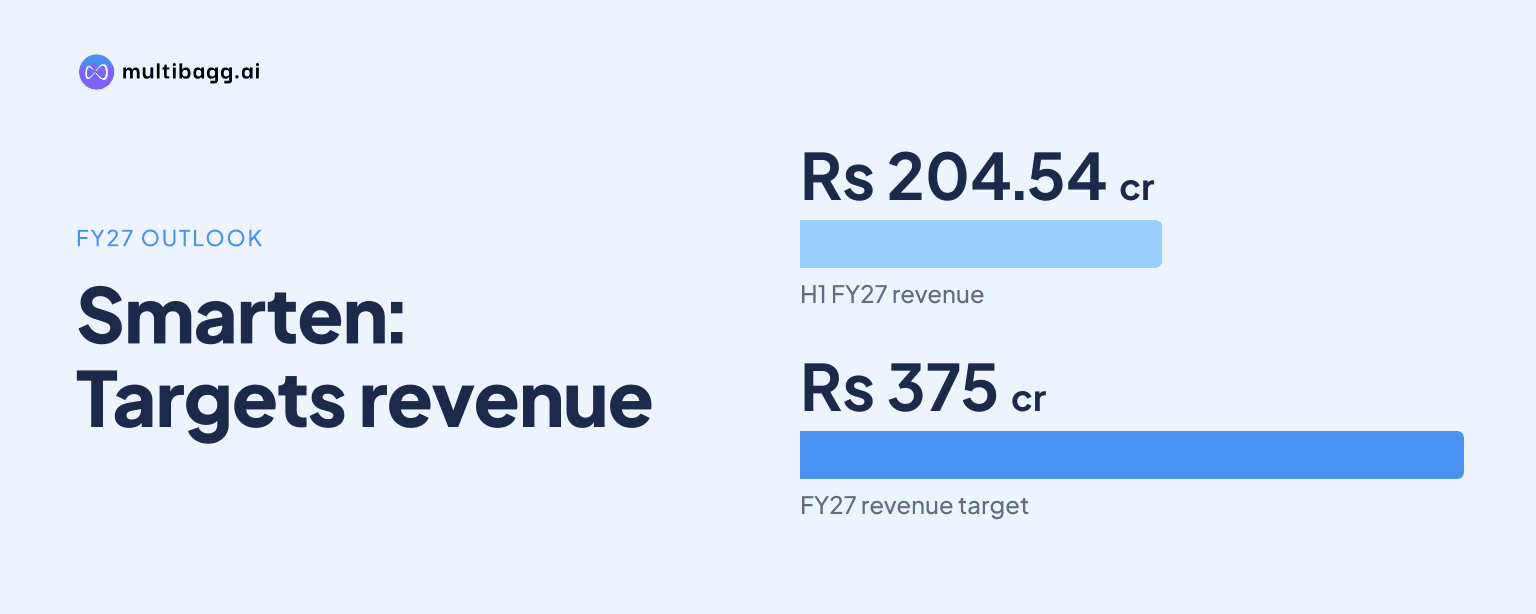
Smarten Power Systems Limited is targeting about Rs 375 crore of FY27 revenue after reporting H1 FY27 revenue from operations of Rs 204.54 crore, up 77.5% year on year. Management linked the target to its operational battery plant, expected Jhajjar inverter-factory start and sales of recently introduced products.
Know Smarten Power Systems inside out
Results, valuation, peers and who's buying, in one view.
What is Smarten's FY27 revenue target?
Smarten is targeting about Rs 375 crore of revenue in FY27, management said on the November 4, 2026 earnings call. Management first referred to a range of about Rs 370 crore to Rs 380 crore, then identified Rs 375 crore as its target and described that figure as conservative.
The target implies that Smarten would need about Rs 170.46 crore in H2 FY27 after generating Rs 204.54 crore in H1 FY27. Management said the target reflects the acquisition and operation of the battery plant, the expected commencement of the inverter factory, and contributions from products that are gaining sales traction.
Management said its FY27 plan remained on track with projections discussed in the draft red herring prospectus, or DRHP. It did not provide a quarterly revenue forecast or revenue estimates by product, customer category or geography for the Rs 375 crore objective.
How did Smarten perform in H1 FY27?
Smarten reported H1 FY27 revenue from operations of Rs 204.54 crore, up 77.5% year on year and 60.5% from H2 FY26. Gross profit rose 77.9% year on year and 88.0% from H2 FY26 to Rs 45.68 crore, exceeding the growth rate in revenue against the preceding half.
Gross margin was 22.3% in H1 FY27, unchanged from the corresponding prior-year period and up from 19.1% in H2 FY26. The 3.2-percentage-point increase from H2 FY26 coincided with revenue growth of 60.5% over that half-year period.
Earnings before interest, tax, depreciation and amortisation, or EBITDA, was Rs 17.02 crore, up 148.7% year on year and 231.8% from H2 FY26. EBITDA margin was 8.3%, compared with 5.9% in the year-earlier period and 4.0% in H2 FY26, while profit after tax was Rs 11.99 crore and its margin was 5.9%, versus 5.1% and 2.3%, respectively.
When will Smarten's Jhajjar facility start operations?
Smarten gave two timing references for the Jhajjar, Haryana facility: the opening presentation said it was expected to commence by the end of FY27, while management later said the inverter factory would commence within three months of the November 4, 2026 call. The transcript therefore does not provide one consistent start date.
The facility is intended to double production capacity to 1,200 units a day from 600 units a day and introduce automated printed circuit board, or PCB, testing. Management said capacity can double from day one, but revenue growth will also depend on expanding sales beyond its main Haryana and Uttar Pradesh territories.
Management expects the facility's revenue effect to emerge in the next financial year, when it aims to become a pan-India player. It also said consolidating operations could reduce rent and costs across locations, including administration, manpower handling and transport, though it gave no quantified savings figure.
Got a follow-up? Ask IRIS
How will battery manufacturing change Smarten's business mix?
Smarten said its acquired Baddi, Himachal Pradesh battery production line is operational and should shift the business from trading toward manufacturing. Management estimated that the manufacturing-to-trading mix could become 70:30 during FY27, compared with the 40:60 mix cited by an analyst during the call.
Battery sales were about Rs 60 crore in H1 FY27, or 29% of revenue from operations. That compares with battery sales of about Rs 72 crore, or about 30% of revenue, in the full FY26, meaning H1 FY27 battery sales approached the prior full-year level.
The Baddi facility was not operating at 100% capacity, according to management, which said it was expanding production. Management expects greater battery manufacturing, together with the Jhajjar facility, to raise margins by about 1% to 3% in the coming financial year, rather than committing to a specific FY27 margin level.
Which products and channels support Smarten's target?
Smarten is supporting its revenue target through more than 372 stock-keeping units, or SKUs, covering home uninterruptible power supply systems, solar inverters, batteries, solar panels and solar charge controllers. Its distribution network includes 427 distributors in 24 states and two union territories, 32 international distributors and 109 in-house and field service engineers.
Management said its smart solar inverters with integrated remote monitoring address institutional demand for smart power infrastructure. It also said in-house-designed hybrid inverters were in field trials and expected to enter mass production within one or two months of the November 4 call, but did not disclose expected revenue from those products.
Smarten also cited a government order of about Rs 1.75 crore for 4,000 solar power conditioning units, or PCUs, and its authorisation as a channel distributor for Exide. These channels supplement the company’s plan to broaden sales geographically in the next financial year.
What could affect Smarten's target and margins?
Smarten's FY27 target depends on translating higher production capacity into sales, which management said cannot be guaranteed quickly despite the planned capacity increase to 1,200 units a day. Inventory was around Rs 55 crore in H1 FY27, and management said it had increased broadly in line with sales growth of about 80%.
Lead costs remain a margin variable because batteries generated about Rs 60 crore of H1 FY27 sales. Management said lead-price disruption in January through March of FY26 reduced battery margins, and it attributed part of that volatility to the Middle East war while noting that its planning cycle is about three months.
Management called the H1 FY27 EBITDA margin of 8.3% sustainable and said it could improve gradually. That view depends on the Baddi ramp-up, Jhajjar operations and lower multi-location costs, rather than on a disclosed fixed margin target for FY27.
Conclusion
Smarten's Rs 375 crore FY27 objective is underpinned by H1 revenue of Rs 204.54 crore, 77.5% year-on-year growth and an 8.3% EBITDA margin, compared with 4.0% in H2 FY26. Battery manufacturing, higher inverter capacity, hybrid-inverter development and wider distribution are the disclosed elements of management's plan.
The next items to watch are the Jhajjar facility's actual start date, given the differing references to within three months and by FY27-end, and the proposed hybrid-inverter mass-production launch within one or two months of November 4, 2026. Management's expected 70:30 manufacturing-to-trading mix and 1% to 3% margin improvement in the coming financial year will depend on those execution steps.