










Smarten plans 1,200 daily assembly units at Jhajjar factory
Key highlights
- Smarten expects the owned 41,903 sq ft Jhajjar facility to start production by the end of FY27.
- Smarten plans to double assembly capacity from 600 to 1,200 units per day.
- The pre-engineered building was 90% complete and civil works were 60% complete at the disclosed update.
- Smarten's Baddi battery plant has capacity of 8,000 units per month and was operating at about 80% utilisation.
powered by IRIS
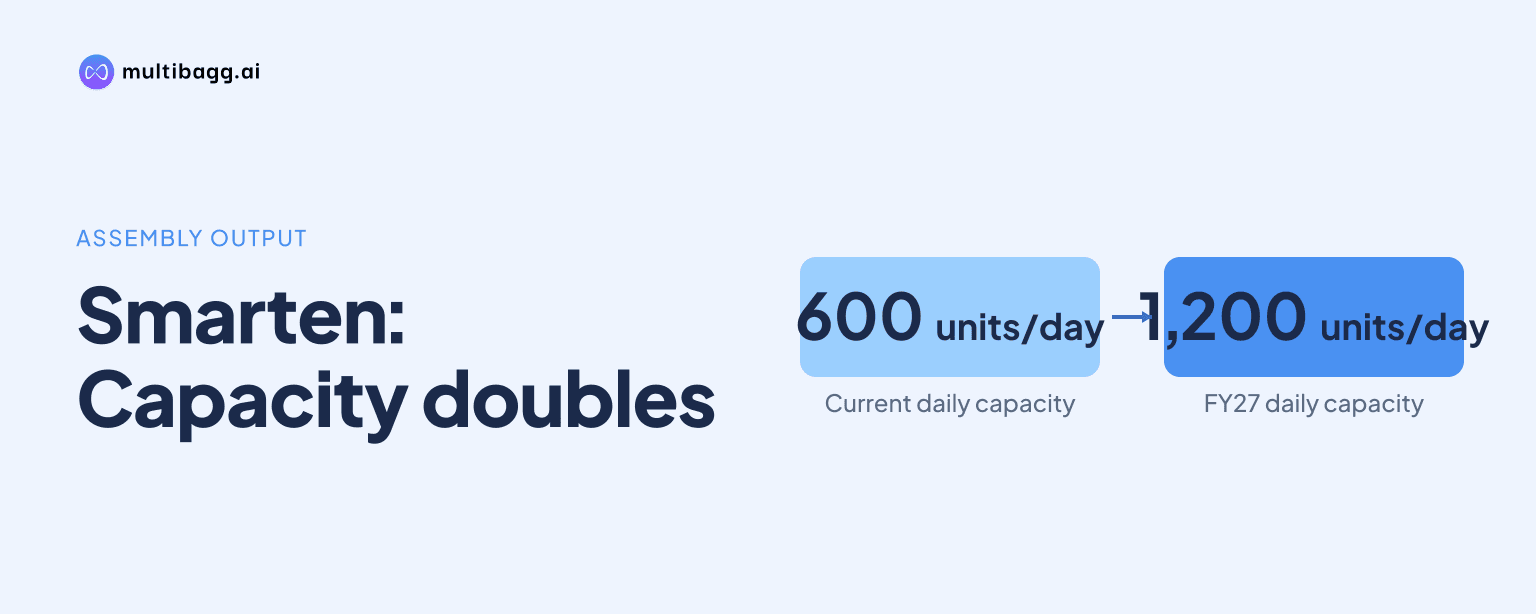
Smarten plans to raise daily assembly capacity from 600 to 1,200 units when its owned 41,903 sq ft Jhajjar, Haryana facility begins production by the end of FY27. The project is designed to phase out two rented Gurugram facilities and shift the production model from 40% procured and 60% in-house output toward 100% in-house production.
Know Smarten Power Systems inside out
Results, valuation, peers and who's buying, in one view.
What will Smarten's Jhajjar factory add?
Smarten's Jhajjar factory is planned as an owned 41,903 sq ft assembly facility at Sector 7A, Model Economic Township, Haryana, with production expected by the end of FY27. The presentation sets out a move from 600 to 1,200 units per day after the site becomes operational, representing an addition of 600 daily units.
The facility is intended to replace parts of a dispersed Gurugram operating footprint. Facility 1 is a rented 22,500 sq ft site used for operations management, quality checks, research and development, purchasing and raw-material storage. Facility 2 is a rented two-storey building on 4,843 sq ft of land that houses sales, marketing, accounts, human resources, customer service and transformer assembly.
Smarten says Facilities 1 and 2 will be phased out when the Jhajjar operation starts. Its rented finished-goods warehouses cover 16,000 sq ft and 5,200 sq ft, while the separately owned Baddi, Himachal Pradesh battery plant spans 32,234 sq ft. The new assembly site therefore sits alongside, rather than replaces, the Baddi battery operation.
When will Smarten's Jhajjar factory begin production?
Smarten expects Jhajjar production to commence by the end of FY27, although it has not disclosed a specific commissioning month or date. At the construction update in the presentation, the pre-engineered building was 90% complete and civil works were 60% complete, leaving both workstreams unfinished.
The stated doubling of capacity is conditional on the proposed factory becoming operational. Smarten does not disclose project capital expenditure, capacity by product category or planned staffing for Jhajjar. It reported 345 FTEs, or full-time equivalents, as of September 2026, including 29 employees at the Baddi battery plant.
Smarten cites the site's logistics and utilities as part of its rationale. The location is connected via the Kundli-Manesar-Palwal Expressway and is close to the Delhi-Mumbai Industrial Corridor, while the Model Economic Township has 220 kilovolt substations and water supply. The company also identifies proximity to Indira Gandhi International Airport as supporting faster deliveries and supply-chain efficiency.
Got a follow-up? Ask IRIS
How will Smarten change its manufacturing model?
Smarten intends to move from 40% procured and 60% in-house production to a 100% in-house production target as the Jhajjar plant comes online. The current model sources sub-assembled printed circuit board, or PCB, cards, inductors, wire harnesses, metal chassis and front panels from an Indian vendor network, while some products are procured in semi-finished form.
Assembly uses manual and conveyor lines, supported by sub-assembly pods that prepare materials for the main line. Smarten reports five assembly lines and says all lines will move to conveyor operation. The Jhajjar plan includes automated PCB testing and an automated final test on the assembly line, although the final-test system remains in development with a manual fallback.
Smarten has started producing transformers in-house, extending the integration plan beyond final assembly. Its eight-member research and development team manages hardware, firmware, PCB and mechanical design intellectual property. Management says retaining design, testing and assembly in-house, alongside transformer production, is intended to provide tighter control over quality, cost and turnaround time; the presentation does not quantify the financial effect.
The planned output could support Smarten's portfolio of 372 stock-keeping units, or SKUs, including home uninterruptible power supply systems, solar inverters, solar power conditioning units, on-grid inverters, batteries, panels and charge controllers. The range includes a 2-in-1 grid-tie inverter with grid-tie and off-grid, no-battery modes, as well as a smart solar inverter with remote monitoring for battery, generation and load data.
How does the Jhajjar plan fit Smarten's wider expansion?
Smarten presents Jhajjar as one of four growth levers, alongside product expansion, geographic expansion, and government projects and partnerships. Product expansion includes backward integration at Baddi, where the battery plant has capacity of 8,000 units a month and was operating at about 80% of installed capacity.
Battery sales increased from Rs 49.19 crore in FY24 to Rs 63.91 crore in FY25 and Rs 72.97 crore in FY26. In H1 FY27, covering April to September 2026, battery sales were Rs 59.43 crore and represented 29.06% of revenue from operations. The sales figure for the six-month period was Rs 13.54 crore below FY26's full-year total, while the revenue share was below 30.07% in FY26 and 31.68% in FY25.
Smarten's geographic strategy is to expand from North India into East, West and South India, supported by a Bangalore facility for the South, while pursuing exports to Asia and Africa. Its current network includes 427 domestic distributors and 32 international distributors across nine international markets. The presentation says about 95% of domestic revenue comes from listed North Indian states, making regional expansion a disclosed objective alongside the capacity plan.
Conclusion
Smarten's Jhajjar project combines a capacity increase with a consolidation and integration plan. The owned 41,903 sq ft facility is intended to add 600 units of daily assembly capacity, phase out two rented Gurugram facilities and move production from a 60% in-house share to a 100% target. The Baddi plant's 8,000-unit monthly battery capacity remains a separate manufacturing base within the broader expansion strategy.
The next disclosed milestone is the expected start of Jhajjar production by the end of FY27. Progress was reported at 90% for the pre-engineered building and 60% for civil works, while automated PCB testing and the automated final-test system are also planned, with the latter still under development and retaining a manual fallback.