










Solex says FY27 supply will remain mostly non-DCR
Key highlights
- Solex said FY27 module supply will remain predominantly non-DCR, with DCR volumes currently very small.
- About 30 GW of grandfathered projects remain eligible to import cells, according to management.
- Management expects domestic cell capacity and availability to improve in about six months.
- Solex expects its TOPCon cell line to begin production by December 2027.
powered by IRIS
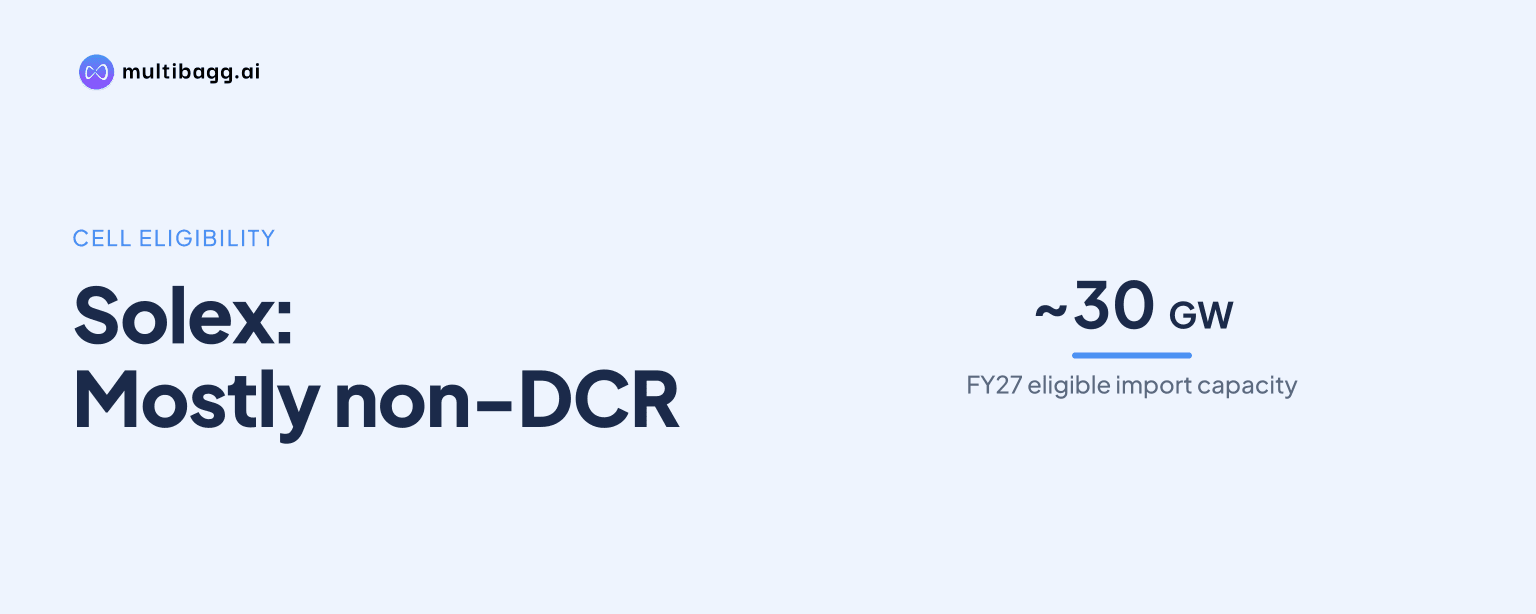
In FY27, Solex expects most module supply to remain non-DCR because domestic cells lack sufficient volume and quality, while about 30 GW of grandfathered projects can still use imported cells. Management said DCR, or domestic-content-requirement, module volumes are currently very small despite the localisation mandate.
Know Solex Energy inside out
Results, valuation, peers and who's buying, in one view.
Why will Solex supply mostly non-DCR modules in FY27?
Solex expects most FY27 deliveries to be non-DCR modules because its principal independent power producer, or IPP, segment continues to use imported cells for eligible projects. Management said the company is still importing cells for the majority of its IPP business, while DCR volumes remain “very, very small” at present.
The immediate support for this mix is a pool of about 30 GW of projects that were grandfathered under earlier rules and are still permitted to import cells. Solex said this pipeline provides sufficient business while domestic cell capacity builds, allowing module supply to continue without relying entirely on DCR-compliant cells.
Solex also said it has arranged supply from domestic cell manufacturers for the coming year until its own facility is operational. Management said this tie-up is intended to secure cells when DCR-module orders arise, rather than indicating that the overall FY27 sales mix will shift predominantly to DCR modules.
What is restricting domestic-cell supply for DCR projects?
Solex said India does not yet have sufficient domestic cell capacity to serve DCR projects at the needed volume and quality. Management linked that constraint to delays in large DCR projects, citing both cell availability and the quality required to support module warranty commitments.
Domestic cells remain costly, limited in availability and, in some cases, below the required quality level, according to management. Solex said new cell lines need time to reach high efficiency and utilisation, meaning installed capacity does not immediately translate into cells that module makers can use for DCR projects.
Management said Solex and other module manufacturers have raised these issues with ministries and the Prime Minister’s Office. The government has granted extensions for certain classified projects, particularly captive projects, and the industry is seeking further extensions until sufficient domestic cell capacity is available.
Solex expects the supply position to improve in about six months, although management also cited challenges involving technology transfer from China. This is management’s expectation, not a confirmed policy decision, and it said DCR implementation should be fully enforced only after adequate domestic capacity is available.
How does the eligible project pipeline support Solex's supply plans?
The roughly 30 GW grandfathered project pool gives Solex an addressable market for non-DCR modules using imported cells. These projects are distinct from new projects that must meet domestic-content requirements, because their earlier classification permits continued cell imports.
Solex said it generally procures cells against confirmed orders rather than carrying large inventories. For larger contracts, management said pricing can be linked to cell costs and the US dollar beyond an agreed range, while certain customers participate in cell procurement to reduce price-volatility exposure.
Shipping costs have been a separate issue because Solex said it could not always pass higher freight costs to customers. Management said container freight that had been planned at $900 to $1,000 reached $3,500 in a recent six-month period, and the company absorbed some of that increase to meet delivery commitments.
The supply mix therefore depends on project eligibility, domestic-cell availability and order timing. Solex’s stated approach is to serve eligible IPP orders with imported cells and draw on domestic supplier arrangements when customers require DCR modules.
Got a follow-up? Ask IRIS
Does Solex see effective solar-module overcapacity in India?
Solex does not consider India to be in effective module overcapacity because management distinguishes listed capacity from actual output and technology-specific demand. It said listed module capacity is 230 GW, but average utilisation is about 50%, implying output of about 115 GW.
Management said about 95% of current demand is for TOPCon modules, whereas 30 GW to 35 GW of installed capacity is older Mono PERC technology. After also excluding 7 GW to 8 GW of proprietary technologies, management argued that capacity suited to current demand is closer to the market requirement than the 230 GW headline figure suggests.
Solex compared about 60 GW of TOPCon modules supplied in India last year with 50 GW of solar projects completed. Management said battery energy storage systems, or BESS, and green-grid development could add to demand, while acknowledging that smaller new entrants can face execution and pricing challenges and that industry consolidation may occur in coming months.
When could Solex increase DCR-module supply?
Solex said a broader move to DCR modules depends on adequate domestic cell quality, supply and cost, which management expects could improve within about six months. Until then, management expects non-DCR modules to remain the principal format of FY27 supply.
Solex’s own cell-manufacturing plan is a longer-term factor. Management said land-related environmental-clearance issues for its TOPCon cell line have been resolved and equipment and service providers are aligned, with production expected to start by December 2027.
Management estimated capital expenditure of Rs 500 crore to Rs 600 crore per GW for a cell line, including land and buildings. It said the planned line would not have a material financial impact in FY28 because production is scheduled for December 2027.
For FY29 onwards, management guided to earnings before interest, tax, depreciation and amortisation margin of 23% to 25% and profit-after-tax margin of 12% to 14%. Solex also said its Rs 4,000 crore memorandum of understanding with the Gujarat government covers 5 GW of solar-cell capacity and 10 GW of BESS assembly capacity.
Conclusion
Solex’s FY27 supply position rests on the gap between the DCR mandate and available domestic cells. Grandfathered projects of about 30 GW and the company’s IPP focus allow continued non-DCR module sales using imported cells, while limited domestic-cell quality and volume delay a broader DCR transition.
The next items to watch are whether further extensions are granted for projects affected by the cell shortage, whether domestic capacity improves within management’s six-month expectation, and progress toward Solex’s planned December 2027 cell-production start. Management’s FY29 margin guidance depends on that cell-line plan becoming operational.