










Solex targets December 2027 TOPCon start and FY29 margins
Key highlights
- Solex targets December 2027 to start TOPCon cell production.
- Solex estimates TOPCon cell-line capex at Rs 500 crore to Rs 600 crore per gigawatt, including land and building.
- Management guided FY29 EBITDA margin at 23%-25%, PAT margin at 12%-14% and revenue of about Rs 4,000 crore.
- Solex's Rs 4,000 crore Gujarat memorandum covers 5 gigawatts of solar cells and 10 gigawatts of BESS assembly.
powered by IRIS
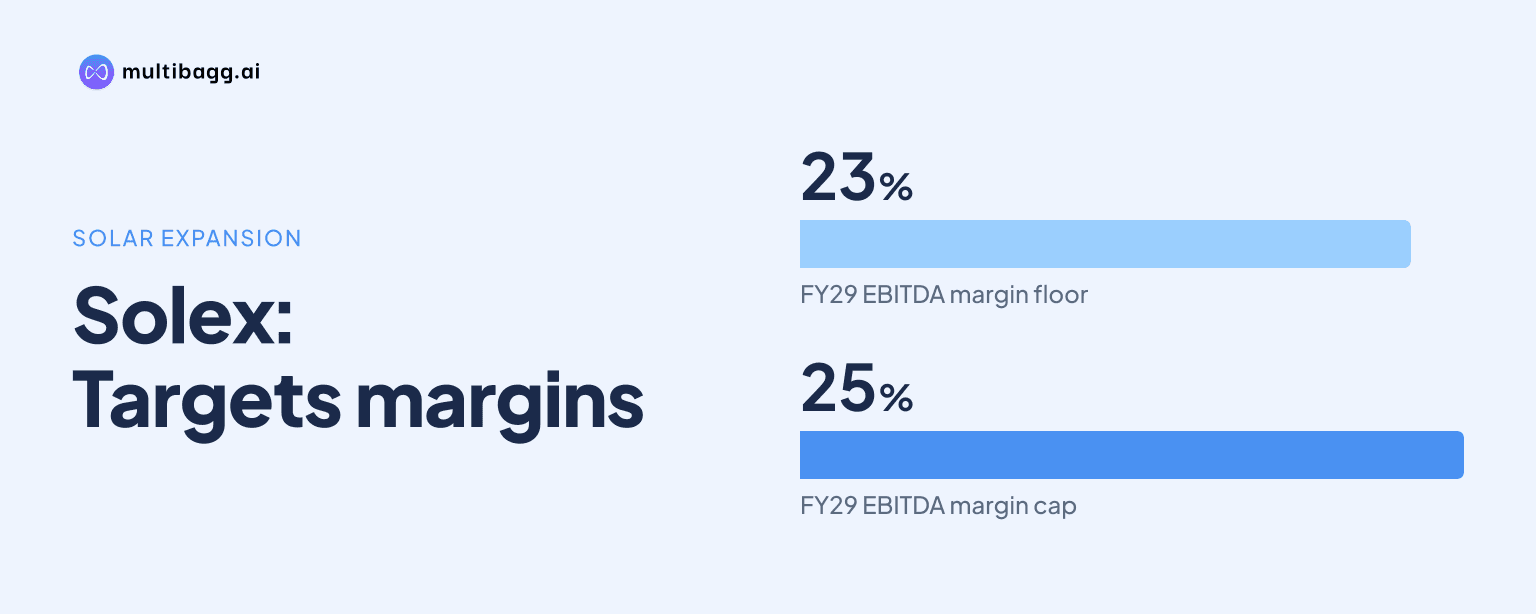
Solex targets December 2027 to start TOPCon cell production and has guided FY29 earnings before interest, tax, depreciation and amortisation, or EBITDA, margin of 23% to 25%. Management said land issues had been resolved, equipment and service providers were aligned, and the line would not materially affect FY28 results.
Know Solex Energy inside out
Results, valuation, peers and who's buying, in one view.
When will Solex begin TOPCon cell production?
Solex expects its TOPCon cell line to begin production by December 2027. Management said the project initially encountered difficulty finding a sufficiently large Gujarat land parcel with environmental-clearance certainty, but described the land issue as resolved and said service and equipment providers had been aligned.
Solex said FY28 would not reflect the cell line's financial contribution because production is targeted only for December 2027. FY29 is therefore the first period for which management has linked the backward-integration plan to explicit revenue and margin guidance. The comparison matters because FY28 is expected to have little cell-line impact, while FY29 is expected to include a fuller operating contribution.
Management said its estimates for the cell line were conservative and cautioned that capacity additions could change the margin environment after about one year. It did not disclose a commissioning sequence, utilisation target or annual production ramp for the December 2027 start.
How much will Solex spend on TOPCon cell capacity?
Solex estimates TOPCon cell-line capital expenditure of Rs 500 crore to Rs 600 crore per gigawatt, including land and building costs. Management said that range assumes good-technology machinery rather than refurbished or second-hand equipment, which it said Solex is not pursuing.
The company has signed a term sheet for a proposed Rs 50 crore issue of compulsorily convertible debentures, or CCDs, in the subsidiary developing the cell line. Management said documentation was being completed and that the funds were being raised primarily for the cell project. It did not disclose the CCD conversion price, coupon, maturity or resulting ownership effect.
Solex said its Rs 4,000 crore memorandum of understanding with the Government of Gujarat covers 5 gigawatts of solar-cell capacity and 10 gigawatts of battery energy storage system, or BESS, assembly. Management said the programme was proceeding in line with that memorandum, but did not provide a final cell-project budget or a schedule for building the full 5 gigawatts.
What FY29 profitability has Solex forecast?
Solex has guided for FY29 EBITDA margin of 23% to 25%, profit after tax, or PAT, margin of 12% to 14%, and revenue of about Rs 4,000 crore. Management presented these figures as conservative estimates tied to the period after the planned December 2027 cell-line start.
An analyst on the call described Solex's EBITDA margin as having risen from 7%-8% to 11%. Management did not independently confirm those historical percentages in its response, whereas management directly stated the 23%-25% FY29 EBITDA range and 12%-14% FY29 PAT range. The disclosed FY29 target is therefore a management forecast, while the earlier margin comparison was raised by the analyst.
Management later referred to an FY29 EBITDA margin range of 23% to 24%, while repeating the 12%-14% PAT margin and about Rs 4,000 crore revenue outlook. Solex did not explain why the upper EBITDA figure was 24% in that later answer rather than 25%, leaving the final upper end of the FY29 range unresolved.
Got a follow-up? Ask IRIS
How will ISC Konstanz support Solex's cell line?
Solex said ISC Konstanz will help set up and operate the upcoming cell line through its technical know-how. Management also said the contract covers development work on Rear Contract technology and other future technologies, extending the arrangement beyond the December 2027 TOPCon start.
Management did not disclose the cost of the ISC Konstanz arrangement. It said the agreement had a cost but had been negotiated for the long term, and management considered it not very high relative to the expected input. Without a fee figure, the call does not establish whether that cost is included in the Rs 500 crore to Rs 600 crore per-gigawatt capex range.
On technology, management said TOPCon should remain a long-term technology in India because significant investment has already gone into TOPCon cell and module manufacturing. It said a later shift could occur toward Back Contact and heterojunction technology, or HJT, and that TOPCon and HJT could provide a base for tandem perovskite technology. Management gave no date for such a transition.
Why is Solex integrating into solar-cell manufacturing?
Solex is entering cell manufacturing because management said domestic-content-requirement, or DCR, cells remain short in supply and their quality does not always meet demand. Management said most of Solex's supply in the current financial year would remain non-DCR modules, particularly in the independent power producer, or IPP, segment where imported cells are still used.
For the coming year, Solex said it had tied up domestic cell supply until its own facility comes up. Management also said it was secured with supplies from existing manufacturers for DCR-module orders, meaning the December 2027 line is intended to supplement rather than immediately replace external sourcing.
Management disputed that India has solar-module overcapacity. It cited about 230 gigawatts of module nameplate capacity and average utilisation of 50%, implying roughly 115 gigawatts of actual output capacity. After removing about 30 gigawatts to 35 gigawatts of older Mono PERC capacity, management estimated India's TOPCon capacity at about 75 gigawatts to 80 gigawatts.
Management compared that 75-gigawatt to 80-gigawatt TOPCon estimate with about 60 gigawatts of TOPCon modules supplied in India last year, against 50 gigawatts of solar projects. It also cited 7 gigawatts to 8 gigawatts of HJT and thin-film capacity as proprietary technologies. These are management estimates supporting its demand-capacity view, not independently verified market data.
Conclusion
Solex has paired a December 2027 TOPCon production target with a Rs 500 crore to Rs 600 crore per-gigawatt capex framework and FY29 EBITDA guidance of 23% to 25%. The plan addresses management's stated shortage of suitable DCR cells while retaining external domestic and imported cell sourcing before the new line starts.
The next points to watch are completion of documentation for the proposed Rs 50 crore CCD issue, adherence to the December 2027 production target, and clarification of whether FY29 EBITDA guidance tops out at 24% or 25%. Progress on the Rs 4,000 crore Gujarat memorandum, covering 5 gigawatts of cells and 10 gigawatts of BESS assembly, will indicate the expansion's pace and scale.