










Subros targets FY28 electric-compressor localisation start-up
Key highlights
- Subros targets a 2027-28 Karsanpura SOP for electric-compressor localisation and new FDC compressor capacity.
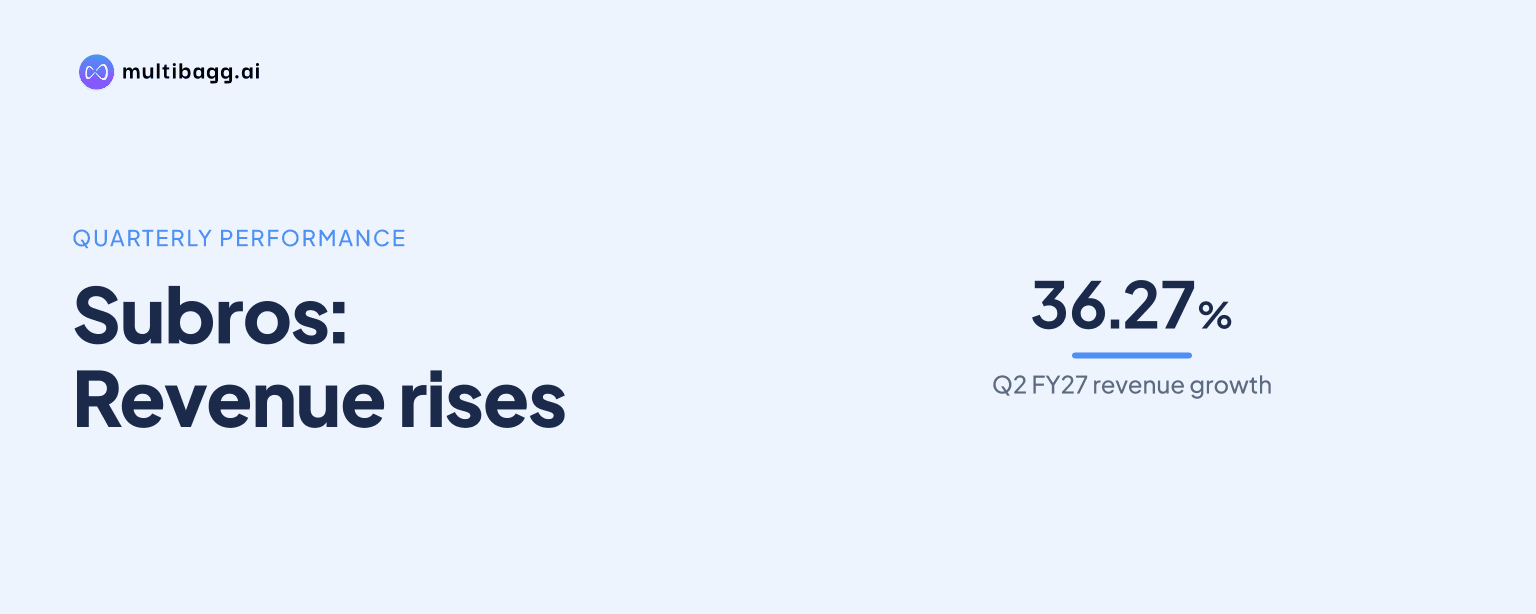
- Q2 2026-27 revenue from operations reached Rs 1,198.90 crore, up 36.27% year on year.
- Q2 2026-27 EBITDA margin was 7.66%, versus 10.04% in Q2 2025-26.
- HY 2026-27 material cost was 75.28% of net sales, versus 72.44% in HY 2025-26.
powered by IRIS
Subros targets a 2027-28 start of production at Karsanpura for localised electric compressors and new FDC compressor capacity, extending its green-mobility product plans after reporting record Q2 2026-27 revenue of Rs 1,198.90 crore. The presentation does not disclose the investment amount, capacity volume, customer allocation or a more specific commissioning date.
Know Subros inside out
Results, valuation, peers and who's buying, in one view.
When will Subros begin electric-compressor localisation at Karsanpura?
Subros has set a target start of production, or SOP, in 2027-28 for the Karsanpura expansion covering electric-compressor localisation and additional FDC compressor capacity. The presentation does not expand the term FDC. Management lists the initiative under business and operations in its way-forward plan, rather than reporting it as capacity already in service during Q2 2026-27.
Subros said in its Q2 2026-27 business highlights that Karsanpura expansion for FDC capacity and electric-compressor expansion was in progress. That wording distinguishes the ongoing Karsanpura work from two new vehicle-model SOPs that had already started in Q2 2026-27. The 2027-28 target therefore concerns the next stage of manufacturing readiness, while the presentation provides no quarterly construction milestone.
The planned localisation specifically applies to electric compressors, while the new capacity is specified for FDC compressors. Subros does not quantify the planned output in units, identify the localisation percentage, or state whether the Karsanpura capacity will replace imports, serve incremental demand, or both. The absence of those metrics means the disclosed plan establishes timing and product direction but not its eventual revenue contribution.
What does Subros plan to make at Karsanpura?
Subros plans to localise electric compressors and add FDC compressor capacity at Karsanpura as part of its stated product expansion in the BEV and SHEV categories named in the presentation. The presentation links this manufacturing plan to green-mobility opportunities that include BEV, SHEV and CNG vehicles, while also identifying commercial vehicles such as buses, rail, trucks and tractors as an expansion area.
Electric-compressor localisation sits alongside a broader operational programme that includes technology upgrades for regulatory changes, foreign-exchange mitigation through hedging and aggressive localisation, and capacity creation through internal efficiency and expansion. These are stated management priorities, not quantified savings forecasts. No capital-expenditure figure, construction cost, equipment supplier, funding source or expected return is disclosed for Karsanpura.
Subros also reported new business awards for future HVAC, compressor and heat-exchanger programmes in Q2 2026-27. These awards provide context for the expansion, but the presentation does not directly allocate any award to Karsanpura or to the electric-compressor line. Investors therefore cannot use the supplied information to link a named customer programme, vehicle platform or order value to the 2027-28 SOP target.
The manufacturing expansion is not confined to Karsanpura. The Q2 2026-27 update also said the Kharkhoda greenfield project was in progress for FDC capacities, alongside the Karsanpura expansion. The presentation does not separate the capacity additions, spending or commissioning dates between Kharkhoda and Karsanpura, so their respective scale and sequencing remain undisclosed.
Got a follow-up? Ask IRIS
How does Subros’s current financial performance frame the expansion?
Subros’s expansion plan follows revenue growth, although profitability ratios declined in the reported periods. Revenue from operations rose 36.27% year on year to Rs 1,198.90 crore in Q2 2026-27, and rose 16.16% from Rs 1,032.11 crore in Q1 2026-27. Management attributed revenue growth to higher volumes, customer provisions for commodity prices, currency movements and minimum wages, and new-model SOPs.
Earnings before interest, tax, depreciation and amortisation, or EBITDA, increased 3.98% year on year to Rs 91.47 crore in Q2 2026-27, below the revenue growth rate. The EBITDA margin fell 2.38 percentage points from 10.04% in Q2 2025-26 to 7.66%. Profit before tax, or PBT, rose 10.04% to Rs 59.95 crore, while profit after tax, or PAT, increased 9.93% to Rs 44.62 crore.
The first-half comparison shows the same pattern. Revenue from operations rose 26.90% to Rs 2,231.01 crore in HY 2026-27 from Rs 1,758.08 crore in HY 2025-26, whereas EBITDA increased 1.58% to Rs 178.46 crore. The EBITDA margin declined from 10.03% to 8.03%, and the PAT margin declined from 4.64% to 3.87%, meaning sales growth did not translate into equivalent margin growth in the reported half year.
Which costs and execution points could affect the Karsanpura plan?
Subros identifies commodity and currency movements, along with product mix, as factors behind higher material costs and margin pressure. Material cost represented 76.57% of net sales in Q2 2026-27, compared with 73.08% a year earlier and 73.79% in Q1 2026-27. The 3.49-percentage-point year-on-year increase occurred even as employee cost declined to 8.48% of net sales from 10.39%.
For HY 2026-27, material cost increased to 75.28% of net sales from 72.44% in HY 2025-26. Management reported a 2.84-percentage-point increase in material cost and said margins remained under pressure from upward commodity and currency movements and product mix. Its responses include productivity, localisation, cost optimisation and operating leverage, which makes the electric-compressor localisation initiative part of a stated operating agenda as well as a product expansion plan.
Other income also changed between periods. It declined to Rs 7.37 crore in Q2 2026-27 from Rs 19.51 crore in Q2 2025-26; incentive income was Rs 64 lakh versus Rs 13.40 crore. In HY 2026-27, other income was Rs 13.56 crore compared with Rs 25.20 crore, with incentive income of Rs 1.28 crore against Rs 13.50 crore in the corresponding half year.
Execution remains the central disclosed uncertainty because Subros gives a 2027-28 SOP target but no project budget, capacity volume or customer-specific volume. The presentation says capacity will be pursued through internal-efficiency optimisation and expansion plans, and it identifies human-skill development and organisation structure as future requirements. Those measures outline management’s approach, but the document does not provide target output, utilisation, localisation savings or a delivery timetable beyond 2027-28.
Conclusion
Subros is positioning Karsanpura for a 2027-28 electric-compressor localisation SOP and new FDC compressor capacity while pursuing BEV, SHEV, CNG and commercial-vehicle opportunities. The plan comes after Rs 1,198.90 crore of Q2 2026-27 revenue and Rs 2,231.01 crore in HY 2026-27 revenue, but with EBITDA margin down to 7.66% in the quarter and 8.03% in the half year.
The next disclosed point to watch is progress toward the 2027-28 Karsanpura SOP, including any later disclosure of capacity, investment, customers or localisation levels. Management’s stated operating focus is on hedging, aggressive localisation, productivity and cost optimisation as material cost reached 76.57% of net sales in Q2 2026-27; the presentation does not state when these measures will produce a measurable margin outcome.