










Sula says it can grow volumes 80-85% without winery capex
Key highlights
- Sula says its 19.2-million-litre cellar capacity can support 80-85% higher volumes without further winery capex.
- Sula added one million litres of cellar capacity before setting out its FY26-FY29 growth strategy.
- Sula reported FY26 net revenue from operations of Rs 556 crore, versus Rs 579 crore in FY25.
- Wine tourism revenue increased to Rs 73 crore in FY26 from Rs 60 crore in FY25.
powered by IRIS
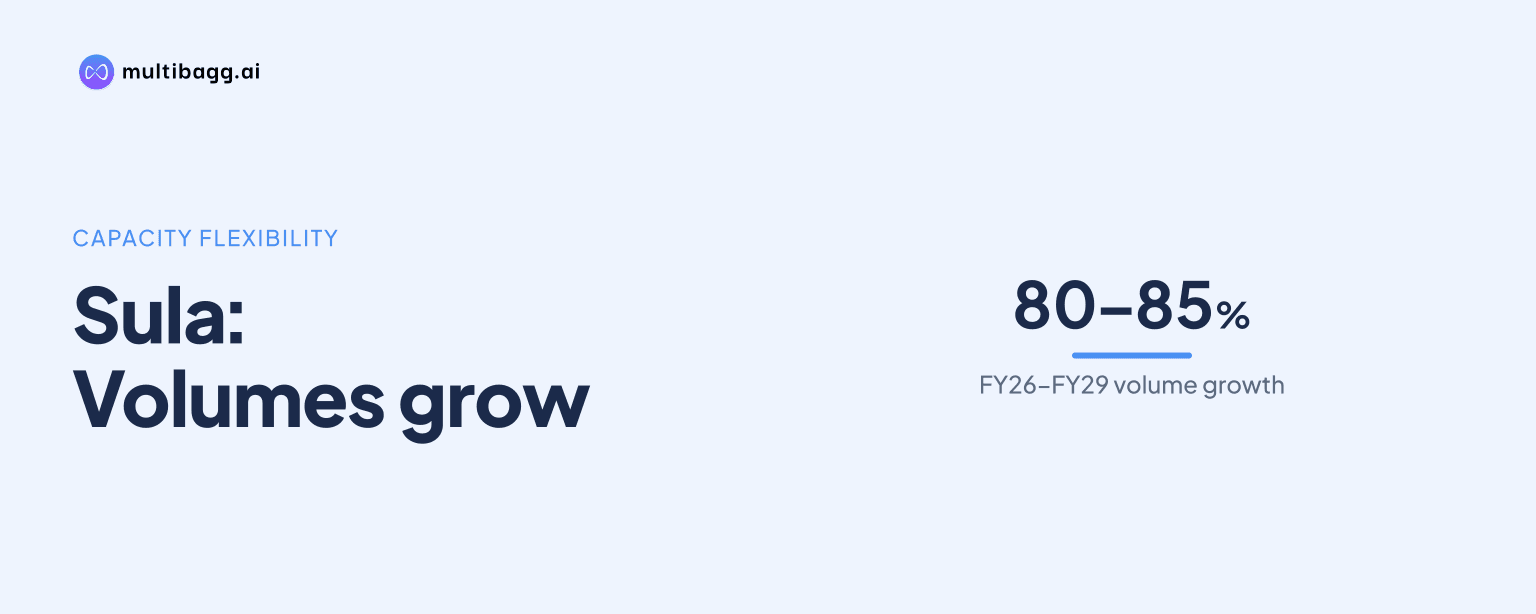
Sula Vineyards says its cellar capacity of 19.2 million litres can support an 80-85% expansion in volumes without further winery capital expenditure, following a one-million-litre addition. Sula has placed this capacity position within a FY26-FY29 plan that also includes new products, wider distribution, wine tourism and direct-to-consumer growth.
Know Sula Vineyards inside out
Results, valuation, peers and who's buying, in one view.
How much can Sula expand wine volumes without capex?
Sula says it can increase volumes by 80-85% without further winery capital expenditure, based on total cellar capacity of 19.2 million litres. The company added one million litres of cellar capacity before outlining its FY26-FY29 growth strategy, which means the stated volume runway is tied to already available winery infrastructure rather than a disclosed new winery-building programme.
The one-million-litre expansion implies capacity stood at 18.2 million litres before the addition, while the company now describes 19.2 million litres as sufficient for growth. Sula does not disclose current production volumes, capacity utilisation, the locations of the added capacity, or a timetable for reaching the potential 80-85% volume increase. The 80-85% figure is therefore a capacity statement, not reported volume guidance for a particular financial year.
What is Sula's FY26-FY29 growth strategy?
Sula's stated FY26-FY29 strategy is to accelerate earnings growth through improved earnings before interest, tax, depreciation and amortisation (EBITDA) margins and capital efficiency. The plan has six parts: product development, use of existing capacity, market penetration, wine tourism and direct-to-consumer (D2C) expansion, wine adoption and visibility initiatives, and strategic mergers and acquisitions.
Product development includes continued launches to address changing consumer demand and the planned near-term launch of wine-based ready-to-drink (RTD) products. Sula has not provided a launch date, planned range, sales target or investment amount for RTDs. Its presentation frames the category as one mechanism to tap new consumer cohorts and occasions during the three financial years from FY26 to FY29.
The operational case for capital efficiency sits alongside a recent decline in reported earnings. Net revenue from operations was Rs 556 crore in FY26, compared with Rs 579 crore in FY25, while operating EBITDA fell to Rs 103 crore from Rs 149 crore. Operating EBITDA margin decreased to 18.5% in FY26 from 25.7% in FY25, making the stated focus on improving margins a disclosed management objective rather than an achieved FY26 outcome.
What distribution initiatives support higher Sula volumes?
Sula plans to broaden the national availability of The Source and Rāsa as part of its market-penetration programme. The presentation specifically calls for a significant expansion of the footprint of these two labels, but it does not disclose their current distribution reach, state count, outlet count, or individual revenue contribution in FY26.
The company also plans to increase sales to Defence through expanded net listings, alongside moves into new markets, consumer cohorts and occasions. Sula does not quantify the number of additional listings or provide a Defence sales target. These distribution actions are intended to complement the 19.2-million-litre cellar base, rather than requiring further winery capital expenditure to support the potential 80-85% volume expansion.
Sula's own brands revenue declined to Rs 511 crore in FY26 from Rs 546 crore in FY25, and elite and premium revenue declined to Rs 401 crore from Rs 421 crore. Over the longer FY21-FY26 period, however, the presentation reports compound annual growth rates of 12% for own brands revenue and 15% for elite and premium revenue. The strategy identifies broader availability for The Source and Rāsa as a route to future penetration, without assigning a revenue target to either label.
Got a follow-up? Ask IRIS
How does wine tourism fit Sula's growth plan?
Sula is pairing winery capacity expansion with a plan to expand wine tourism and D2C business, including new resort projects. The Haven by Sula, a 50-key resort near York, was launched in Q3 FY26. The company states that it is focused on expanding its resort portfolio, though it gives no capital budget or expected revenue contribution for further projects.
Management targets the opening of a fourth hotel, a 35-key property alongside The Haven by Sula, by Q4 FY28. That target creates a dated execution milestone within the broader FY26-FY29 plan. The presentation does not say whether the 35-key property is under construction, identify its expected opening cost, or quantify how it would affect room inventory and wine-tourism revenue.
Wine tourism revenue rose to Rs 73 crore in FY26 from Rs 60 crore in FY25, even as net revenue from operations declined to Rs 556 crore from Rs 579 crore. Across FY21 to FY26, wine tourism revenue increased from Rs 18 crore to Rs 73 crore, for a reported compound annual growth rate of 32%. The resort strategy is therefore linked to a business line that grew in FY26, unlike the group's overall revenue and own-brands revenue.
How does Sula's financial record frame the capacity plan?
Sula's financial record shows revenue and profitability expansion through FY24 followed by lower results in FY25 and FY26. Net revenue from operations rose from Rs 386 crore in FY21 to Rs 568 crore in FY24, before reaching Rs 579 crore in FY25 and falling to Rs 556 crore in FY26. The presentation reports an 8% FY21-FY26 compound annual growth rate for this measure.
Operating EBITDA reached Rs 176 crore in FY24 and then fell to Rs 149 crore in FY25 and Rs 103 crore in FY26. Operating EBITDA margin followed the same direction, peaking at 31.0% in FY24 before declining to 25.7% in FY25 and 18.5% in FY26. Sula's aim of better EBITDA margins by FY29 should be read against that recorded 12.5-percentage-point margin decline from FY24 to FY26.
Profit after tax was Rs 26 crore in FY26, down from Rs 70 crore in FY25 and Rs 93 crore in FY24. Its profit-after-tax margin, calculated by the company as profit after tax divided by net revenue plus other income, was 4.6% in FY26 versus 12.0% in FY25 and 16.2% in FY24. Existing winery capacity may limit the need for additional winery spending as volumes grow, but the presentation does not quantify the margin impact of that capacity advantage.
Conclusion
Sula's central disclosed growth proposition is that its 19.2-million-litre cellar network can accommodate 80-85% more volume without further winery capital expenditure. The company is seeking to use that runway alongside wine-based RTDs, wider availability for The Source and Rāsa, expanded Defence listings, and a larger wine-tourism and D2C presence. FY26 results, including Rs 556 crore of net revenue and Rs 103 crore of operating EBITDA, provide the recent baseline for that plan.
The next disclosed milestones are the planned launch of wine-based RTDs and the target to open a 35-key fourth hotel by Q4 FY28 beside The Haven by Sula. The presentation provides no annual targets for The Source and Rāsa distribution, Defence listings, volume growth or EBITDA margins through FY29, leaving progress on those measures unresolved.