










Sula Q2 profit rises 34% to Rs 8.09 crore as revenue grows
Key highlights
- Sula reported consolidated Q2 net profit of Rs 8.09 crore, up 34% from Rs 6.02 crore a year earlier.
- Sula’s Q2 revenue from operations increased 4% to Rs 145.44 crore from Rs 139.66 crore.
- Sula generated Rs 4.90 crore of net operating cash flow in the six months ended 30 September 2026.
- Sula’s current borrowings were Rs 261.40 crore at 30 September 2026, versus Rs 237.44 crore at 31 March 2026.
powered by IRIS
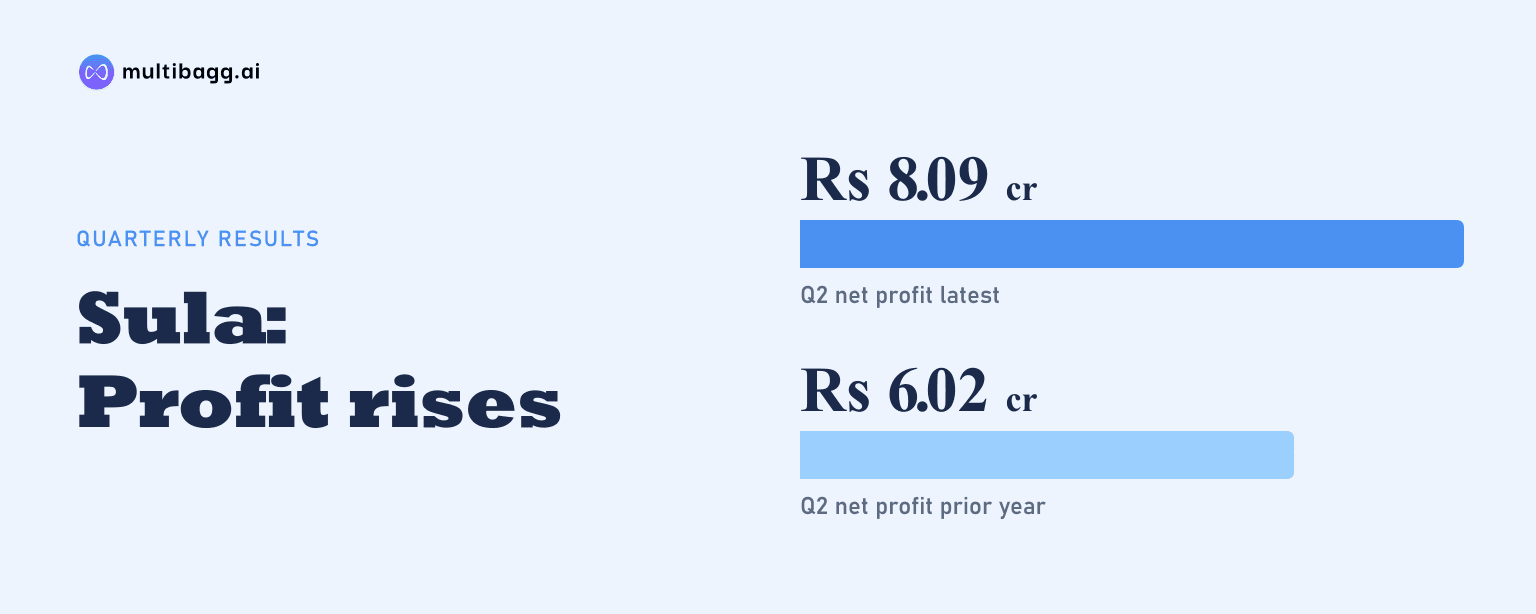
Sula Vineyards Limited reported consolidated net profit of Rs 8.09 crore for the quarter ended 30 September 2026, up 34% from Rs 6.02 crore a year earlier, while revenue from operations rose 4% to Rs 145.44 crore. Sula’s profit before tax increased to Rs 10.92 crore from Rs 8.27 crore.
Know Sula Vineyards inside out
Results, valuation, peers and who's buying, in one view.
How did Sula perform in the September 2026 quarter?
Sula increased consolidated revenue from operations by Rs 5.78 crore year on year to Rs 145.44 crore in the quarter ended 30 September 2026. Total income rose to Rs 146.39 crore from Rs 140.49 crore, including other income of Rs 0.95 crore versus Rs 0.83 crore. Net profit increased by Rs 2.07 crore to Rs 8.09 crore, while basic earnings per share rose to Rs 0.95 from Rs 0.71.
Sula’s September-quarter result was also higher than its June 2026 quarter, when revenue from operations was Rs 120.79 crore and net profit was Rs 1.06 crore. Profit before tax rose from Rs 1.52 crore in June to Rs 10.92 crore in September. Sula says its wines and spirits business is seasonal, so revenue, costs and profits do not accrue evenly over the year and quarterly results may not be strictly comparable.
What changed in Sula’s costs and profitability?
Sula’s total expenses rose by Rs 4.25 crore to Rs 136.47 crore in the September 2026 quarter, below the Rs 5.90 crore increase in total income. Employee benefits expense fell to Rs 21.75 crore from Rs 23.16 crore, and finance costs declined to Rs 7.16 crore from Rs 8.55 crore. Depreciation and amortisation expense increased slightly to Rs 10.38 crore from Rs 10.28 crore.
Selling, distribution and marketing expense decreased to Rs 14.92 crore from Rs 16.63 crore in the comparable quarter. However, cost of materials consumed increased to Rs 11.88 crore from Rs 10.97 crore, purchases of stock-in-trade rose to Rs 13.73 crore from Rs 9.26 crore, and excise duty on sales increased to Rs 9.91 crore from Rs 8.75 crore. The lower employee, finance and marketing costs accompanied the rise in quarterly profit before tax to Rs 10.92 crore.
What do Sula’s first-half results show?
Sula reported consolidated revenue from operations of Rs 266.23 crore for the six months ended 30 September 2026, compared with Rs 257.95 crore in the corresponding prior-year period. Net profit rose to Rs 9.15 crore from Rs 7.96 crore, while profit before tax increased to Rs 12.44 crore from Rs 10.83 crore. Six-month basic earnings per share were Rs 1.08, compared with Rs 0.94, and were not annualised.
The half-year figures included Rs 3.33 crore of other income, compared with Rs 1.81 crore a year earlier. During the quarter ended 30 June 2026, Sula sold its Mumbai office property for consideration of Rs 27.00 crore and recognised profit of Rs 1.79 crore in other income. The sale therefore affected the six-month comparison, rather than representing September-quarter revenue from operations.
Sula is engaged in the manufacture, purchase and sale of alcoholic beverages, comprising wines and spirits. Management monitors the group as a whole, and the filing reports no separate operating segments under Indian Accounting Standard 108, Operating Segments. The consolidated accounts cover Sula and its subsidiaries, Artisan Spirits Private Limited and N D Wines Private Limited.
Got a follow-up? Ask IRIS
How did Sula’s cash flow and working capital move?
Sula generated net cash from operating activities of Rs 4.90 crore in the six months ended 30 September 2026, compared with Rs 4.11 crore in the prior-year half. Cash generated from operations was Rs 9.60 crore after working-capital movements, and direct taxes paid, net of refunds, were Rs 4.70 crore. Operating profit before working-capital changes was Rs 44.74 crore, marginally above Rs 44.16 crore a year earlier.
A Rs 38.98 crore decrease in inventories supported operating cash flow, but was partly offset by a Rs 22.14 crore increase in trade receivables and a Rs 47.00 crore decrease in trade payables, other liabilities and provisions. Financial assets and other assets increased by Rs 4.98 crore. Inventories at 30 September stood at Rs 161.28 crore, down from Rs 200.91 crore at 31 March, while trade receivables rose to Rs 259.00 crore from Rs 237.19 crore.
Investing activities generated Rs 9.94 crore, compared with an outflow of Rs 21.94 crore in the previous first half. Sula received Rs 27.06 crore from the sale of property, plant and equipment and other intangible assets, while spending Rs 17.89 crore on property, plant, capital work-in-progress and intangible assets. The disposal-proceeds line is higher than the Rs 27.00 crore Mumbai office sale consideration disclosed in the notes.
What does Sula’s September balance sheet show?
Sula’s total assets were Rs 1,057.77 crore at 30 September 2026, compared with Rs 1,095.52 crore at 31 March 2026. Property, plant and equipment declined to Rs 452.08 crore from Rs 471.26 crore, while total current assets decreased to Rs 528.83 crore from Rs 546.90 crore. Cash and cash equivalents fell to Rs 2.90 crore from Rs 7.19 crore over the six months.
Total equity was Rs 581.06 crore at 30 September, down from Rs 587.40 crore at 31 March. Non-current borrowings decreased to Rs 47.49 crore from Rs 56.63 crore, whereas current borrowings rose to Rs 261.40 crore from Rs 237.44 crore. Current liabilities fell to Rs 360.71 crore from Rs 383.78 crore, including a reduction in dues to creditors other than micro and small enterprises to Rs 39.30 crore from Rs 82.74 crore.
Financing activities used Rs 19.13 crore in the first half, compared with generating Rs 24.51 crore a year earlier. Sula repaid Rs 56.65 crore of long-term borrowings and raised Rs 30.93 crore of long-term borrowings. It also reported Rs 33.80 crore of net proceeds from working-capital demand loans, while dividend payments were Rs 16.87 crore.
Conclusion
Sula’s September-quarter profit grew faster than revenue, with net profit increasing 34% to Rs 8.09 crore while total income rose by Rs 5.90 crore and total expenses increased by Rs 4.25 crore. The first-half accounts also show inventory reduction of Rs 38.98 crore, a Rs 22.14 crore increase in receivables and net operating cash generation of Rs 4.90 crore.
The next factor to watch is how Sula’s disclosed seasonal business pattern affects subsequent quarterly comparisons. The balance sheet ended September with current borrowings of Rs 261.40 crore and cash and cash equivalents of Rs 2.90 crore, while the first-half cash flow recorded Rs 33.80 crore of net proceeds from working-capital demand loans.