










Sula Elite & Premium portfolio reaches 82% in Q2 FY27
Key highlights
- Sula's Elite & Premium portfolio reached 82% of Q2 FY27 own-brand sales, up 420 basis points year on year.
- Elite & Premium revenue rose 9.0% to Rs 105.4 crore in Q2 FY27.
- Economy & Popular revenue declined 16.4% to Rs 23.0 crore in Q2 FY27.
- Wine tourism revenue increased 23.7% to Rs 16.3 crore in Q2 FY27.
powered by IRIS
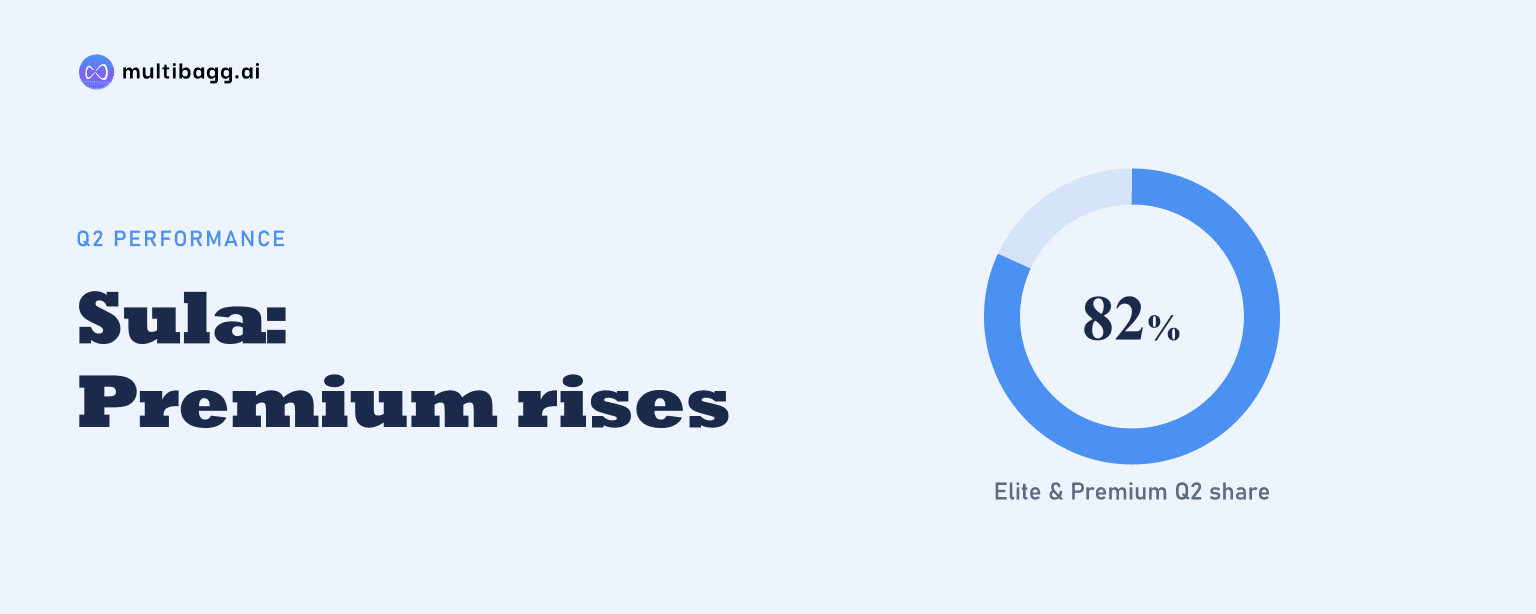
Sula Vineyards Limited said its Elite & Premium portfolio accounted for 82% of own-brand sales in Q2 FY27, up 420 basis points year on year, after portfolio revenue rose 9.0% to Rs 105.4 crore while Economy & Popular revenue fell 16.4% to Rs 23.0 crore.
Know Sula Vineyards inside out
Results, valuation, peers and who's buying, in one view.
What drove Sula's higher Elite & Premium mix in Q2 FY27?
Sula's Elite & Premium mix increased because revenue from that portfolio grew faster than the wider own-brand business in Q2 FY27. The portfolio generated Rs 105.4 crore, a 9.0% year-on-year increase, compared with own-brand revenue of Rs 128.3 crore, up 3.4%. Management attributed Elite & Premium growth to strong double-digit growth in The Source, Sula sparkling wines and Sula Merlot.
The shift was also shaped by a decline in the lower-priced portfolio. Economy & Popular revenue was Rs 23.0 crore in Q2 FY27, down 16.4% year on year. Elite & Premium's share of the own-brand portfolio consequently rose to 82% from 78% in Q2 FY26, while Economy & Popular's share fell to 18% from 22%.
Sula reported net revenue from operations of Rs 135.5 crore for Q2 FY27, up 3.5% year on year, and operating earnings before interest, tax, depreciation and amortisation, or EBITDA, of Rs 27.5 crore, up 8.1%. The higher Elite & Premium mix was accompanied by operating EBITDA growth that exceeded net revenue growth, although the presentation does not quantify the profit contribution of either wine portfolio.
How did Sula's portfolio mix change over the first half?
Sula's premiumization trend continued in H1 FY27, although the mix movement was smaller than in Q2. Elite & Premium revenue rose 7.8% year on year to Rs 186.6 crore, while Economy & Popular revenue declined 13.5% to Rs 46.1 crore. Elite & Premium therefore represented 80% of own-brand sales in H1 FY27, compared with 76% in H1 FY26.
The four-percentage-point H1 movement took Economy & Popular to 20% of the portfolio from 24% a year earlier. The Q2 mix of 82% Elite & Premium and 18% Economy & Popular was more weighted to Elite & Premium than the H1 mix of 80% and 20%, respectively. That comparison shows the second quarter extended the first-half direction.
The H1 revenue split also shows the same divergence across a longer reporting period: Elite & Premium generated Rs 186.6 crore and Economy & Popular generated Rs 46.1 crore. In Q2, the corresponding figures were Rs 105.4 crore and Rs 23.0 crore. Sula did not disclose unit volumes, price realisation or brand-level sales figures for either portfolio.
The revenue split indicates that the mix gain reflected both higher Elite & Premium revenue and lower Economy & Popular revenue. Sula did not give a reason for the 16.4% Q2 decline in Economy & Popular. The disclosure therefore establishes the portfolio outcome but not whether volumes, pricing, distribution or demand was the principal factor in that segment.
Got a follow-up? Ask IRIS
How did premiumization relate to Sula's Q2 FY27 profitability?
Sula said healthy Elite & Premium growth and strategic cost actions helped operating EBITDA rise 7.9% year on year to Rs 27.5 crore in Q2 FY27. Operating EBITDA margin increased 85 basis points to 20.3% from 19.4%, calculated on net revenue. Profit before tax rose 32% to Rs 10.9 crore and profit after tax rose 34% to Rs 8.1 crore.
Gross profit nevertheless declined 0.6% to Rs 89.7 crore, while gross margin fell 278 basis points to 66.2% from 69.0%. Cost of goods sold rose 13% to Rs 45.8 crore, faster than the 4% increase in revenue from operations to Rs 145.4 crore. Management said higher blended grape cost primarily affected gross margins in H1 FY27.
The revenue bridge included Rs 128.3 crore from own brands, Rs 16.3 crore from wine tourism and Rs 0.8 crore from other activities, including BIO, before Rs 9.9 crore of excise duty. Finance costs fell 16% to Rs 7.2 crore from Rs 8.6 crore, while employee cost fell 6% to Rs 21.8 crore and other expenses fell 3% to Rs 40.5 crore. Sula does not separately disclose gross or EBITDA margins for Elite & Premium and Economy & Popular.
What other Q2 FY27 businesses and plans matter for Sula?
Sula's wine tourism revenue grew faster than own brands, rising 23.7% year on year to Rs 16.3 crore in Q2 FY27. Wine tourism, including wine sales, contributed 19.1% of total revenue, up 220 basis points year on year. The business recorded more than 97,800 visitors, up 7%, and day-visitor spend per guest of Rs 1,765, up 4%.
Room revenue increased 32% year on year, helping wine tourism growth, while average room rate, or ARR, rose 3% to Rs 10,014. Room occupancy was 66%, down from 76% in the prior year. Sula said the decline primarily reflected a 50% increase in rooms; excluding The Haven, launched in October 2026, occupancy was 73% in Q2 FY27.
Sula opened The Vintage Room, a 5,000-square-foot indoor banquet facility at its Nashik campus with capacity for 300 people, and said it had already hosted its first event. Management also said it would launch wine-based ready-to-drink, or RTD, products in Q3 FY27. These are disclosed initiatives rather than revenue forecasts.
Conclusion
The Q2 FY27 disclosures combine a shift toward Elite & Premium wines with mixed cost outcomes. Operating EBITDA margin increased 85 basis points to 20.3% and profit after tax rose 34% to Rs 8.1 crore, while gross margin declined 278 basis points to 66.2% as cost of goods sold rose 13%.
The next disclosed milestones are the planned Q3 FY27 launch of wine-based RTD products and management's expectation that blended grape-cost pressure will subside from Q4 FY27 and normalise from Q1 FY28 as the wine and table-grape mix rebalances in Harvest 2027. Sula also plans to begin construction of a 35-key fourth hotel near The Haven, expected to open in Q4 FY28.