










Sula Plans 20% Nashik Room Capacity Increase by Q4 FY28
Key highlights
- Sula expects a 35-key fourth Nashik hotel to lift room capacity 20% to 185 keys in Q4 FY28.
- Sula's 5,000-square-foot Vintage Room can host 300 people and has already held its first event.
- Sula welcomed more than 4 lakh visitors in FY26, including resorts, and its flagship tasting room received more than 3 lakh visitors.
- Sula's wine-tourism revenue increased to Rs 73 crore in FY26 from Rs 60 crore in FY25.
powered by IRIS
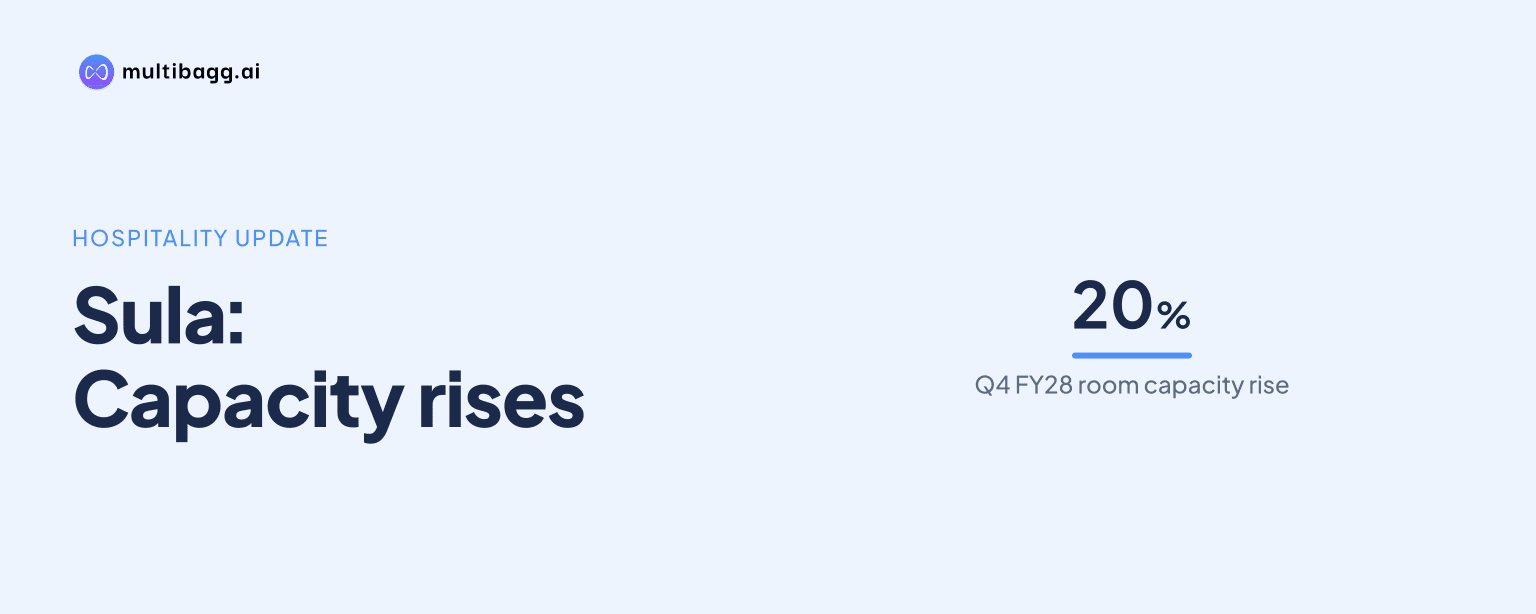
Sula Vineyards expects its 35-key fourth Nashik hotel to open in Q4 FY28, lifting room capacity 20% to 185 keys, after opening The Vintage Room, a 5,000-square-foot indoor banquet venue for 300 people. The plan follows FY26 wine-tourism revenue of Rs 73 crore, up from Rs 60 crore in FY25.
Know Sula Vineyards inside out
Results, valuation, peers and who's buying, in one view.
What has Sula opened at its Nashik campus?
Sula has opened The Vintage Room, a 5,000-square-foot indoor banquet facility at its Nashik campus that can host 300 people and has already held its first event. The venue adds a dedicated indoor events format to a Nashik tourism offering that already includes tastings, tours, bottle shops, gourmet dining and accommodation.
The Pavilion sits alongside three luxury resorts in Nashik: The Source, Beyond and The Haven BY SULA. Those resorts have more than 150 keys and reported average occupancy of 77% in FY26, while their average room rate, or ARR, was above Rs 10,000. The presentation does not disclose a separate investment amount, booking pipeline, pricing schedule or revenue target for The Vintage Room.
The venue's 300-person capacity and 5,000-square-foot area refer to event attendance and indoor space, rather than hotel inventory. By contrast, the three Nashik resorts supply overnight accommodation, and the planned fourth hotel will add 35 keys. Sula describes The Vintage Room as open rather than as a proposed project.
How will Sula increase Nashik hotel capacity?
Sula plans to commence construction of a 35-key fourth hotel alongside The Haven and close to its flagship Nashik campus, with opening expected in Q4 FY28. Management says the project will raise Nashik room capacity by 20% to 185 keys from the present base of more than 150 keys across its three resorts.
The disclosed location confines the hotel plan to Nashik. Sula also operates visitor facilities at York Winery and Domaine Sula in Karnataka, but the presentation gives no hotel construction timetable for either site. York records more than 21,000 visitors annually, while Domaine Sula records more than 26,000 visitors annually.
The Q4 FY28 date is an expectation rather than a completed milestone. Sula has provided the planned opening quarter, 35-key size and location beside The Haven, but it has not disclosed construction cost, funding source, opening phases, projected occupancy or projected ARR for the new hotel.
Got a follow-up? Ask IRIS
How large is Sula's wine-tourism business?
Sula welcomed more than 4 lakh visitors in FY26 across its wine-tourism business, including resorts, and its flagship tasting room and bottle shop near The Source received more than 3 lakh visitors. The company describes its vineyards as among the most visited globally, although the presentation does not give a comparable visitor total for earlier fiscal years.
The visitor network spans the flagship Nashik facility, York Winery and Domaine Sula in Karnataka. The Source, Beyond and The Haven offer luxury accommodation alongside tasting and tour experiences and gourmet dining, while York and Domaine Sula are presented as tasting, dining and vineyard-visit locations. Sula does not provide separate FY26 visitor counts for each of the three Nashik resorts.
Wine-tourism revenue rose from Rs 18 crore in FY21 to Rs 73 crore in FY26, a gain of Rs 55 crore over five fiscal years. Sula reports a compound annual growth rate, or CAGR, of 32% for this revenue line over that period, compared with an 8% CAGR for net revenue from operations.
The latest-year comparison shows tourism expanding while the broader revenue measures declined. Wine-tourism revenue increased by Rs 13 crore from Rs 60 crore in FY25 to Rs 73 crore in FY26, whereas net revenue from operations fell by Rs 23 crore to Rs 556 crore and own brands revenue fell by Rs 35 crore to Rs 511 crore. The source does not split wine-tourism revenue between rooms, food, events, tastings, tours or bottle-shop sales.
How does Sula link tourism to direct wine sales?
Sula says wine tourism provides a retail platform for its direct-to-consumer, or D2C, wine business, and D2C wine sales increased 7% year on year in both Q2 FY27 and H1 FY27. Management states that expanding wine tourism supports expansion of this D2C channel.
The stated mechanism is on-site visitor access to tasting and tour facilities, bottle shops and gourmet dining. The flagship tasting room and bottle shop near The Source received more than 3 lakh visitors in FY26, creating a direct retail touchpoint. Sula does not disclose the proportion of visitors who buy wine, the D2C sales value, or the channel's share of total wine sales.
Tourism operates alongside a wider distribution platform rather than replacing it. Sula has domestic presence in 23 states and seven Union Territories, around 25,000 points of sale and exports to 29 countries. Its portfolio comprises more than 60 labels across 14 brands, but the presentation does not identify which labels are sold at each tourism site or at The Vintage Room.
Conclusion
Sula is adding two Nashik tourism assets with separate roles: The Vintage Room provides a 300-person indoor events facility that is already operating, while the planned 35-key hotel is intended to take room capacity to 185 keys. The expansion follows FY26 indicators of more than 4 lakh visitors, 77% average resort occupancy, ARR above Rs 10,000 and Rs 73 crore of wine-tourism revenue.
The next disclosed milestone is the start of construction for the fourth hotel and its expected Q4 FY28 opening. Investors can also watch whether Sula maintains D2C wine-sales growth after the 7% year-on-year increases reported in Q2 FY27 and H1 FY27, and whether management subsequently provides costs, bookings or revenue details for the venue and hotel.