










Sutlej links turnaround plan to ageing assets and costs
Key highlights
- Sutlej reported more than Rs 100 crore of first-half EBITDA, compared with Rs 85 crore for last year.
- Sutlej said power cost fell from about 12% to 12.5% last year to 9.9%.
- Sutlej estimates modernization could lower manpower cost by about 1.5 to 2 percentage points.
- Sutlej targets about Rs 250 crore of home-textile turnover in the current year.
powered by IRIS
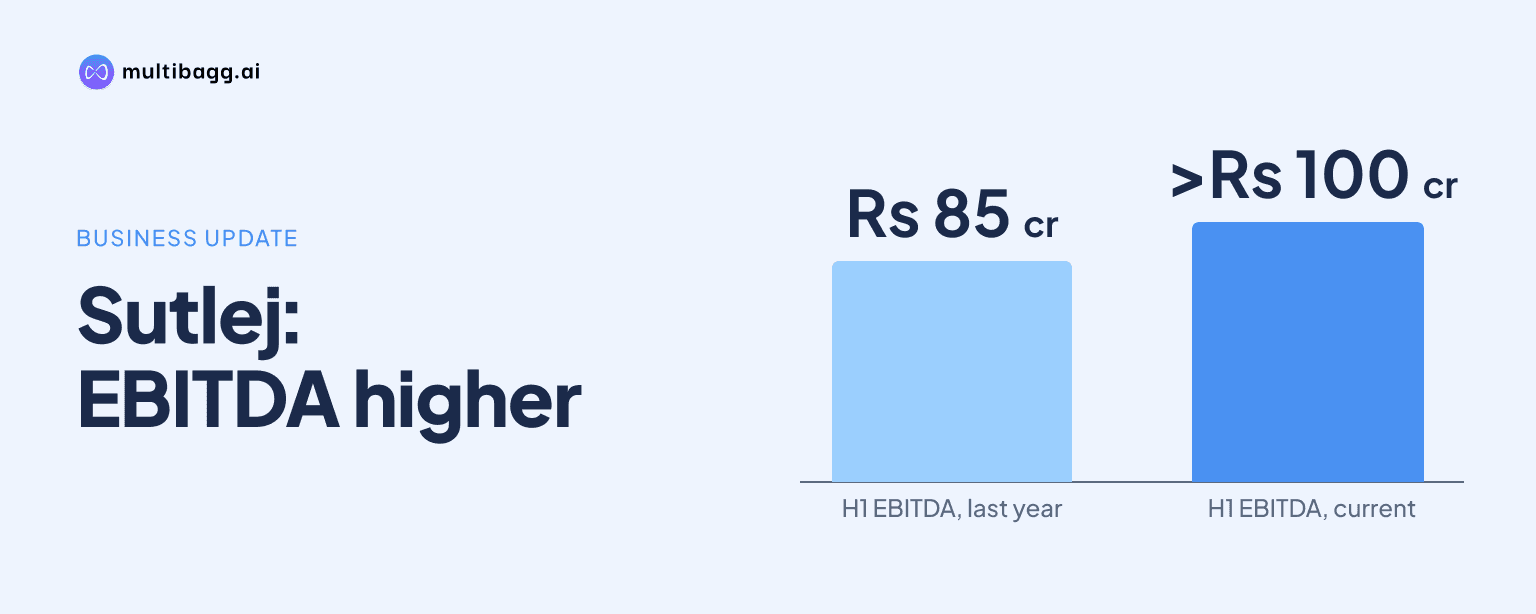
Sutlej Textiles and Industries Limited said on its November 13, 2026 earnings call that ageing spinning assets, higher labour and power costs, and a changing yarn market had reduced competitiveness, while first-half EBITDA exceeded Rs 100 crore versus Rs 85 crore for last year as its phased response began to show results.
Know Sutlej Textiles and Industries inside out
Results, valuation, peers and who's buying, in one view.
Why did Sutlej underperform textile peers?
Sutlej said its underperformance reflected a combination of older equipment, elevated employee and energy costs, and changes in the yarn market rather than a single operational failure. Management said Sutlej operates more than 400,000 spindles and had historically centred its business on yarn, but the pace of infrastructure upgrades did not keep up with newer technology and changing market requirements over the past four to five years.
The product-market change was material because filament yarn gained ground against spun yarn, affecting Sutlej’s cost competitiveness in its traditional segment. Management said some spindles and unit infrastructure were old, and that machine condition affects productivity, yield and the labour required to run operations. Sutlej said it had continued upgrading infrastructure, but acknowledged that the upgrades had not moved at the speed required by the market.
Management said raw-material costs were not the primary issue. Sutlej described its cost of materials consumed as reasonably competitive relative to other yarn producers, while identifying other controllable expenses as the larger concern. Those expenses included labour and power, alongside the need to broaden the portfolio from commodity yarn toward value-added products that can build longer customer relationships.
How much can modernization lower Sutlej’s labour costs?
Sutlej is targeting a phased reduction of about 1.5 to 2 percentage points in manpower cost through modernization, based on management’s comparison with spinning and grey-spinning peers. Management said comparable companies’ manpower costs range from about 9% to 12.5%, while an analyst on the call cited Sutlej’s employee-cost ratio as having declined from 18% to 18.5% to 14% in the company presentation.
Sutlej said it employed about 15,500 people across the business, but that headcount was declining deliberately. Management said absolute labour cost was static or falling despite annual wage increases, indicating that the reduction was being managed through operating changes rather than a disclosed one-time programme. It did not provide a final employee-cost target or a timetable for achieving the 1.5 to 2 percentage-point improvement.
The labour programme is linked directly to asset replacement. Sutlej said it has a phased plan for replacing spindles that can improve competitiveness on both manpower and power costs. Management also said value-added products, or VAP, may not initially lift margins, but could improve customer stickiness and economics once scale is reached, distinguishing the portfolio effort from the separate automation and equipment programme.
What is Sutlej doing to reduce power costs?
Sutlej said power cost declined from about 12% to 12.5% last year to 9.9%, and management expects a further reduction. The company said it had not adopted renewable energy to the same extent as some competitors, making renewable investment one of the identified actions to address a cost category that management considers controllable.
Management distinguished renewable projects from the broader modernization plan by describing renewables as a quicker-return priority. Spinning-asset renewal requires more careful capital allocation because production must continue while changes are made. Sutlej said it remains conscious of working capital and leverage, and did not disclose either a total renewable-energy investment or a company-wide power-cost target.
Freight and input-price volatility also affected the recent margin environment. Management said EBITDA margin remained flat in the quarter despite sharply higher freight costs and volatile raw-material prices, noting a lag in passing the full raw-material increase to customers. Sutlej said a more stable raw-material outlook and lower freight costs could have supported a better result, but did not give margin guidance for the next six months.
Got a follow-up? Ask IRIS
Which spinning assets is Sutlej modernizing first?
Sutlej is modernizing its fibre-dyeing unit and its dye house, while considering selective spinning-asset replacement where management sees quicker returns. Management gave a specific illustration for the dye-house project: a current operation employing about 10 people could require only two people after modernization. That mechanism links the investment to lower labour intensity rather than relying only on general headcount reduction.
The company said machine upgrades alone would not resolve its competitiveness issue. Sutlej is assessing where to allocate capital across the textile value chain, including fibre, technical textiles and home textiles, so that it does not reproduce the same problem in five years. Management described this as portfolio rebalancing, with spinning modernization proceeding alongside downstream expansion rather than as a stand-alone overhaul.
Sutlej has not disclosed the number of old spindles it will retire, a full modernization budget, or a deadline for completing spinning renewal. Management said priorities are being addressed quarter by quarter while operations continue, likening the process to repairing a running business. The disclosed focus remains on projects that can lower manpower or power use and on segments where Sutlej expects greater value addition.
Can downstream businesses change Sutlej’s earnings mix?
Sutlej is directing more capital toward fabric, home textiles and eventually technical textiles because management expects downstream value addition to produce higher realization and contribution than yarn alone. In home textiles, management said meterage grew by about 30% year on year, with a mix shift toward designed and value-added fabrics, including jacquards, rather than basic fabric alone.
Management is targeting home-textile turnover of about Rs 250 crore in the current year, against a gross block of about Rs 110 crore in that business. Sutlej said it had orders covering almost five months in home textiles and intends to pursue reasonable year-on-year growth rather than accelerate at the expense of its design position. Its focus includes drapery and tapestry rather than the basic bedding and sheeting categories described by management.
Sutlej is also pursuing an asset-light polyester-viscose fabric export model. It uses its own yarn, designs the fabric, works with external weaving and processing partners, and exports the finished material. Management said the approach supports access to markets including Africa and the Middle East without requiring major investment in additional weaving infrastructure, while allowing Sutlej to move further up the value chain.
Technical textiles remain a later-stage component of the plan. Sutlej said four products were approved and market-ready, while related equipment was expected to be settled by the end of Q4. Management said commercial contribution is expected from FY28, adding that customers were ready to accept the approved fabrics once equipment was installed and supply could begin.
Conclusion
Sutlej’s explanation for its earlier gap with peers combines operational and strategic factors: old spinning assets reduced productivity, labour and power costs remained elevated, and filament yarn altered the economics of its traditional spun-yarn market. First-half EBITDA of more than Rs 100 crore, compared with Rs 85 crore for last year, indicates improvement, but management still describes the overhaul as phased and incomplete.
The next disclosed markers are dye-house modernization, selective spinning-asset replacement, further renewable investment and the settlement of technical-textile equipment by the end of Q4. Management’s current-year target of about Rs 250 crore in home-textile turnover and its plan for technical-textile contributions from FY28 will show whether portfolio rebalancing is progressing alongside the spinning-cost programme.