










Sutlej returns to profit as Q2 EBITDA more than triples
Key highlights
- Sutlej reported Q2 FY27 EBITDA of Rs 53.4 crore, compared with Rs 17 crore in Q2 FY26.
- Sutlej reported Q2 FY27 profit after tax of Rs 6.7 crore, compared with a Rs 18 crore loss a year earlier.
- Sutlej recorded H1 FY27 profit after tax of Rs 9.5 crore, versus a Rs 44.1 crore loss in the corresponding previous-year half.
- Sutlej reported a 6.4% Q2 FY27 EBITDA margin and an approximate debt-equity ratio of 1.1 times.
powered by IRIS
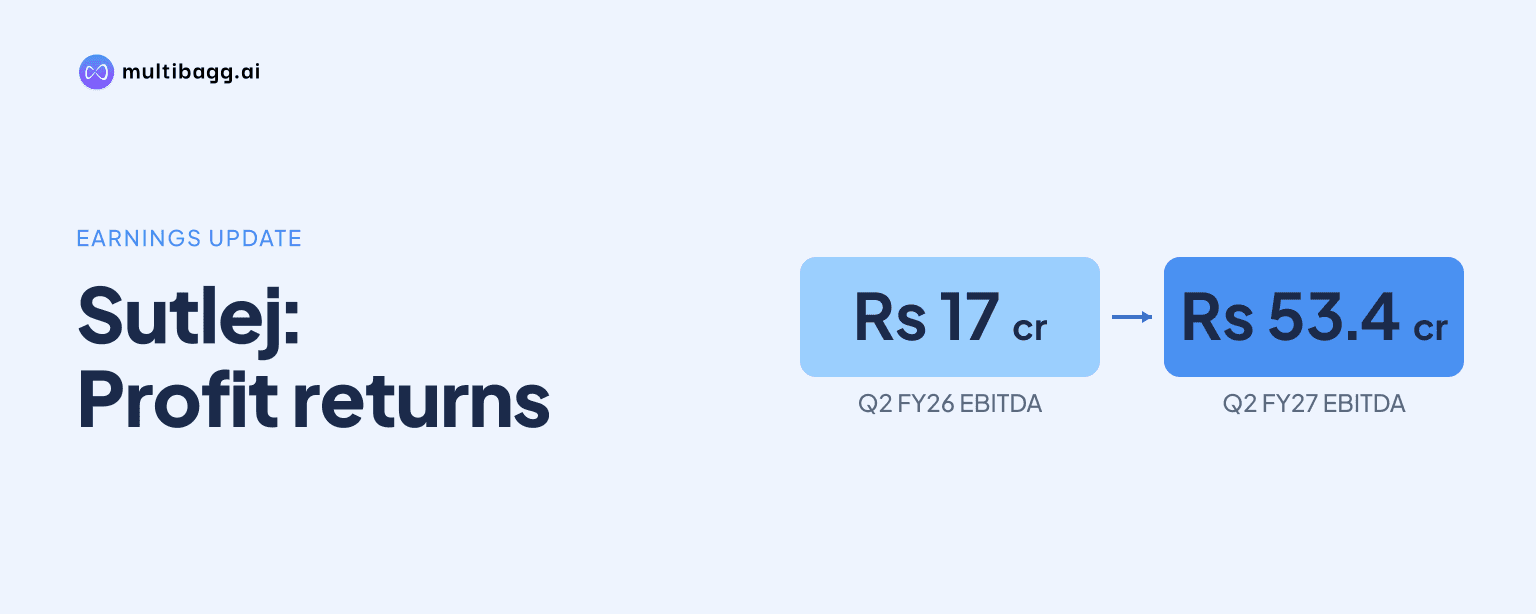
Sutlej Textiles and Industries Limited returned to profit in Q2 FY27, reporting EBITDA (earnings before interest, tax, depreciation and amortisation) of Rs 53.4 crore, versus Rs 17 crore a year earlier, and profit after tax of Rs 6.7 crore against a Rs 18 crore loss. Stand-alone income reached Rs 833 crore.
Know Sutlej Textiles and Industries inside out
Results, valuation, peers and who's buying, in one view.
How did Sutlej's Q2 FY27 earnings change?
Sutlej's Q2 FY27 earnings moved from a loss to a profit as EBITDA rose to Rs 53.4 crore from Rs 17 crore in Q2 FY26. Stand-alone income for the quarter ended September 30, 2026, increased by Rs 191 crore to Rs 833 crore from Rs 642 crore a year earlier, while the EBITDA margin was 6.4%.
Profit after tax was Rs 6.7 crore in Q2 FY27, compared with a Rs 18 crore loss in Q2 FY26, a Rs 24.7 crore swing between the periods. Management said all three business verticals remained EBITDA-positive, indicating that the improvement extended across its operations rather than being limited to one vertical.
Management attributed the Q2 improvement to product-portfolio rationalisation, operational efficiencies and a sharper focus on profitable business. It characterised these as structural initiatives undertaken over several quarters, alongside efforts to optimise the cost structure and strengthen the product portfolio.
What does Sutlej's first-half performance show?
Sutlej also returned to profit in H1 FY27, with EBITDA of Rs 101 crore and profit after tax of Rs 9.5 crore. Total income was Rs 1,537 crore in the first half, and the EBITDA margin was 6.5%, compared with the 6.4% margin reported in Q2 FY27.
The H1 FY27 profit of Rs 9.5 crore compared with a Rs 44.1 crore loss in the corresponding previous-year half, an improvement of Rs 53.6 crore. The six-month outcome covers two quarters and supports the Q2 result, in which Sutlej recorded profit after tax of Rs 6.7 crore.
Management linked the first-half improvement to operating discipline, cost-structure optimisation and product-portfolio strengthening. It said profitability was becoming increasingly broad-based, with all three business verticals EBITDA-positive during the period ended September 30, 2026.
Got a follow-up? Ask IRIS
What supported Sutlej's profitability despite higher costs?
Sutlej reported a 6.4% Q2 FY27 EBITDA margin despite firm cotton prices and changing conditions for polyester and other synthetic fibres. Management said synthetic-fibre costs continued to be influenced by developments in global crude-oil and petrochemical markets, while Q2 EBITDA reached Rs 53.4 crore.
Management said freight costs were exceptionally higher during the quarter and that there is a lag in passing raw-material price changes through to the market. It told an analyst that margins remained flat despite those pressures, adding that a more stable raw-material outlook and lower freight costs could have supported a better outcome.
The company cited product-portfolio rationalisation, operating efficiencies and focus on profitable business as the mechanisms behind the increase in EBITDA from Rs 17 crore to Rs 53.4 crore. Its yarn strategy includes moving toward differentiated and value-added products, including dyed and melange yarns and cotton- and polyester-based products, to reduce dependence on commoditised products.
How is Sutlej managing working capital and leverage?
Sutlej said working capital increased because of higher material prices and inventory requirements, although it remained within management's envisaged range. Management did not disclose a working-capital amount or a preceding-period comparison during the call covering the quarter and half year ended September 30, 2026.
The debt-equity ratio was approximately 1.1 times, which management said was within its internal threshold. Sutlej said it would finance growth and modernisation through a prudent mix of internal accruals and existing financing arrangements while seeking to improve cash generation and manage working capital efficiently.
Management said capital allocation would be directed toward spinning-capacity modernisation and higher-value segments, with emphasis on productivity. In the yarn business, it said it is modernising the fibre-dye unit and has a phased approach to replacing spindles to improve manpower and power costs.
Conclusion
Sutlej's Q2 FY27 figures show that its operating recovery reached reported profitability: EBITDA more than tripled to Rs 53.4 crore from Rs 17 crore, while profit after tax turned to Rs 6.7 crore from a Rs 18 crore loss. The H1 result, with a Rs 9.5 crore profit after a Rs 44.1 crore loss, adds support to management's account of broader operational and portfolio progress.
The next disclosed factors to watch are whether Sutlej can sustain its 6.4% Q2 and 6.5% H1 EBITDA margins while cotton, synthetic-fibre and freight costs remain volatile. Management plans further investment in spinning modernisation and higher-value segments, while aiming to keep working capital within its envisaged range and the approximately 1.1-times debt-equity ratio within its internal threshold.