










Suyog Telematics Has 2,000-Plus VI Sites in Progress
Key highlights
- Suyog is working on more than 2,000 additional Vodafone Idea sites across India.
- Suyog reports 6,263 total towers and 7,674 total tenancies across 26 states and union territories.
- Suyog reports 4,129 small-cell tenancies, 1,041 government-site tenancies and 6,510 km of fiber network.
- VI represented 30.9% of Suyog's H1’FY27 operator revenue mix, compared with 31.3% in Q2’FY27.
powered by IRIS
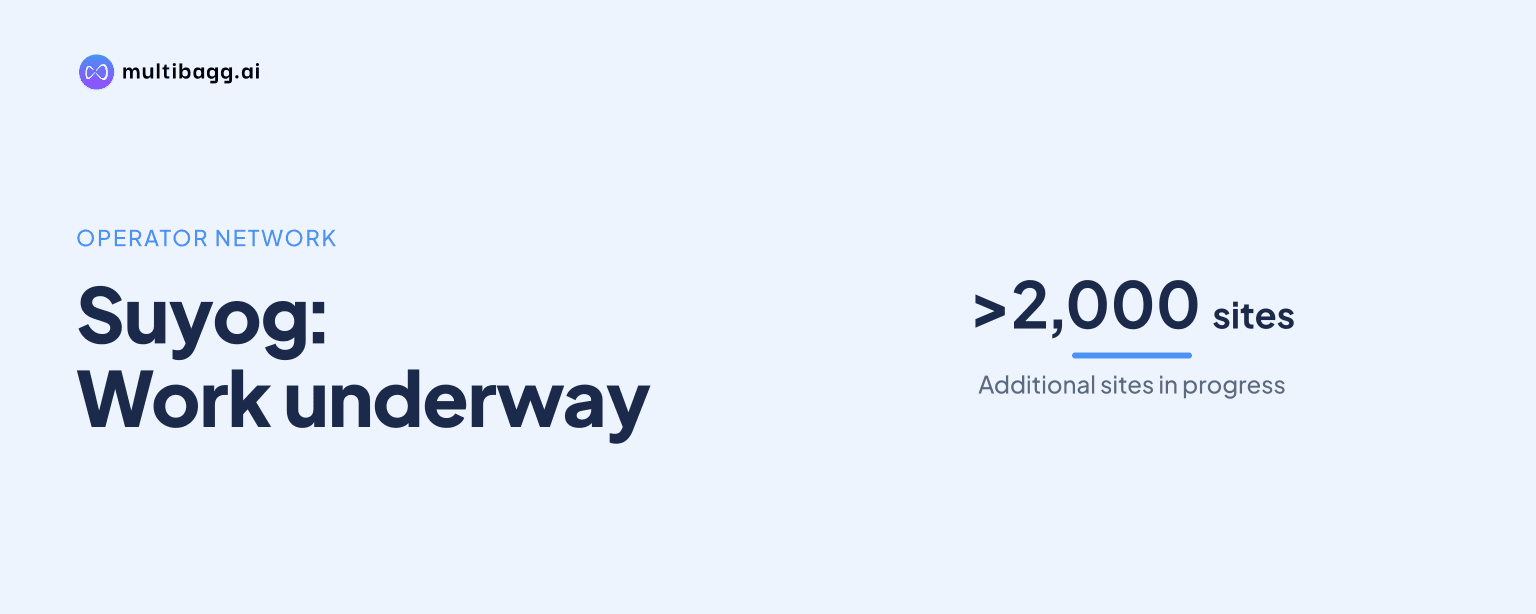
Suyog Telematics Limited is working on more than 2,000 additional Vodafone Idea sites across India, to be deployed under Vodafone Idea's deployment plan, alongside 6,263 total towers and 7,674 total tenancies across 26 states and union territories. Suyog does not disclose a completion date, project value or location-wise allocation for the additional sites.
Know Suyog Telematics inside out
Results, valuation, peers and who's buying, in one view.
What is Suyog's Vodafone Idea site pipeline?
Suyog is currently working on more than 2,000 additional sites for Vodafone Idea at various locations across India, and the source says deployment will follow Vodafone Idea's plan. The presentation identifies these as additional sites under work rather than completed additions to the reported 6,263-tower base.
The disclosure does not state when any of the more than 2,000 sites will be commissioned, how many are in each telecom circle, or whether they will be towers, small cells or another infrastructure type. It also does not attach a revenue, lease-value or tenancy target to the Vodafone Idea programme. The pace of deployment is therefore expressly linked to Vodafone Idea's plan.
Vodafone Idea is relevant to Suyog's disclosed operator revenue mix because VI accounted for 31.3% in Q2’FY27 and 30.9% in H1’FY27. Those revenue-share figures provide customer context for the pipeline, but they do not quantify the expected financial contribution from the additional sites.
How large is Suyog's reported infrastructure footprint?
Suyog reports 6,263 total towers and 7,674 total tenancies across 26 states and union territories. The reported tenancy count exceeds the tower count by 1,411, while the presentation does not provide a separately calculated tenancy-per-tower ratio.
Small-cell tenancies total 4,129, compared with 1,041 government-site tenancies, making small cells the larger of the two separately reported tenancy categories. Suyog also reports 6,510 km of fiber network and says it has a presence in all crucial circles in the small-cell segment, which the presentation describes as essential for 5G deployment.
A company-overview page uses rounded figures of more than 6,200 total telecom towers and more than 7,600 total tenancies, while the key-highlights page provides the precise figures of 6,263 and 7,674. Because the source does not identify separate reporting dates for those two displays, they should not be treated as a period-on-period movement.
How does Suyog provide telecom infrastructure?
Suyog describes itself as a passive telecommunications infrastructure provider that builds and operates telecom towers and related assets for telecommunication service providers on a shared basis. Its stated scope of work combines tower infrastructure, power supply and fiberization, with ready infrastructure provided under long-term leases.
Under this arrangement, operators deploy active equipment such as antennas and base transceiver stations, or BTS, at the prepared sites. Suyog says its master service agreements include service-level agreements intended to ensure site uptime for telecom companies. The presentation does not specify lease durations, uptime thresholds or the value of these agreements.
Suyog lists tower erection, fiber-optics network solutions and pole erection among its services. Its portfolio includes ground-based towers, roof-top towers, cow towers, GBM towers and camouflage towers. The company also says it has built more than 10,000 roof-top towers for Bharat Sanchar Nigam Limited under engineering, procurement and construction work, a historical delivery figure separate from the reported total-tower count.
The presentation says Suyog's infrastructure can support telecom companies' network expansion and 5G rollout across Indian telecom circles. It does not disclose how many of the more than 2,000 Vodafone Idea sites will use small-cell infrastructure, fiber connectivity or any specified tower category.
Got a follow-up? Ask IRIS
How does Suyog's operator revenue mix compare?
Suyog's disclosed operator revenue mix differs slightly between Q2’FY27 and H1’FY27, with Airtel remaining the largest contributor at 48.6% and 48.5%, respectively. VI represented 31.3% in Q2’FY27 and 30.9% in H1’FY27, while Jio represented 19.0% and 19.5%.
Airtel and VI together accounted for 79.9% of the Q2’FY27 mix and 79.4% of the H1’FY27 mix. Jio's 0.5-percentage-point difference between the two disclosed periods was the largest movement shown, while Bharat Sanchar Nigam Limited's 1.1% share was unchanged.
The table reports revenue shares rather than rupee revenue or site-level income. As a result, the 30.9% VI share in H1’FY27 cannot establish the revenue that may arise from the 2,000-plus additional Vodafone Idea sites, nor whether all such sites will enter service in the same period.
What remains undisclosed about the Vodafone Idea rollout?
Suyog has not disclosed a commissioning schedule, geographic split, contract value or expected tenancy level for the more than 2,000 Vodafone Idea sites. The only stated execution condition is that deployment will occur according to Vodafone Idea's deployment plan.
The source also does not say whether the additional sites will be included in the 6,263 reported total towers, because it presents them as work in progress. Future reported tower and tenancy totals would be the direct measures for observing additions to the existing 6,263-tower and 7,674-tenancy footprint.
Suyog's presentation provides no capital-expenditure figure, funding plan or expected revenue contribution specifically tied to the Vodafone Idea programme. It also gives no split between sites that may involve tower infrastructure, power supply, fiberization, small cells or pole erection, despite listing each as part of its broader service offering.
Conclusion
Suyog's disclosure combines a more than 2,000-site Vodafone Idea deployment pipeline with an existing reported footprint of 6,263 towers, 7,674 tenancies, 4,129 small-cell tenancies and 6,510 km of fiber network. VI's 30.9% share of H1’FY27 operator revenue gives context to the customer relationship, but the presentation does not assign revenue or a completion timetable to the new sites.
The next disclosed milestone is execution under Vodafone Idea's deployment plan, for which no schedule is provided. Investors can watch for future updates on completed-site counts, changes from the 6,263-tower and 7,674-tenancy totals, and any disclosure of the rollout's location mix or financial contribution.