










Suyog Says Vodafone Idea Site Builds Follow Monthly Priorities
Key highlights
- Suyog received the first Vodafone Idea order for more than 600 sites around 15 June and delivered nearly 150 sites within 15 days.
- Suyog added more than 200 tenancies in Q2 FY27, but said monthly Vodafone Idea priorities determine deployment timing.
- Suyog said it can deliver more than 1,000 sites monthly, while Vodafone Idea’s rollout pace can vary with its funding plan.
- Suyog reported Rs 71.7 crore of revenue and Rs 43.1 crore of EBITDA while planning Rs 200 crore of H2 capital expenditure.
powered by IRIS
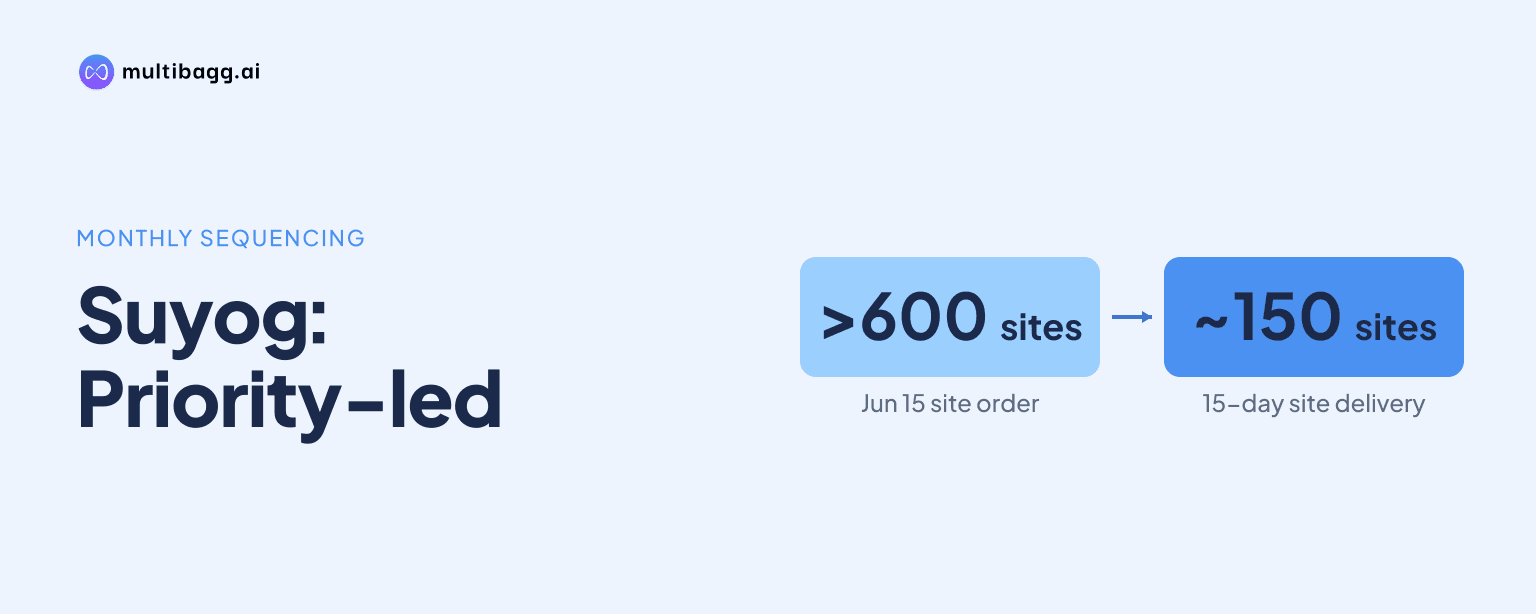
Suyog said in Q2 FY27 that its 600-site Vodafone Idea order will be built only to monthly, circle-level priorities, even though it can deliver more than 1,000 sites a month. It delivered more than 200 tenancies in Q2 after receiving the order around 15 June.
Know Suyog Telematics inside out
Results, valuation, peers and who's buying, in one view.
Why will Suyog not build all 600 sites at once?
Suyog will not build all 600 Vodafone Idea sites at once because it seeks monthly confirmation of priority locations in each telecom circle before beginning work. Management said Vodafone Idea may release an order in one batch on a quarterly or monthly basis, but Suyog delivers sites only when required by the operator. The approach is intended to avoid completing a site before Vodafone Idea is ready to integrate it, which would delay billing.
Suyog received its first Vodafone Idea order for more than 600 sites around 15 June and delivered nearly 150 sites within 15 days. It then added more than 200 tenancies in Q2 FY27. An analyst noted that this was below an earlier expectation of converting the maximum number of 600 to 700 tenancies during the quarter, and management attributed the difference to Vodafone Idea’s rollout requirements.
Suyog said it had acquired all 600 locations and signed letters of intent with site owners. The sites are therefore available for construction, but Vodafone Idea must identify the locations it wants deployed in a given month and circle. Management said Suyog’s monthly and quarterly plans depend on those customer instructions.
How does Vodafone Idea’s funding plan affect Suyog’s rollout?
Vodafone Idea’s funding plan affects Suyog’s rollout because management said the operator’s monthly and quarterly deployment schedule can vary with its financial planning. Suyog cited Vodafone Idea’s publicly declared target of 45,000 sites over three years, while cautioning that this does not mean a fixed rollout of 3,000 to 3,500 sites every month. A lower rollout in one quarter could move installations into a later quarter or financial year.
Suyog said it has teams across India and capacity to deliver more than 1,000 sites each month. Management also said funding was available for site construction. However, it does not want to build ahead of Vodafone Idea’s integration schedule because an unintegrated site would postpone billing; the customer’s selected rollout sequence, rather than Suyog’s stated construction capacity, controls timing.
Management was still awaiting Vodafone Idea’s final guidance for the next few quarters, although it had received a tentative number and expected final guidance within a few days. The 600-site order is therefore a service-order pipeline rather than a fixed quarterly delivery commitment, according to the explanation on the call.
Got a follow-up? Ask IRIS
How does Suyog limit capital expenditure risk on customer orders?
Suyog said it does not spend on a site without first receiving a service order from an operator. For Vodafone Idea, management said billing begins immediately after deployment, generally within 30 days, and that all 356 Vodafone Idea tenancies discussed on the call had started billing. This links capital expenditure to a confirmed instruction rather than a broad forecast of potential demand.
Management said that under its master service agreement, a service order cannot be cancelled after handover without exit charges equal to 10 years of payments. It described post-handover lock-in periods of seven to 10 years. These provisions were cited in response to an analyst’s concern that capital expenditure could become a drag if Vodafone Idea provided fewer tenancies than anticipated.
Bharat Sanchar Nigam Limited, or BSNL, has had a different billing experience. Suyog said it had completed about 1,800 BSNL sites, with roughly 50% moving to billing, while Tejas equipment, line-of-sight issues and fibre issues delayed the integration of remaining sites. Management said it would not make further BSNL investments without a confirmed integration commitment and was gradually bringing Vodafone Idea onto remaining sites.
The reporting treatment reflects that distinction. Management said more than 150 BSNL tenancies formed part of capital expenditure but were excluded from reported tenancy counts because billing had not started, while the 356 Vodafone Idea tenancies had started billing. Suyog reported revenue of Rs 71.7 crore, earnings before interest, tax, depreciation and amortisation of Rs 43.1 crore, and net profit of Rs 15.3 crore.
What does the dependency mean for Suyog’s FY27 plans?
Suyog’s FY27 capital expenditure and revenue progression remain conditional on operator rollout priorities, despite management outlining a Rs 200 crore capital expenditure plan. Management said this budget could be funded with Rs 120 crore of internal accruals and more than Rs 80 crore of sanctioned debt. In a later response, it said it was targeting Rs 200 crore of capital expenditure in H2 for about 2,000 tenancies, based on numbers then available from Vodafone Idea.
Management also stressed that the H2 plan could change with monthly and quarterly operator requirements. The company said it would update the plan as it received confirmations from operators. That qualification matters because Vodafone Idea’s final guidance remained pending at the time of the call.
Suyog’s operating revenue was Rs 70.95 crore in the June quarter and Rs 71.70 crore in the following quarter, based on figures discussed during the call. Management said the limited sequential increase reflected a lack of operator rollout in Q1, while Vodafone Idea began rollout on 15 June and Suyog’s maximum rollout occurred in Q2. Sites completed late in Q2 would not contribute a full quarter of revenue until the subsequent period.
Management said it was aiming to reach Rs 100 crore in quarterly revenue by next September, after reaching about Rs 75 crore from about Rs 60 crore. It expected additions to continue over the next two quarters, but said achievement would depend on operator plans. The target is therefore management’s expectation, not a committed outcome from Vodafone Idea.
Conclusion
Suyog’s clarification is that its 600-site Vodafone Idea service order provides a prepared deployment pipeline rather than an automatic quarterly rollout. The company had acquired the locations, signed letters of intent and added more than 200 tenancies in Q2 FY27, but Vodafone Idea’s monthly priorities and integration readiness determine when sites are built and begin contributing to billing.
The next item to watch is Vodafone Idea’s final guidance for coming quarters, which Suyog said it expected within a few days, and progress against the planned Rs 200 crore H2 capital expenditure for about 2,000 tenancies. Management’s stated aim of Rs 100 crore in quarterly revenue by next September also depends on continued operator additions and site integration.