










Suyog locks tower tenants into 10-plus-year service contracts
Key highlights
- Suyog says its average Master Service Agreement tenure is more than 10 years with 2.5% annual escalation.
- Suyog uses advance monthly payment terms and exit penalties for co-locations extending beyond seven years.
- Suyog reported 6,263 towers and 7,674 total tenancies across 26 states and Union Territories.
- Suyog is working on more than 2,000 Vodafone Idea sites, subject to the operator's deployment plan.
powered by IRIS
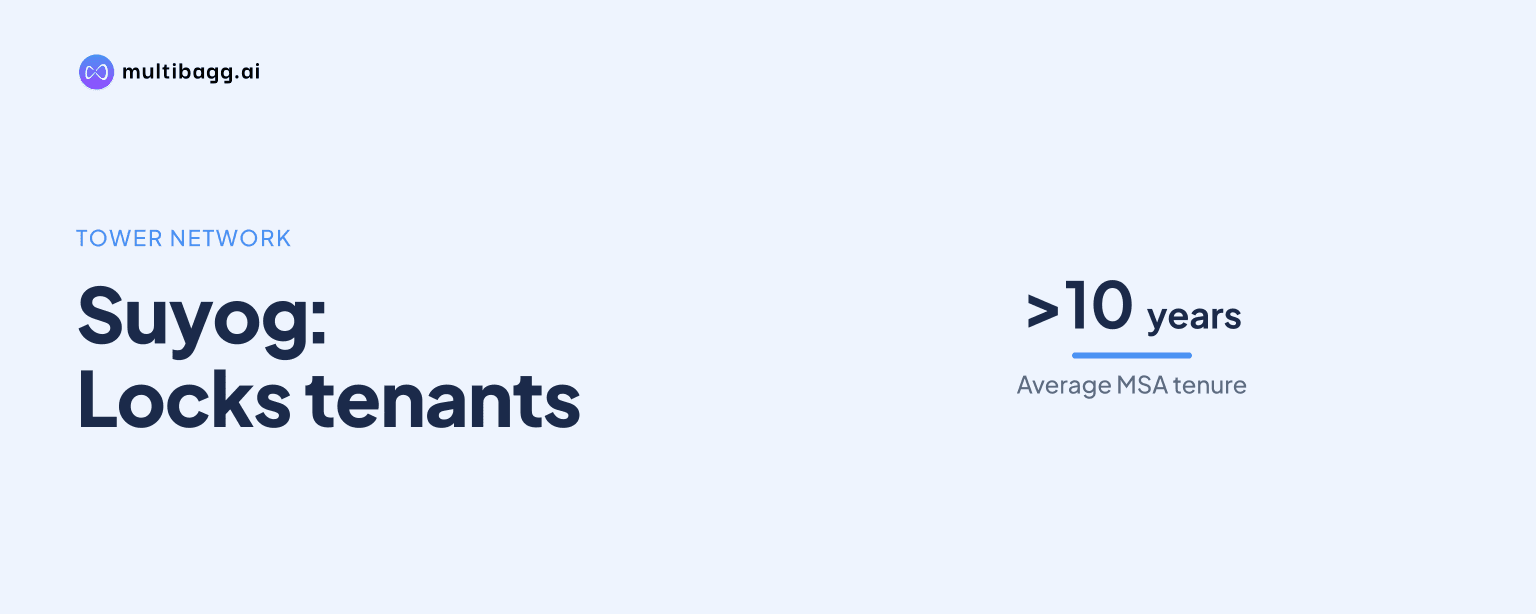
Suyog Telematics Limited locks tower tenants into Master Service Agreements averaging more than 10 years, with 2.5% annual escalation and advance monthly payments. Its contracts combine passive tower infrastructure, power supply and fiberization, while co-locations extending beyond seven years carry exit penalties, according to the investor presentation.
Know Suyog Telematics inside out
Results, valuation, peers and who's buying, in one view.
How does Suyog turn tower assets into recurring revenue?
Suyog provides telecom service providers with ready passive infrastructure on long-term lease, enabling them to install active equipment such as antennas and base transceiver stations, or BTS. Its scope of work combines tower infrastructure, power supply and fiberization, while the telecom tenant owns and operates the active equipment at the site.
Suyog begins the process after a customer requests a location. Its acquisition team identifies the site, secures a land lease from the owner and deploys the tower infrastructure before leasing the completed asset to a wireless tenant under a predetermined-fee Master Service Agreement, or MSA.
The MSA includes a Service Level Agreement, or SLA, specifying Suyog's commitment to ensure site uptime for telecom companies. This links the lease structure to an operating obligation, although the presentation does not disclose an uptime percentage, service-credit terms or operator-specific performance metrics.
Suyog reported 6,263 towers and 7,674 total tenancies across 26 states and Union Territories in its key highlights. It also reported 4,129 small-cell tenancies, 1,041 government-site tenancies and 6,510 kilometres of fiber network, showing that its leased passive-infrastructure base includes more than conventional tower sites.
What contract protections does Suyog use for tenants?
Suyog says its average MSA tenure is more than 10 years and carries annual escalation of 2.5%. The disclosed escalation provides a contractual pricing increase over the stated average service period, while the presentation does not specify whether every individual MSA has identical terms.
Suyog also uses advance monthly payment terms. Under the arrangement described, tenants pay monthly charges before the relevant service period, but the presentation does not state payment dates, collection periods, receivables balances or consequences of late payment.
The company separately says it secures co-locations with tenures extending beyond seven years and exit penalties. This is distinct from the average MSA tenure of more than 10 years: Suyog identifies the former as a co-location feature with an exit protection, but does not disclose the amount or calculation method of any penalty.
The SLA adds an availability commitment to the tenure, escalation and payment provisions. Suyog says the agreement specifies its commitment to site uptime for telecom operators, but provides no contractual uptime threshold or comparison of achieved uptime across its 6,263-tower portfolio.
Got a follow-up? Ask IRIS
What charges do Suyog tenants pay under an MSA?
Suyog bills site rentals either on an actual-cost basis or as a fixed cost included with infrastructure-provider, or IP, fees. The two methods allow the rental element to be billed directly on actuals or incorporated into a fixed-fee structure for the site.
IP fees are determined by site characteristics including location type, city premium and the number of operators at a location. The presentation cites ground-based towers, rooftop towers and pole sites as location types, meaning the fee framework can vary by physical format, location and tenant-sharing configuration.
Loading charges are either agreed fixed charges or are based on equipment installed by telecom companies at the site. This creates a separate charge tied either to a preset commercial term or to the tenant's equipment deployment, alongside rental and IP-fee billing.
Utilities use different allocation mechanisms rather than one uniform site charge. Suyog passes actual fuel costs to telecom companies, shares electricity charges equally among operators and allocates diesel costs according to actual usage among operators.
Why can more tenants change Suyog's site economics?
Suyog says incorporating new tenants at existing sites requires minimal additional operating cost compared with the one-time fixed cost of deploying infrastructure. The stated mechanism is infrastructure sharing: after a tower and related passive assets are installed, additional wireless tenants can use the site under long-term agreements.
This differs from the initial deployment process, which requires site identification, a land lease and tower construction. Suyog characterises the initial deployment as a one-time fixed-cost step and says the lower incremental cost of an added tenant contributes positively to its bottom line and profitability margins, without quantifying either effect.
The reported portfolio illustrates the difference between sites and tenancy relationships. Suyog's 7,674 total tenancies exceeded its 6,263 towers, a gap of 1,411, indicating more reported tenancy relationships than tower sites; however, the presentation does not provide a tower-by-tower occupancy ratio or identify how many towers have multiple tenants.
Suyog is also working on more than 2,000 additional sites from Vodafone Idea across India, with deployment subject to Vodafone Idea's plan. The presentation does not provide a deployment date, contract value, expected tenancy count or revenue-recognition schedule for these additional sites.
Conclusion
Suyog's recurring-revenue structure is based on leasing passive telecom infrastructure while tenants operate antennas and BTS equipment. The combination of more than 10-year average MSAs, 2.5% annual escalation, advance monthly payments, exit penalties for qualifying co-locations and separately allocated utility costs sets out how it converts tower, power and fiber-supported sites into contracted service revenue.
The next disclosed item to watch is the rollout of more than 2,000 Vodafone Idea sites, which remains dependent on that operator's deployment plan. Suyog also points to Vodafone Idea's planned 3,000 to 3,500 new 4G sites each month and BSNL's proposed 16,000 tower installations by March 2027, but it does not disclose the share of those programmes it expects to deploy.