










Suyog has Rs 30 crore of BSNL CapEx awaiting billing
Key highlights
- Suyog said Rs 30 crore of Bharat Sanchar Nigam Limited CapEx across about 300 sites was awaiting billing.
- Management said all CapEx completed for Vodafone had been monetised, unlike the pending Bharat Sanchar Nigam Limited sites.
- Suyog said its Bharat Sanchar Nigam Limited MSA provides for payment from the RFI date after a maximum 60-day waiver.
- Suyog plans Rs 200 crore of second-half CapEx for about 2,000 sites, subject to operator confirmations.
powered by IRIS
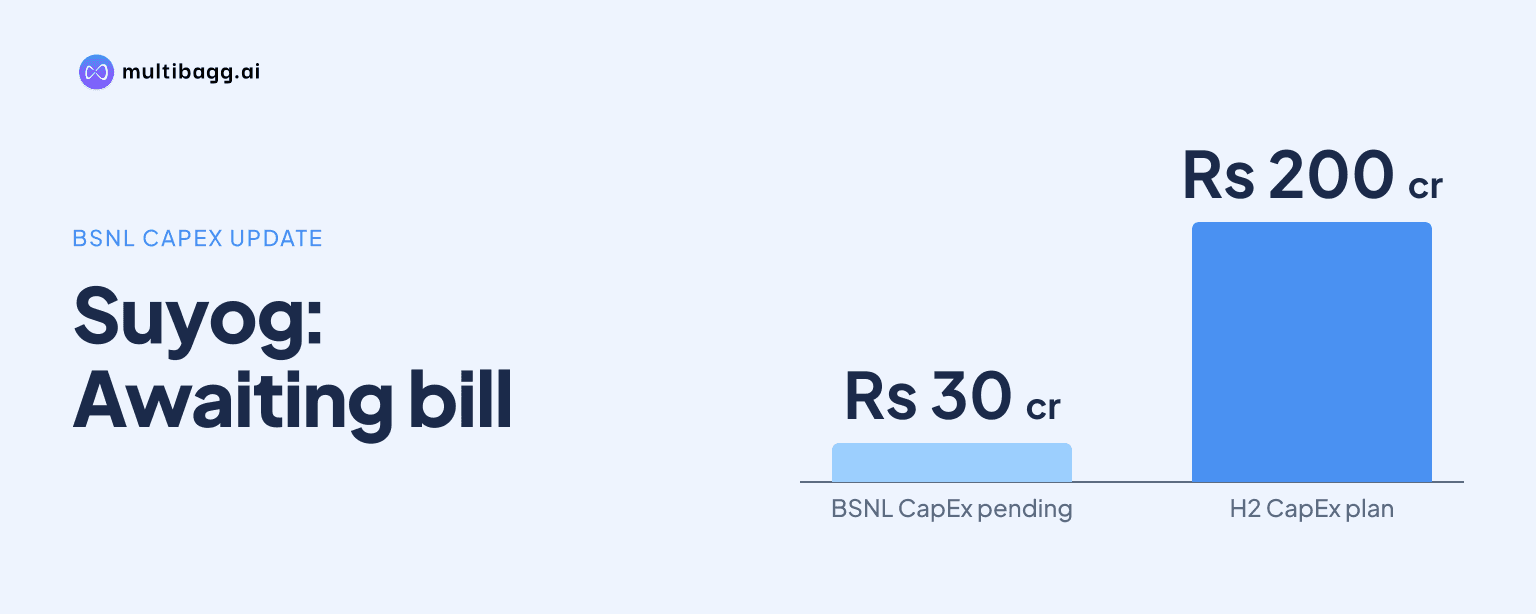
Suyog has about Rs 30 crore of capital expenditure, or CapEx, across roughly 300 Bharat Sanchar Nigam Limited sites awaiting billing because integration has not been completed. Management said the sites had reached the ready-for-integration, or RFI, stage, while its contract provides for payment from RFI after a maximum 60-day waiver.
Know Suyog Telematics inside out
Results, valuation, peers and who's buying, in one view.
How much BSNL CapEx is awaiting billing at Suyog?
Suyog said about Rs 30 crore of Bharat Sanchar Nigam Limited-related CapEx across roughly 300 sites was awaiting billing. Management described these as sites where CapEx had been completed and which had reached RFI, but said billing had not begun. The disclosure identifies a gap between completed Bharat Sanchar Nigam Limited investment and billing from those assets.
The contrast with Vodafone was explicit: management said all CapEx completed for Vodafone had been monetised, while the Rs 30 crore equivalent for Bharat Sanchar Nigam Limited was awaiting billing. Management also said it had undertaken more CapEx for Bharat Sanchar Nigam Limited than for Vodafone, making the delay customer-specific rather than portfolio-wide.
The 300-site backlog compares with 356 tenancy additions in the first half, according to management. It later referred to more than 600 sites for which revenue could be billed, combining the 300-plus pending Bharat Sanchar Nigam Limited tenancies with other additions. These comments distinguish delivered sites from those contributing a full period of revenue.
Why has BSNL billing not started on these sites?
Suyog said Bharat Sanchar Nigam Limited had not been able to integrate the affected sites because of Tejas-related requirements and fibre issues. Management said work was in progress and that Suyog was supporting the process, including offering to lay fibre for Bharat Sanchar Nigam Limited. It did not quantify the cost of that support or provide a confirmed integration date.
Management linked the delay to Bharat Sanchar Nigam Limited’s wider rollout. It said the operator had called for 18,000 sites across India, including Delhi and Mumbai, where Suyog said it has a substantial presence. Suyog said it deployed sites to secure work in its home markets but constructed them only after receiving an order and service order.
Suyog also said Bharat Sanchar Nigam Limited had hired an international agency for a brand relaunch. That plan did not establish a billing date. Management instead said the Tejas requirement and fibre issues needed resolution before integration, leaving billing dependent on Bharat Sanchar Nigam Limited’s readiness.
What does Suyog's BSNL contract say about payment?
Suyog said its master service agreement, or MSA, requires Bharat Sanchar Nigam Limited to pay from the RFI date, with a maximum 60-day waiver before billing starts automatically. Management said the terms were clear, but it also said the parties could discuss a waiver if Bharat Sanchar Nigam Limited placed a large order or offered compensation.
The stated contractual mechanism and the current billing position differ. Suyog said the sites had reached RFI, yet Rs 30 crore of CapEx remained outside billing because Bharat Sanchar Nigam Limited had not integrated them. Management did not say the operator had rejected the sites or quantify any receivable accrued for the pending period.
The call did not provide a final recovery calculation for the 300 sites. Management cited the MSA’s 60-day provision while acknowledging that a negotiated waiver could be considered. The amount and timing of any backdated payment therefore remained unresolved at the time of the call.
Got a follow-up? Ask IRIS
Is Suyog paying site-owner rent before BSNL billing starts?
Suyog said it had told site owners that commercial rent payments were on hold while Bharat Sanchar Nigam Limited was unable to integrate the sites. Management said rent would start once integration occurred, describing the arrangement as a way to avoid a rental charge before related Bharat Sanchar Nigam Limited revenue begins.
This rent arrangement relates to the Rs 30 crore of unbilled Bharat Sanchar Nigam Limited CapEx, rather than all sites in the portfolio. Management did not disclose the aggregate rent being deferred, the number of site owners receiving the communication, or whether site-owner terms could change.
Management said its immediate focus was starting billing on existing Bharat Sanchar Nigam Limited towers before further work. It said CapEx for the operator would be undertaken only when Suyog received a service order. The company did not state that it had halted all Bharat Sanchar Nigam Limited activity or cancelled orders.
When does Suyog expect the BSNL billing backlog to clear?
Suyog did not give a firm billing-start date for all 300 sites. One executive said the company expected deployment by December, while another said pending billing could begin at any time in the third or fourth quarter and declined to make a firm commitment because integration depended on Bharat Sanchar Nigam Limited.
Management said it expected pending sites to be completed within the financial year, leaving the next financial year as a clean slate for Bharat Sanchar Nigam Limited. It said the Tejas requirement and fibre constraints remained the key unresolved issues, while Suyog had offered fibre support to assist integration.
The backlog sits alongside a separate second-half CapEx plan of Rs 200 crore for about 2,000 sites, based on available Vodafone numbers. Management said the plan could be updated monthly as operator confirmations arrive. It also said one tower generates around Rs 30,000 of revenue, subject to operators’ rollout plans.
Conclusion
Suyog’s Rs 30 crore of pending Bharat Sanchar Nigam Limited CapEx represents completed investment across about 300 sites that has not entered billing because integration remains incomplete. Management contrasted this with Vodafone CapEx, which it said was fully monetised, while using deferred site-owner rent as an interim measure on the affected sites.
The next point to watch is whether Tejas-related and fibre issues are resolved in time for billing to begin in the third or fourth quarter and for the pending sites to be completed within the financial year, as management expects. Management’s Rs 200 crore second-half CapEx plan for about 2,000 sites also depends on operator rollout confirmations.