










Suyog says 30% of prior CapEx funded Airtel upgrades
Key highlights
- Suyog said 30% of last financial year's CapEx was used for Bharti Airtel site upgrades.
- Bharti Airtel upgrades lifted Suyog's revenue per tower from Rs 28,000 to Rs 30,000.
- Around Rs 30 crore of BSNL CapEx across roughly 300 sites was awaiting billing.
- Suyog added 356 tenancies in H1 FY26 and said it had more than 2,000 Vodafone sites on its list.
powered by IRIS
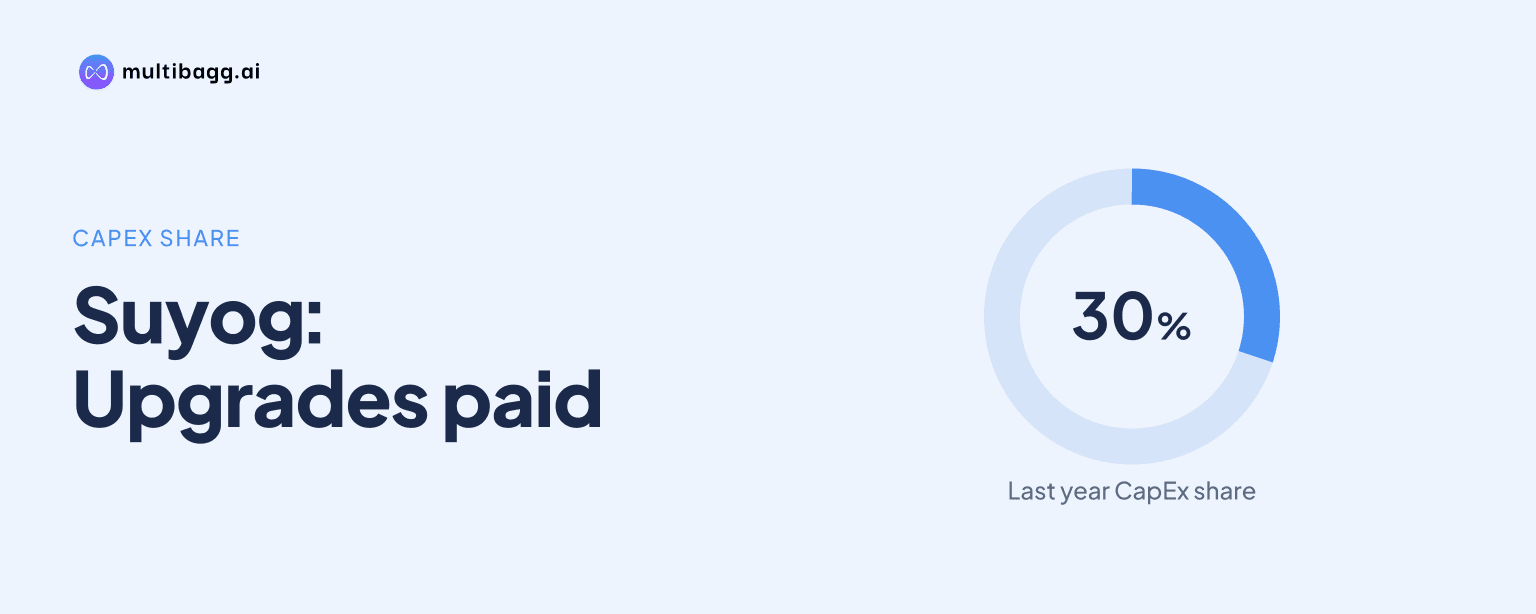
Suyog said 30% of capital expenditure in the last financial year was used to upgrade Bharti Airtel sites, rather than add new tenancies, and management said the work lifted revenue per tower from Rs 28,000 to Rs 30,000. The explanation addresses why CapEx and reported tenancy additions have not moved in step.
Know Suyog Telematics inside out
Results, valuation, peers and who's buying, in one view.
Why did Suyog's CapEx not translate directly into new tenancies?
Suyog said CapEx funds both new tower deployment and upgrades at existing sites, so spending does not necessarily produce a matching increase in tenancies. In response to an investor's comparison of almost Rs 150 crore of FY26 CapEx with roughly 400 to 500 additions, management said H1 FY26 itself recorded 356 tenancy additions.
Management said 30% of CapEx in the last financial year went into site upgrades, mainly for Bharti Airtel. It contrasted that earlier spending with the current financial year's major CapEx focus, which management said is Vodafone rollout. An upgrade can raise charges at an operating site without creating a separately reported new tenancy.
The timing of deployment has also affected reported revenue. Management said Vodafone rollout began on 15 June, with 150 sites completed in the final 15 days of Q1 and another 150-plus tenancies added in Q2. It said Q3 should include three full months of revenue for much of the 356 H1 additions.
The comparison shows that the 356 H1 additions were partly deployed late in the half, while around 300 BSNL sites were not yet contributing billed revenue. Management said the gap between CapEx and monetisation should narrow once BSNL billing starts and Vodafone additions receive a full-quarter revenue contribution.
How did Airtel upgrades change Suyog's revenue per tower?
Suyog said the Bharti Airtel upgrades generated additional loading charges of Rs 2,500 per site, helping lift realised revenue per tower from Rs 28,000 to Rs 30,000. Management identified this higher charge as the return mechanism from prior-year upgrade CapEx rather than a larger reported count of new sites.
Management said Bharti Airtel still represented 48% of Suyog's revenue, despite substantial Vodafone revenue. It attributed Airtel's position principally to the upgrade CapEx and associated loading charges, rather than identifying a corresponding increase in newly built Airtel towers.
Vodafone Idea's share was around 31% of total revenue in Q2, compared with around 30% on an H1 basis, according to management. Management said the share had increased by almost 3%, while also describing current-year CapEx as being mainly directed to Vodafone rollout.
The two programmes have different revenue profiles. Airtel upgrades increased the charge earned from existing sites by Rs 2,500 per site, while Vodafone deployment is intended to add new sites and tenancies. Management said the latter's reported revenue effect is delayed when delivery occurs in the final weeks of a quarter.
Got a follow-up? Ask IRIS
What is delaying BSNL monetisation for Suyog?
Suyog said around Rs 30 crore of BSNL-related CapEx across roughly 300 sites remained unmonetised because billing had not started. Management said the sites were RFI, or ready for installation, but BSNL had not integrated them into its network.
Management cited Tejas equipment requirements and fibre issues as obstacles to BSNL integration. It said Suyog had completed the sites after receiving orders and under its master service agreement, or MSA, and had offered to lay fibre to support the integration process.
Under the MSA, management said BSNL is required to pay from the RFI date, with a maximum 60-day waiver allowed before billing begins automatically. Management added that a longer waiver or another compensation arrangement could be discussed if BSNL made a larger order, but said no such decision had been made.
Suyog said it had notified site owners that commercial rent payments would remain on hold until BSNL integrates the locations. Management said this was intended to prevent rental expense from being recognised before related BSNL revenue begins, limiting the operating cost effect of the delayed billing.
Management said some billing had started in the wider BSNL programme, but described the approximately 300 sites as pending. It expected the pending sites to be completed within the financial year and said billing could begin in Q3 or Q4, subject to BSNL resolving the integration constraints.
When could Vodafone rollout affect Suyog's reported revenue?
Suyog said Q3 should show a revenue increase because its major Vodafone rollout occurred in Q2, after a largely flat Q1. Management said the 356 H1 tenancies had not received a full revenue contribution by Q2 because 150 sites were completed only during Q1's final 15 days.
Management said monthly rental remained close to Rs 30,000 per tower and could rise marginally towards Rs 31,000. It did not issue revenue guidance, but said its Rs 200 crore CapEx plan could translate into 2,000 sites and invited investors to calculate the potential revenue using the stated monthly rental.
Management cautioned that the actual outcome depends on operators' quarterly and monthly rollout schedules. It said Suyog had field teams, materials and funding available for more than 2,000 Vodafone sites, but would deliver them according to Vodafone's business and financial plan.
In a separate answer, management referred to Rs 203 crore of H2 CapEx, comprising Rs 120 crore from internal accruals and Rs 80 crore from debt already sanctioned by ICICI Bank. The call also referred to a Rs 200 crore plan, and management did not reconcile the Rs 3 crore difference between the two figures.
Conclusion
Suyog's explanation for the gap between CapEx and new tenancies has three parts: 30% of last financial year's spending went to Bharti Airtel upgrades, the 356 H1 FY26 additions were delivered too late for full Q2 revenue recognition, and around 300 BSNL sites representing Rs 30 crore of CapEx were awaiting billing. The Airtel work increased revenue per tower by Rs 2,000 through Rs 2,500 loading charges.
The next disclosure to watch is whether BSNL resolves its Tejas equipment and fibre integration issues in Q3 or Q4, as management expects pending sites to be completed within the financial year. Management's stated H2 plan of Rs 200 crore to Rs 203 crore of CapEx also leaves Vodafone's requested rollout schedule as the key determinant of new-site delivery and revenue recognition.