










Tarsons starts Amta revenue, targets H2 FY27 cell culture
Key highlights
- Tarsons began revenue from its Amta fulfilment, sterilisation and manufacturing capacity in Q4 FY26.
- Tarsons expects Panchla cell-culture category revenue to begin in H2 FY27.
- Amta contributed 1.0% of FY26 manufacturing revenue, while Panchla contributed 15.4%.
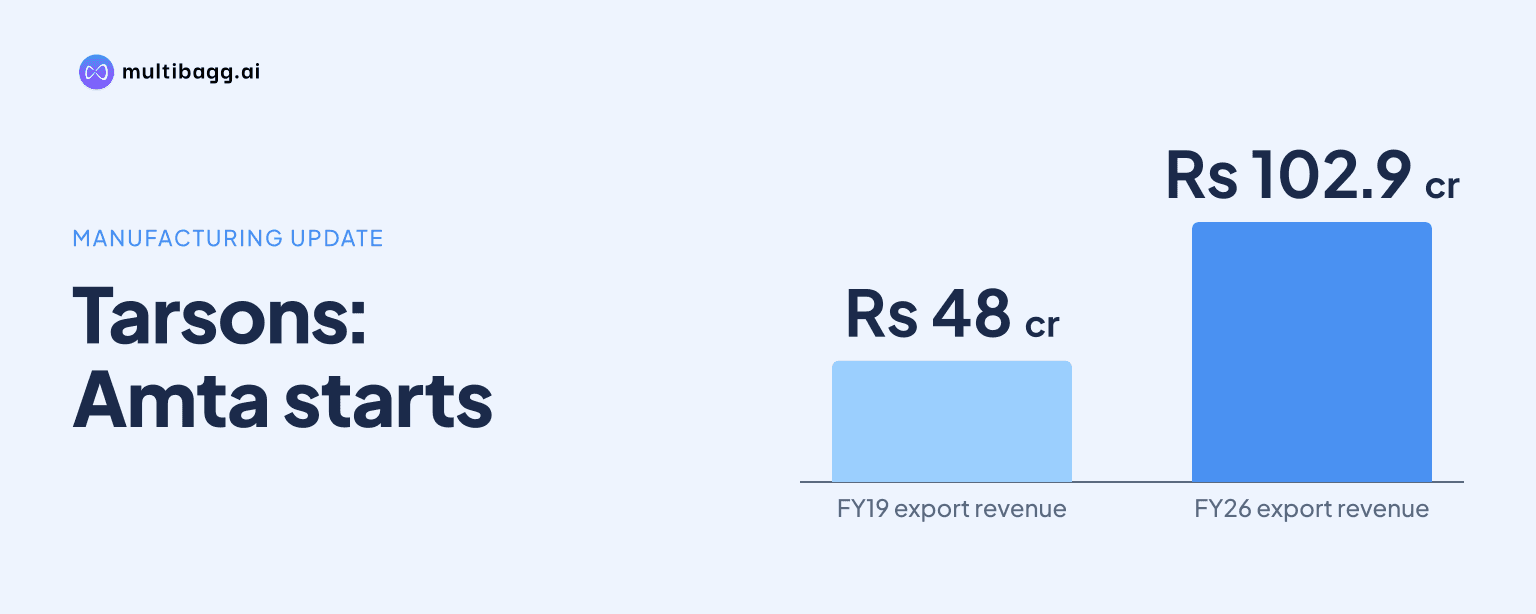
- Export revenue increased from Rs 48 crore in FY19 to Rs 102.9 crore in FY26.
powered by IRIS
Tarsons Products Limited began revenue from its Amta facility in Q4 FY26 and expects revenue from new cell-culture categories at Panchla to begin in H2 FY27. The expansion adds in-house sterilisation and fulfilment capability at Amta while moving Tarsons into flasks, plates, dishes and roller bottles for cell-culture applications.
Know Tarsons Products inside out
Results, valuation, peers and who's buying, in one view.
What has commenced at Tarsons’ Amta facility?
Tarsons has commenced revenue from new capacity at its Amta, West Bengal facility from Q4 FY26. The company describes Amta as a new fulfilment centre with in-house sterilisation as well as manufacturing capability, making it distinct from a distribution-only site and linking the project directly to production and delivery operations.
Amta was Tarsons’ largest site by land area in the FY26 facility disclosure, spanning 24,280 square metres and owned by the company. It contributed 1.0% of manufacturing revenue in FY26, compared with 15.4% for Panchla and 47.9% for Jangalpur, indicating that Amta’s newly commenced capacity had a limited contribution during the reported year.
The Amta plan also includes a radiation facility and additional capacity for certain existing products, according to Tarsons’ stated business strategy. The presentation does not identify the products receiving extra capacity, quantify radiation capacity, or give a revenue target for Amta beyond confirming that revenue began in Q4 FY26.
When will Tarsons launch cell-culture products from Panchla?
Tarsons expects revenue from new cell-culture categories at its Panchla, West Bengal production facility to begin in H2 FY27. This is an expectation disclosed by the company rather than reported revenue, and the presentation does not state a precise launch date, initial sales value, capacity volume or margin contribution for the category.
The intended cell-culture range comprises cell-culture flasks, plates, dishes and roller bottles. Tarsons says flasks and plates are used to grow and maintain cells in controlled environments for research and industrial purposes, including disease study, drug testing, vaccine production and protein production; dishes are used for growing, expanding and propagating cell lines.
Roller bottles are the fourth named product type in the Panchla expansion. Tarsons says a smooth-wall design supports uniform cell attachment, while a ribbed-wall, expanded-surface option increases growth area and cell yield. The September 2026 Analytica India display and the 2026 Analytica Germany display both included roller bottles, while WHX Dubai 2026 included cell-culture plates.
Panchla is an owned facility with 21,550 square metres of land and supplied 15.4% of Tarsons’ FY26 manufacturing revenue. That established FY26 contribution contrasts with Amta’s 1.0%, but the source does not separate Panchla’s existing production from the proposed cell-culture line, so it does not show how much of the facility is allocated to the new segment.
Got a follow-up? Ask IRIS
How does the expansion change Tarsons’ product and capacity mix?
Tarsons is using Panchla to enter cell culture and Amta to add fulfilment, sterilisation and manufacturing, alongside planned additions in liquid handling, centrifuge ware and cryo ware. The company says these existing-category expansions will use additional machines, moulds and ancillary infrastructure, while its automated production processes operate in fully validated, third-party-certified International Organization for Standardization, or ISO, 8 clean rooms.
The company’s FY26 sales mix was led by consumables at 58.9%, followed by reusables at 38.1% and others at 3.0%. Cell culture is presented as a new product category rather than as part of an existing disclosed revenue segment, so the presentation does not provide a starting percentage of sales or a future product-mix target for it.
Tarsons frames the cell-culture and robotic-handled consumables initiative as an entry into markets it characterises as import dominated. Its domestic route to market included 152 distributors in FY26: 43 in North India, 46 in East India, 23 in West India and 40 in South India. South India accounted for 42% of FY26 domestic sales, ahead of West India at 29%, North India at 16% and East India at 13%.
How does Panchla fit Tarsons’ export expansion plan?
Tarsons plans to export to about 120 countries over the next five to 10 years, compared with sales to more than 40 countries through more than 45 distributors as of 31 March 2026. Management’s strategy sets out branded sales for emerging markets in Asia Pacific, the Middle East and South America, and original design manufacturer, or ODM, sales for developed markets including the United States and Europe.
Export revenue rose from Rs 48 crore in FY19 to Rs 102.9 crore in FY26. The sales mix changed only slightly over that period: branded exports declined from 35% to 34%, while ODM increased from 65% to 66%. Tarsons defines the ODM model as independently designing and developing products to customer requirements before selling them to the respective brand owners.
The company identifies Avantor, iCell, FC-BIOS and Toei Kaisha as key overseas ODM clients. It also says it acquired Nerbe, a Hamburg-based distributor specialising in plastic labware products, but the supplied presentation gives no acquisition date, price, financial contribution or integration timetable. Its export-market discussion cites expected 10% compound annual growth rate, or CAGR, for plasticware demand in developing markets such as Asia Pacific and the Middle East and Africa.
Conclusion
Tarsons’ disclosed expansion has two separate operating milestones: Amta began generating revenue in Q4 FY26, and Panchla is expected to generate revenue from cell-culture categories in H2 FY27. The projects add sterilisation and fulfilment capabilities, enlarge manufacturing capacity and broaden a FY26 portfolio in which consumables represented 58.9% of revenue.
The next disclosed milestone is the H2 FY27 start of Panchla cell-culture revenue. Investors will also be able to assess progress against management’s longer-term plan to reach about 120 export countries within five to 10 years, from more than 40 countries as of 31 March 2026, and whether Amta’s 1.0% FY26 manufacturing-revenue contribution rises as the new capacity operates for a full period.