










Tarsons H1 revenue rises 21% as consolidated profit turns loss
Key highlights
- Tarsons reported Rs 233.9 crore consolidated revenue in H1 FY27, up 21% year on year.
- Tarsons' consolidated profit after tax shifted to a Rs 1.8 crore loss in H1 FY27 from a Rs 5.1 crore profit.
- Tarsons' standalone export revenue grew 33% to Rs 65.2 crore in H1 FY27.
- Tarsons generated Rs 53.8 crore of net operating cash flow in H1 FY27, versus Rs 44.5 crore a year earlier.
powered by IRIS
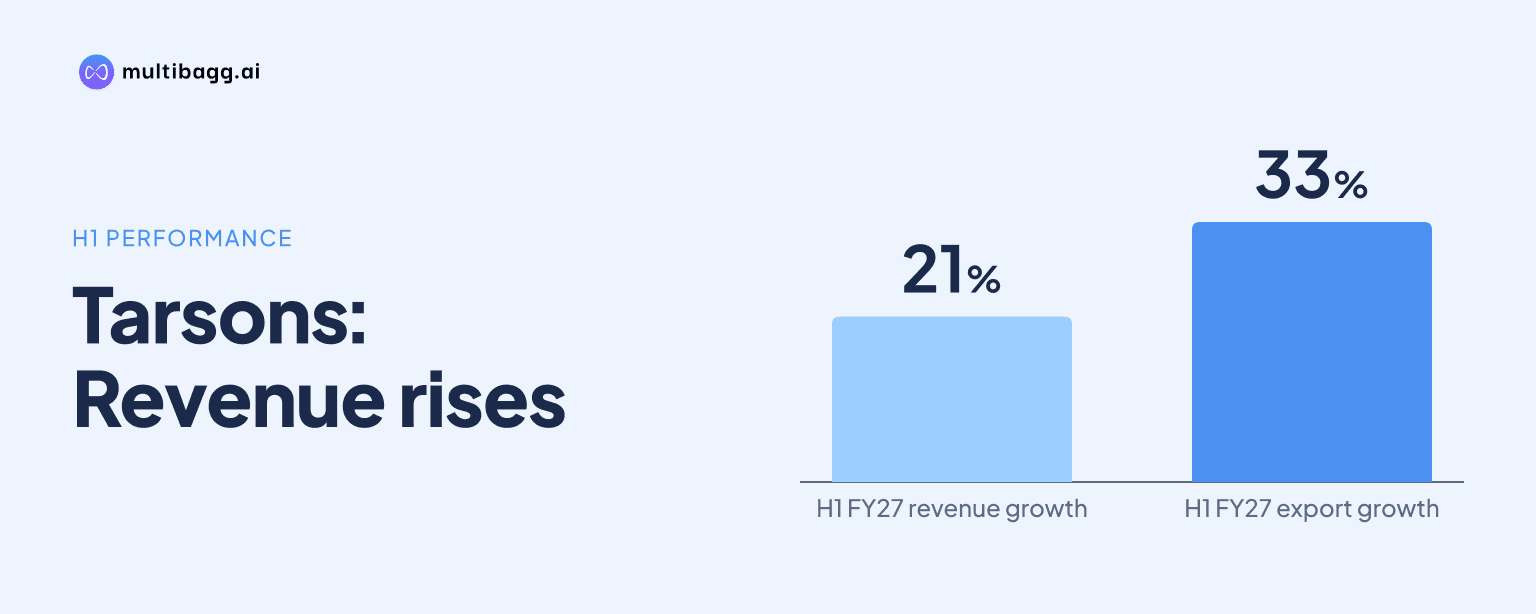
Tarsons Products Limited reported consolidated revenue of Rs 233.9 crore in H1 FY27, up 21% year on year, but recorded a Rs 1.8 crore loss after tax against a Rs 5.1 crore profit a year earlier. Higher raw-material costs, depreciation and finance costs associated with new facilities outweighed sales growth.
Know Tarsons Products inside out
Results, valuation, peers and who's buying, in one view.
Why did Tarsons report a loss despite higher revenue?
Tarsons reported a consolidated loss because Rs 57.1 crore of H1 FY27 earnings before interest, tax, depreciation and amortisation, or EBITDA, did not cover the increase in depreciation, finance cost and tax. EBITDA rose 9.4% from Rs 52.1 crore in H1 FY26, but depreciation increased to Rs 55.3 crore from Rs 42.4 crore and finance cost rose to Rs 12.9 crore from Rs 10.2 crore. Profit before tax consequently moved to a Rs 0.7 crore loss from a Rs 8.6 crore profit.
The result moved further into loss after Rs 1.1 crore of tax in H1 FY27, compared with Rs 3.5 crore in H1 FY26. Tarsons also reported a Rs 0.3 crore consolidated loss after tax in Q2FY27, against a Rs 3.3 crore profit in Q2FY26. Management attributed the profit impact to accelerated depreciation and higher finance costs related to the new Amta and Panchla facilities, as well as higher raw-material prices, product mix and facility expenses.
Which Tarsons businesses drove H1 FY27 revenue growth?
Tarsons' domestic, export and Nerbe businesses all increased revenue in H1 FY27, with exports delivering the fastest growth at 33%. Standalone domestic revenue rose 18% to Rs 121.2 crore, while standalone export revenue increased from Rs 49.0 crore to Rs 65.2 crore. Nerbe revenue grew 13% to Rs 47.5 crore, alongside the Rs 40.2 crore increase in total consolidated revenue.
Tarsons said domestic growth reflected a revival in demand across healthcare and pharmaceutical industries, brand recall and its distribution network. Management said Q2FY27 growth was largely generated by the existing portfolio, with limited contribution from newer product categories. Standalone revenue, excluding Nerbe, rose 23% to Rs 186.4 crore in H1 FY27, exceeding the 21% consolidated revenue growth rate.
How much did Tarsons' margins contract in H1 FY27?
Tarsons' consolidated gross margin fell by 340 basis points to 64.3% in H1 FY27, while EBITDA margin declined by 250 basis points to 24.4%. One basis point equals one-hundredth of a percentage point. Gross profit increased 14.7% to Rs 150.4 crore, slower than the 20.8% increase in revenue, as cost of goods sold rose to Rs 83.5 crore from Rs 62.5 crore.
Management linked the margin decline to higher raw-material prices after the onset of the West Asia crisis and supply-chain disruptions amid geopolitical challenges. Employee cost rose to Rs 42.8 crore from Rs 35.7 crore, and other expenses increased to Rs 50.5 crore from Rs 43.3 crore. Tarsons said cost optimisation and operating leverage partly cushioned the EBITDA effect, although the EBITDA margin remained below its H1 FY26 level.
Got a follow-up? Ask IRIS
What explains the difference between Tarsons standalone and consolidated profit?
Tarsons reported standalone profit after tax of Rs 3.8 crore in H1 FY27, but consolidation reduced this to a Rs 1.8 crore loss. The bridge included a Rs 2.0 crore standby letter of credit commission booked in Tarsons' accounts and eliminated on consolidation, Rs 2.1 crore of interest paid by the subsidiary to a bank, and Rs 1.5 crore from elimination of amortisation on acquired intangible assets. Nerbe contributed Rs 0.1 crore of profit after tax.
The standalone figures show that profitability pressure was not limited to consolidation adjustments. Standalone gross margin declined 500 basis points to 67.2% in H1 FY27 and EBITDA margin fell 250 basis points to 29.4%. Standalone depreciation increased to Rs 50.5 crore from Rs 37.9 crore, while finance cost rose to Rs 11.2 crore from Rs 8.7 crore; standalone profit after tax therefore declined 62.7% from Rs 10.1 crore to Rs 3.8 crore.
What do Tarsons' facilities and cash flows indicate for the next period?
Tarsons said the Amta facility is fully operational, while select production lines at Panchla have commenced and its cell-culture lines are expected to become operational in H2 FY27. Management expects utilisation at the new facilities to improve progressively over the next two years and said Amta and Panchla revenues are expected to contribute meaningfully from FY29. The Amta site includes a radiation plant, warehousing infrastructure and expanded manufacturing capacity for existing products.
Cash generation remained positive despite the reported H1 FY27 loss. Net cash from operating activities increased to Rs 53.8 crore from Rs 44.5 crore in H1 FY26, while net cash used in investing activities declined to Rs 50.8 crore from Rs 78.3 crore. Cash and cash equivalents ended H1 FY27 at Rs 15.7 crore, compared with Rs 23.2 crore at March 2026; current borrowings rose to Rs 198.5 crore from Rs 173.1 crore, while non-current borrowings fell to Rs 188.9 crore from Rs 209.5 crore.
Conclusion
Tarsons' H1 FY27 results show that demand recovery has not yet translated into reported profit growth. Consolidated revenue rose Rs 40.2 crore year on year, supported by 33% export growth, but cost of goods sold increased Rs 21.0 crore and facility-linked depreciation and finance costs resulted in a Rs 1.8 crore loss after tax. Cash profit after tax, defined by Tarsons as profit after tax plus depreciation, rose 12.6% to Rs 53.5 crore.
The next disclosed milestones are the expected H2 FY27 commissioning of Panchla's cell-culture lines and management's expectation of improving facility utilisation over the following two years. Tarsons has also said Amta and Panchla revenues are expected to contribute meaningfully from FY29, making raw-material costs, finance costs, capacity utilisation and margin movement relevant measures to watch in subsequent results.