










Tata Steel EBITDA rises 14% as net debt reaches Rs 91,423 crore
Key highlights
- Tata Steel’s consolidated EBITDA rose to Rs 10,665 crore in 2QFY27 from Rs 9,370 crore in 1QFY27.
- Tata Steel’s consolidated deliveries increased to 7.92 million tons in 2QFY27 from 7.27 million tons in 1QFY27.
- Tata Steel’s net debt stood at Rs 91,423 crore in September 2026, compared with Rs 80,144 crore at FY26.
- Tata Steel’s India deliveries rose to 6.0 million tons in 2QFY27 from 5.2 million tons in 1QFY27.
powered by IRIS
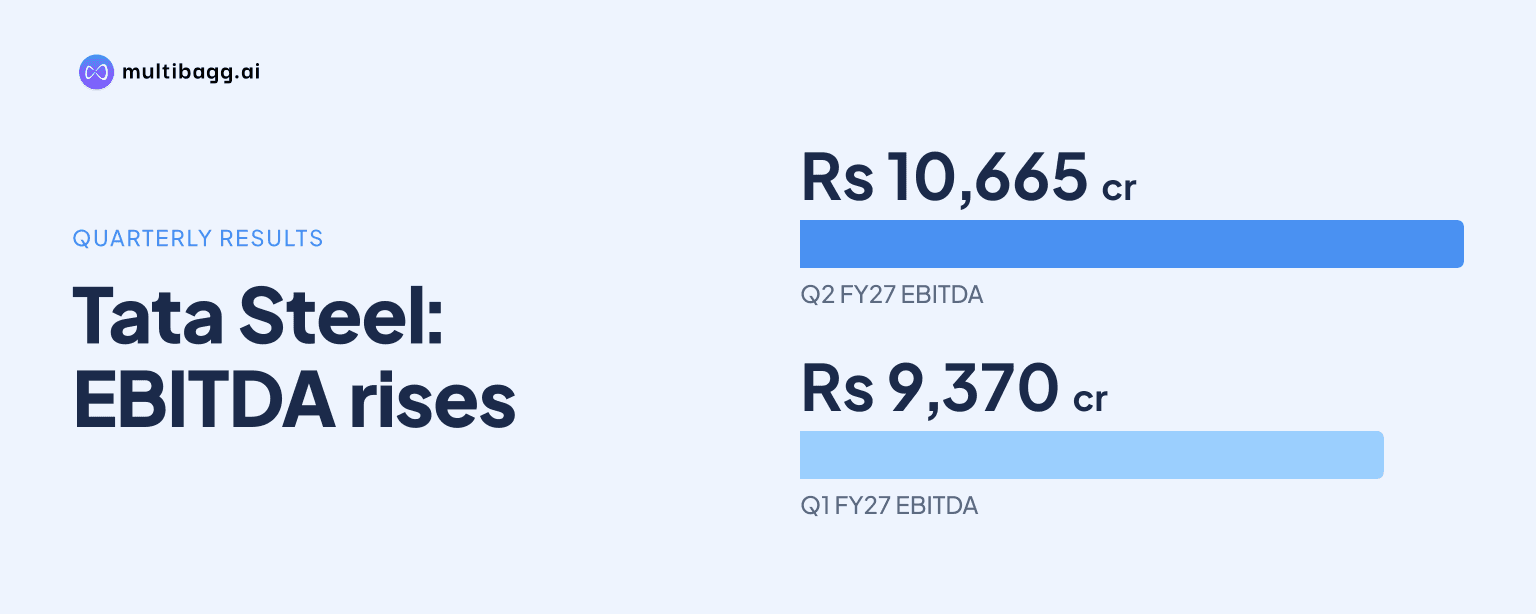
Tata Steel reported consolidated earnings before interest, tax, depreciation and amortisation (EBITDA) of Rs 10,665 crore in the second quarter of financial year 2027 (2QFY27), up 14% sequentially from Rs 9,370 crore, supported by India volumes and Rs 662 crore from a Direct Sheet Plant restart and cost-profile improvement at Tata Steel Netherlands. Net debt stood at Rs 91,423 crore in September 2026.
Know Tata Steel inside out
Results, valuation, peers and who's buying, in one view.
Why did Tata Steel’s EBITDA rise in 2QFY27?
Tata Steel’s EBITDA rose by Rs 1,295 crore sequentially through Rs 311 crore of market impact, Rs 294 crore of volume impact, Rs 662 crore from the Direct Sheet Plant restart and improved cost profile at Tata Steel Netherlands, Rs 275 crore from West Asia and Rs 303 crore of other factors. The company said market impact reflected improved steel realisations partly offset by higher raw-material costs.
Tata Steel’s revenue rose by Rs 4,642 crore to Rs 65,436 crore as consolidated deliveries increased to 7.92 million tons from 7.27 million tons. EBITDA per ton increased to Rs 13,462 from Rs 12,898, while production rose to 8.07 million tons from 7.69 million tons.
Tata Steel also faced higher operating costs in 2QFY27, with raw-material costs increasing by Rs 2,383 crore and other expenses by Rs 894 crore. The company attributed the raw-material increase to higher production in India and elevated input costs, while citing power and fuel, freight and handling, and consumables for the rise in other expenses.
How did India volumes affect Tata Steel’s quarter?
Tata Steel’s India deliveries rose 16% quarter on quarter to 6.0 million tons in 2QFY27 from 5.2 million tons in 1QFY27, providing the volume effect identified in the EBITDA bridge. Domestic deliveries rose by 0.5 million tons to 5.4 million tons, while exports doubled to 0.6 million tons from 0.3 million tons.
Tata Steel’s India deliveries were also above 5.6 million tons in 2QFY26. At the consolidated level, deliveries increased by 0.65 million tons sequentially, compared with a 0.38 million-ton increase in production, from 7.69 million tons to 8.07 million tons.
Tata Steel’s 2QFY27 India end-use mix was led by auto and ancillaries, which accounted for 24% of deliveries, followed by retail housebuilders at 21% and construction and infrastructure at 20%. Engineering and packaging represented 17%, trade and commercial 8%, and exports 10%.
Tata Steel sold 1.4 million tons to auto and ancillary customers in 2QFY27, compared with 1.3 million tons in both 1QFY27 and 2QFY26. Retail deliveries rose to 1.2 million tons from 1.1 million tons sequentially, while construction and infrastructure deliveries reached 1.2 million tons, above 1.1 million tons in 1QFY27 but below 1.4 million tons a year earlier.
Got a follow-up? Ask IRIS
What drove Tata Steel’s net debt to Rs 91,423 crore?
Tata Steel’s net debt was Rs 91,423 crore in September 2026 after gross debt rose to Rs 1,02,368 crore from Rs 97,985 crore in June 2026. The movement comprised Rs 3,900 crore in leases, Rs 209 crore of loan movement and Rs 273 crore from foreign-exchange effects and other items.
Tata Steel deducted Rs 10,301 crore of cash, bank balances and current investments and Rs 644 crore of mark-to-market gains on currency hedges from September gross debt. Its financial-management summary separately reported liquidity of Rs 40,076 crore and cash and cash equivalents of about Rs 10,300 crore.
Tata Steel’s net debt was Rs 80,144 crore at FY26, making the 1HFY27 figure Rs 11,279 crore higher. Gross debt increased from Rs 92,382 crore at FY26, while net debt to EBITDA moved to 2.39 times from 2.30 times; the company calculates that ratio using last-12-month EBITDA.
Tata Steel’s net debt-to-equity ratio increased to 0.87 times in 1HFY27 from 0.82 times at FY26. Its interest coverage ratio, defined as EBITDA divided by interest, rose to 5.2 times from 4.9 times, while Moody’s Ratings assigned Baa2 with a stable outlook in its May 2026 review and S&P Global Ratings assigned BBB with a stable outlook in August 2026.
How do Tata Steel’s latest credit metrics compare with earlier periods?
Tata Steel’s EBITDA margin was 15.9% in 1HFY27, compared with 15.0% in FY26 and 11.8% in FY25. EBITDA per ton rose to Rs 13,192 from Rs 10,900 in FY26, though both measures remained below FY22 levels of 26.2% and Rs 21,626 per ton.
Tata Steel’s net debt-to-EBITDA ratio of 2.39 times in 1HFY27 was below 3.31 times in FY24 and 3.19 times in FY25, but above FY26’s 2.30 times. Net debt was Rs 51,049 crore in FY22, compared with Rs 91,423 crore in 1HFY27.
Tata Steel identified India EBITDA of Rs 10,634 crore, working-capital management and capital expenditure of Rs 3,280 crore as elements of its financial-management framework. It also listed portfolio optimisation, including strategic mergers and acquisitions, and currency and commodity hedging as risk-resilience measures, without disclosing a debt-reduction target in the presentation.
Conclusion
Tata Steel’s 2QFY27 earnings recovery combined higher India deliveries, improved steel realisations, West Asia contributions and the Tata Steel Netherlands Direct Sheet Plant and cost-profile effects. These factors lifted EBITDA by Rs 1,295 crore sequentially, even as gross debt increased by Rs 4,383 crore from June to September 2026 and net debt reached Rs 91,423 crore.
The disclosed item to watch is Tata Steel’s Rs 7,140 crore FY2027 cost-optimisation target, measured against the average FY2026 baseline. The company identifies raw materials and procurement, production yield and reliability, fuel-rate optimisation, downstream initiatives and supply-chain optimisation as the mechanisms intended to deliver those benefits.