










Tata Steel India deliveries rise 16% across key segments
Key highlights
- Tata Steel India deliveries reached 6.0 million tons in 2QFY27, up 16% QoQ from 5.2 million tons.
- Auto and ancillary volumes increased to 1.4 million tons in 2QFY27 from 1.3 million tons in 1QFY27.
- Tata Steel reported 26% year-on-year growth in high-end auto sales in 2QFY27.
- Standalone revenue rose 15% QoQ to Rs 42,535 crore and EBITDA reached Rs 10,315 crore in 2QFY27.
powered by IRIS
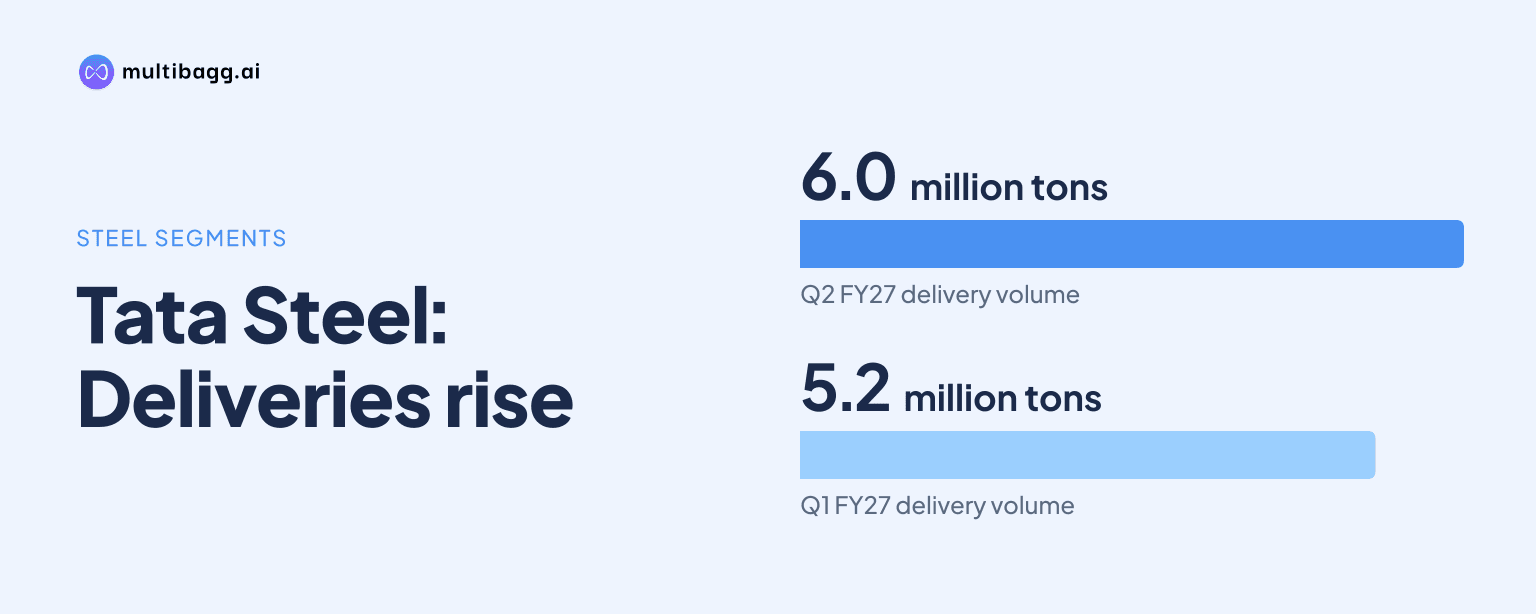
Tata Steel reported India deliveries of 6.0 million tons in 2QFY27, up 16% quarter on quarter from 5.2 million tons, supported by higher sales in auto and ancillaries, retail housebuilding, and construction and infrastructure. Domestic deliveries reached 5.4 million tons and exports rose to 0.6 million tons during the quarter.
Know Tata Steel inside out
Results, valuation, peers and who's buying, in one view.
How did Tata Steel's India deliveries change in 2QFY27?
Tata Steel's India deliveries increased to 6.0 million tons in 2QFY27 from 5.2 million tons in 1QFY27, a 16% quarter-on-quarter, or QoQ, increase. Domestic deliveries rose by 0.5 million tons to 5.4 million tons, while exports increased to 0.6 million tons from 0.3 million tons. Total deliveries also exceeded the 5.6 million tons reported for 2QFY26.
Tata Steel's standalone financial results recorded deliveries of 5.98 million tons in 2QFY27, compared with 5.17 million tons in 1QFY27 and 5.55 million tons in 2QFY26. Production increased to 5.91 million tons from 5.46 million tons sequentially. Management said deliveries rose faster than production because demand was broad-based across customer segments.
Which customer segments drove Tata Steel's volume recovery?
Tata Steel's sequential recovery was led by auto and ancillaries, retail sales to individual housebuilders, and construction and infrastructure. Auto and ancillary volumes rose to 1.4 million tons in 2QFY27 from 1.3 million tons in 1QFY27. Retail increased to 1.2 million tons from 1.1 million tons, and construction and infrastructure also rose to 1.2 million tons from 1.1 million tons.
The 2QFY27 end-use mix placed auto and ancillaries at 24%, followed by retail at 21% and construction and infrastructure at 20%. Engineering and packaging accounted for 17%, trade and commercial for 8%, and exports for 10%. Engineering and packaging recovered to 1.0 million tons from 0.9 million tons in 1QFY27, matching its 2QFY26 level.
The year-on-year comparison was uneven across sectors despite the sequential recovery. Auto and ancillaries increased from 1.3 million tons in 2QFY26 to 1.4 million tons in 2QFY27, while retail rose from 1.1 million tons to 1.2 million tons. Construction and infrastructure remained below its 2QFY26 volume of 1.4 million tons, although it gained 0.1 million tons from 1QFY27.
What indicates Tata Steel's value-added sales expansion?
Tata Steel reported 26% year-on-year growth in high-end auto sales in 2QFY27 and an approximately sixfold year-on-year increase in sales from Tata Steel Kalinganagar, or TSK, continuous annealing and continuous galvanising lines. Management identified the ramp-up of these new downstream facilities as part of its auto sales strategy.
The company cited product developments including approval of a CR IFHS340 skin-panel grade by a passenger-vehicle original equipment manufacturer and galvannealed steel with a chrome-free coating for two-wheeler fuel tanks. TSK's phase-two downstream operations also received small-diameter bar approvals for suspension and transmission applications from global manufacturers. These approvals and processing lines are the disclosed mechanisms behind the value-added product push.
Tata Steel's branded-products volumes rose 17% QoQ and 11% year on year in 2QFY27. Digital gross merchandise value increased 35% QoQ and 50% year on year through Tata Steel Aashiyana and iDigEca, its digital platform for emerging corporate accounts. Tata Tiscon had an established retail volume of 2.75 million tons, served about 500,000 customers annually, and recorded double-digit year-on-year district growth in about 78% of districts.
Got a follow-up? Ask IRIS
How did higher India deliveries affect Tata Steel's standalone earnings?
Tata Steel's standalone revenue from operations rose 15% QoQ to Rs 42,535 crore in 2QFY27 from Rs 36,897 crore in 1QFY27, primarily because of higher volumes, according to management. Earnings before interest, tax, depreciation and amortisation, or EBITDA, increased to Rs 10,315 crore from Rs 9,409 crore. Revenue and EBITDA were also higher than Rs 34,680 crore and Rs 8,394 crore, respectively, in 2QFY26.
EBITDA per ton declined sequentially to Rs 17,257 from Rs 18,198, although it remained above Rs 15,112 in 2QFY26. Raw-material cost increased to Rs 17,252 crore from Rs 14,844 crore in 1QFY27, reflecting higher production and input costs, including logistics. Inventory movement was Rs 82 crore in 2QFY27, compared with an inventory buildup of Rs 1,985 crore in 1QFY27, according to management.
Reported profit after tax rose to Rs 5,054 crore in 2QFY27 from Rs 4,535 crore in 1QFY27, while pre-exceptional profit before tax increased to Rs 6,766 crore from Rs 6,112 crore. Finance cost rose to Rs 1,504 crore from Rs 1,357 crore. Exceptional items were Rs 71 crore, primarily relating to an employee separation scheme, compared with Rs 292 crore in the preceding quarter.
Conclusion
Tata Steel's 2QFY27 India delivery increase reflected gains across its largest customer categories, with auto and ancillaries at 1.4 million tons, retail at 1.2 million tons and construction and infrastructure at 1.2 million tons. The higher volume base contributed to a 15% QoQ increase in standalone revenue to Rs 42,535 crore and a rise in EBITDA to Rs 10,315 crore, while EBITDA per ton declined as raw-material and logistics costs increased.
The next indicator is management's disclosed ramp-up of TSK downstream facilities and the conversion of passenger-vehicle, two-wheeler, suspension and transmission product approvals into sales. Branded-products volumes rose 17% QoQ and digital gross merchandise value grew 35% QoQ in 2QFY27, making subsequent performance in these channels relevant to the company's customer-ecosystem plan.