










Tata Steel plans nearly 40 MTPA of India steel capacity
Key highlights
- Tata Steel plans about 40 MTPA of India steelmaking capacity, versus 27.4 MTPA in FY26.
- The NINL expansion is 4.8 MTPA with a disclosed investment of Rs 33,873 crore.
- Tata Steel plans an iron-ore hub and a 5 MTPA steel plant in Maharashtra.
- India steel demand is projected at 220 million tonnes in FY30, up from 164 million tonnes in FY26.
powered by IRIS
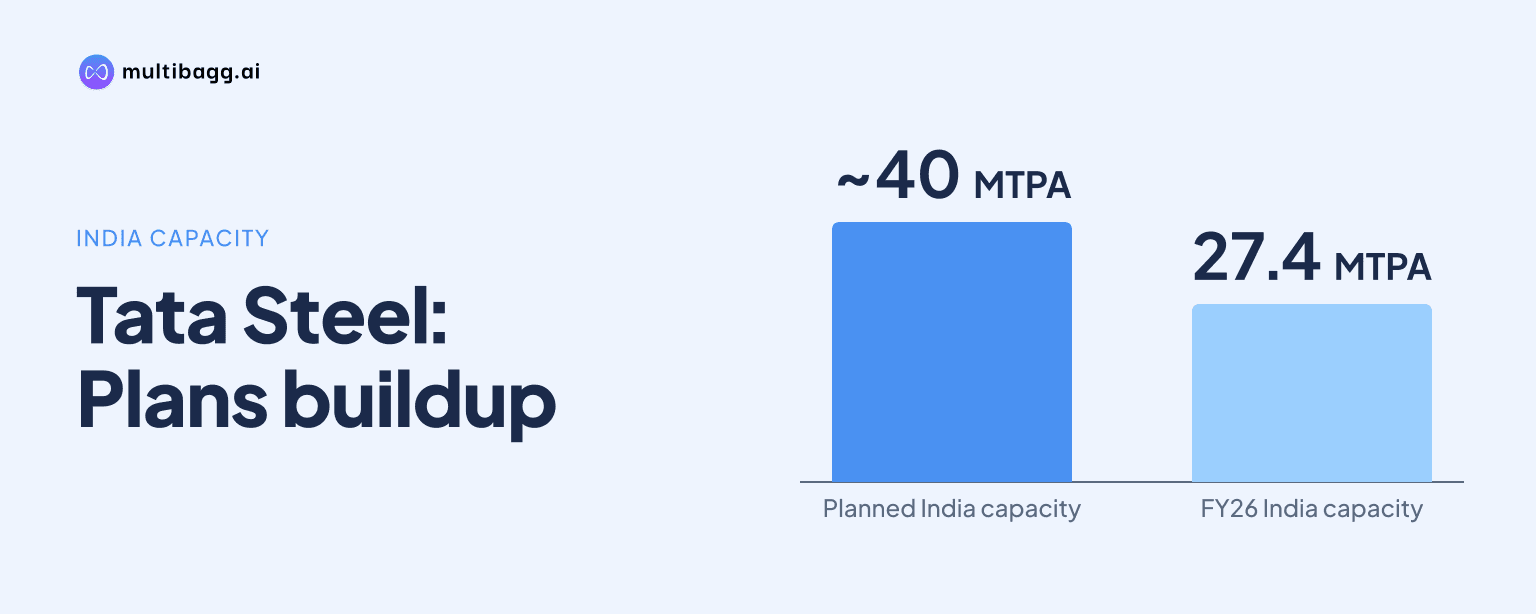
In its 2QFY27 results presentation, Tata Steel said it plans about 40 MTPA of India steelmaking capacity, compared with 27.4 MTPA in FY26, with a 4.8 MTPA NINL expansion, a planned 5 MTPA Maharashtra steel plant and a 2.5 MTPA Meramandali facility in its disclosed pipeline.
Know Tata Steel inside out
Results, valuation, peers and who's buying, in one view.
Why is Tata Steel expanding India steelmaking capacity?
Tata Steel is expanding because it identifies India as its core growth engine, with domestic steel demand projected to reach 220 million tonnes in FY30 from 164 million tonnes in FY26. Demand was 91 million tonnes in FY18, meaning FY26 demand was 1.8 times the level eight years earlier. Tata Steel also cites Make in India, the National Infrastructure Pipeline, the Specialty Steel Production-Linked Incentive scheme and PM Gati Shakti as structural demand drivers.
India’s per-capita steel use was 116 kilograms, compared with a global average of 210 kilograms, according to the presentation. Tata Steel says demand is steadily shifting towards quality and customisation, a trend it describes as premiumisation. About 90% of Tata Steel sales are in domestic markets, giving its India operations direct exposure to the domestic steel-demand cycle.
Tata Steel’s planned capacity of about 40 MTPA compares with 13.0 MTPA in FY18 and 27.4 MTPA in FY26. The planned level is about 12.6 MTPA above the FY26 base, while Tata Steel says the pipeline can be scaled beyond 40 MTPA. The presentation does not assign a completion date to the overall capacity objective, so it is a capacity plan rather than a stated production forecast.
Where is Tata Steel’s existing India capacity located?
Tata Steel’s existing 27.4 MTPA India capacity is concentrated in Jamshedpur, Kalinganagar and Meramandali, with smaller long-products sites at NINL, Gamharia and Ludhiana. Jamshedpur has 7.5 MTPA of flat-products capacity and 3.5 MTPA of long-products capacity, while Kalinganagar has 8.0 MTPA of flats and Meramandali has 5.6 MTPA of flats.
NINL and Gamharia each have 1.0 MTPA of long-products capacity, while Ludhiana has 0.75 MTPA. The site mix is therefore primarily weighted to flat steel, while long-products capacity is spread across four sites. Tata Steel describes its integrated sites as combining primary steelmaking with downstream facilities, supported by energy integration, raw-material logistics and supply-chain efficiencies.
Tata Steel identifies Jamshedpur and Kalinganagar as World Economic Forum Lighthouse facilities. The 27.4 MTPA India total includes the 0.75 MTPA Ludhiana electric arc furnace, whose ramp-up remains in progress, showing that part of the stated capacity base is still moving toward fuller utilisation.
Which projects are intended to lift Tata Steel’s capacity?
Tata Steel’s clearest disclosed steelmaking addition is a 4.8 MTPA expansion at NINL, with an investment of Rs 33,873 crore. NINL, or Neelachal Ispat Nigam Limited, is listed with 1.0 MTPA of existing long-products capacity. The expansion is consequently a major element of the move from 27.4 MTPA in FY26 toward the approximately 40 MTPA planned level.
At Tata Steel Meramandali, Tata Steel lists a 2.5 MTPA thin slab caster and rolling facility. In Maharashtra, it plans to develop an iron-ore hub and a 5 MTPA steel plant. The presentation does not disclose investment cost, construction timing or commissioning dates for the Meramandali facility or the Maharashtra plan, and it does not specify whether all project capacities can be added directly to the FY26 base.
Ludhiana provides a separate scrap-based route through its 0.75 MTPA electric arc furnace, or EAF, where ramp-up is in progress. Tata Steel also says it has commissioned 0.75 MTPA of EAF capacity in India under its responsible-growth actions. This combines larger integrated-site projects with an EAF operation already included in the company’s reported FY26 India capacity.
Got a follow-up? Ask IRIS
How is Tata Steel expanding downstream products?
Tata Steel is pairing steelmaking expansion with downstream investment in cold rolled, galvanised, colour-coated, tubes, tinplate, wires and ready-to-use products. At the Tata Steel Kalinganagar cold rolling mill complex, it lists a continuous annealing line of about 0.9 MTPA and two continuous galvanising lines of about 0.5 MTPA each. Tata Steel also says zinc-aluminium-magnesium coated coil is now produced at Kalinganagar for construction, infrastructure, solar and agriculture applications.
A 0.7 MTPA hot rolled pickling and galvanising line is under engineering and civil erection. Tata Steel has colour-coated facilities at Jamshedpur, Khopoli, Angul and Sahibabad with combined capacity of about 0.5 MTPA. Its tinplate project is in civil and equipment erection, with phase-one capacity intended to rise from 0.4 MTPA to 0.7 MTPA, while a 75 KTPA, or thousand tonnes per annum, wire-capacity addition is in progress.
The downstream programme serves automobiles, engineering, packaging and construction. Tata Steel says it is localising advanced grades and co-creating products for automotive customers, while expanding specialised engineering and packaging applications including oil and gas and appliances. In construction, Tata Steel reports more than 80 steel processing centres, 35 construction service centres, 22 stockyards and more than 35,000 retail influencers.
How does Tata Steel plan to reach chosen customer segments?
Tata Steel’s route to chosen segments includes advanced-grade localisation for automotive customers, its Tata Tiscon construction offering and the Aashiyana e-commerce platform for individual home builders. The company also says it is shaping construction practices through integrated solutions intended to improve ease of use and project efficiency, alongside an asset-light model for tubes capacity expansion.
For micro, small and medium enterprises, Tata Steel cites seamless digital access and customer experience as part of its approach. Its network serves more than 80 micro segments, alongside the 80-plus processing centres and 22 stockyards disclosed for construction distribution. Tata Steel also identifies shipbuilding, defence and data centres as emerging growth segments, without giving volume targets for these markets.
Conclusion
Tata Steel’s India strategy combines a planned move from 27.4 MTPA in FY26 to about 40 MTPA of steelmaking capacity with downstream additions in coated, cold-rolled, tinplate and wire products. The plan is linked to Tata Steel’s view that India steel demand could rise from 164 million tonnes in FY26 to 220 million tonnes in FY30 while demand shifts towards customised products.
The next items to watch are progress on the Rs 33,873 crore NINL expansion, the planned 5 MTPA Maharashtra steel plant and the 2.5 MTPA Meramandali facility. Tata Steel has disclosed that Ludhiana’s 0.75 MTPA EAF ramp-up and the 0.7 MTPA galvanising-line erection are in progress, but it has not provided a timetable for reaching the overall approximately 40 MTPA capacity plan.