










Tata Steel Netherlands returns to positive EBITDA in 2QFY27
Key highlights
- Netherlands EBITDA rose to Rs 790 crore in 2QFY27 from Rs 39 crore in 1QFY27.
- Netherlands raw-material cost fell by Rs 526 crore sequentially to Rs 6,780 crore after the Direct Sheet plant restart.
- UK’s EBITDA loss widened to Rs 719 crore in 2QFY27 from Rs 341 crore in 1QFY27.
- UK deliveries declined 22% quarter on quarter to 0.38 million tons in 2QFY27.
powered by IRIS
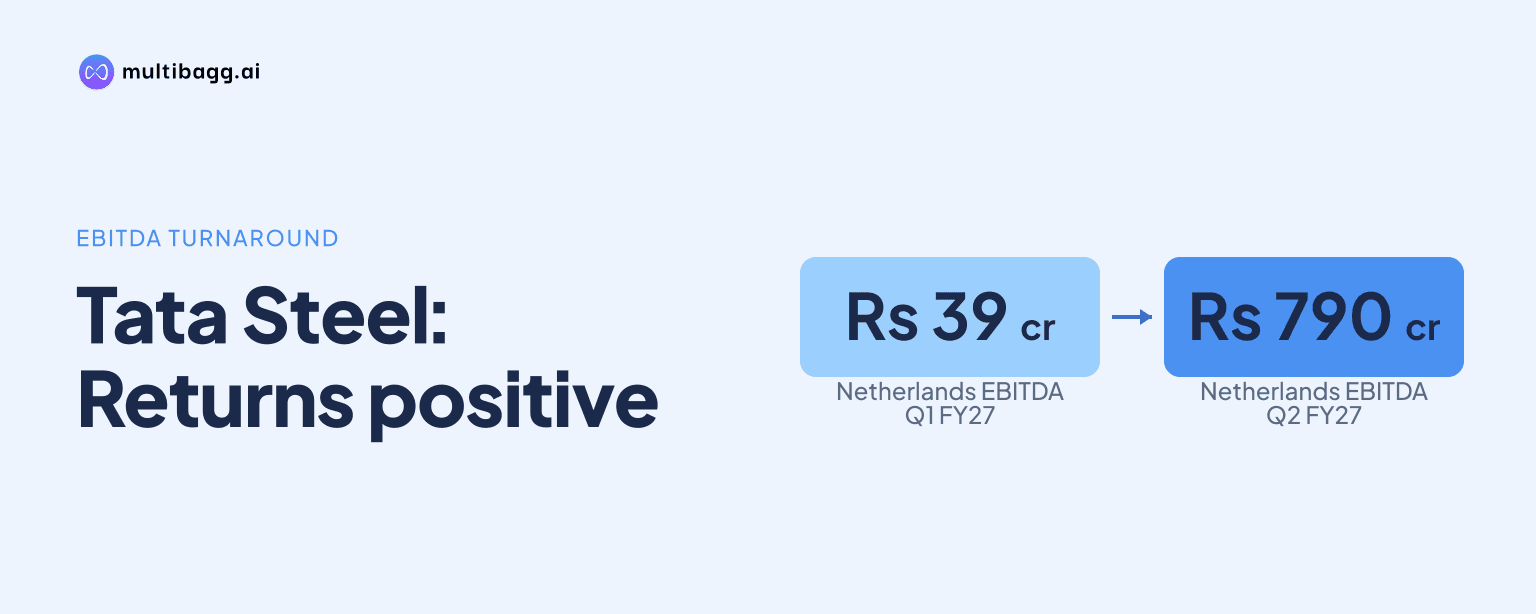
Tata Steel Netherlands returned to positive EBITDA of Rs 790 crore in 2QFY27 from Rs 39 crore in 1QFY27, as lower purchases after the Direct Sheet plant restart reduced raw-material cost; Tata Steel UK’s EBITDA loss widened to Rs 719 crore from Rs 341 crore.
Know Tata Steel inside out
Results, valuation, peers and who's buying, in one view.
What drove Netherlands' EBITDA recovery in 2QFY27?
Netherlands' EBITDA recovery was driven primarily by a Rs 526 crore sequential reduction in raw-material cost after the Direct Sheet plant restart. Raw-material cost declined to Rs 6,780 crore in 2QFY27 from Rs 7,306 crore in 1QFY27, while EBITDA increased to Rs 790 crore from Rs 39 crore. Management attributed the lower cost mainly to lower purchases following the plant restart.
The sequential improvement did not restore EBITDA to its year-earlier level of Rs 916 crore in 2QFY26. EBITDA in 2QFY27 was therefore Rs 126 crore below the prior-year quarter, although EBITDA per ton rose to Rs 6,062 from Rs 279 in 1QFY27 and exceeded Rs 5,948 in 2QFY26. The presentation reports EBITDA for Netherlands, not net profit or loss.
Costs outside raw materials moved in different directions during 2QFY27. Employee-benefit expense fell to Rs 3,024 crore from Rs 3,552 crore in 1QFY27, whereas other expenses increased by Rs 600 crore to Rs 5,996 crore. Management linked the increase in other expenses to consumables and greater spending on bulk gas-related costs, partly offsetting the savings from lower purchases.
How did Netherlands' production, deliveries and revenue change?
Netherlands' production, deliveries and revenue all declined in 2QFY27 despite the EBITDA recovery. Liquid-steel production was 1.52 million tons, down from 1.55 million tons in 1QFY27 and 1.67 million tons in 2QFY26. Deliveries decreased to 1.30 million tons from 1.40 million tons sequentially and 1.54 million tons a year earlier.
Revenue from operations declined to Rs 15,330 crore in 2QFY27 from Rs 15,803 crore in 1QFY27, a fall of Rs 473 crore. Management said higher realisations did not offset the drop in volume. This means the Rs 751 crore sequential EBITDA increase occurred alongside lower production, deliveries and revenue, with the reduction in raw-material purchases providing the stated operating-cost support.
The inventory-change line was negative Rs 1,261 crore in 2QFY27, compared with negative Rs 491 crore in 1QFY27 and positive Rs 316 crore in 2QFY26. Management said inventory built up primarily because of price and mix. The presentation does not disclose selling prices per ton, inventory tonnage, or the restart date of the Direct Sheet plant, so it does not quantify the contribution of price, mix or volumes to EBITDA.
Got a follow-up? Ask IRIS
Why did UK’s EBITDA loss widen in 2QFY27?
UK’s EBITDA loss widened because lower demand and inventory build-up reduced deliveries while raw-material cost increased. EBITDA was a loss of Rs 719 crore in 2QFY27, compared with a Rs 341 crore loss in 1QFY27. Deliveries fell 22% quarter on quarter to 0.38 million tons from 0.48 million tons.
Management attributed the delivery decline to weak demand and inventory build-up in the UK supply chain before revised trade measures became effective on 01st July 2026. Revenue fell by Rs 840 crore sequentially to Rs 5,275 crore in 2QFY27 from Rs 6,115 crore, as higher realisations were more than offset by the volume reduction.
Raw-material cost rose to Rs 3,987 crore in 2QFY27 from Rs 3,528 crore in 1QFY27, primarily because of higher substrate cost, according to management. Other expenses also increased by Rs 85 crore to Rs 1,677 crore, while employee-benefit expense was unchanged at Rs 1,103 crore. EBITDA per ton consequently moved to a loss of Rs 19,027 from a loss of Rs 7,071 in the preceding quarter.
How did the two European businesses diverge during the quarter?
The two businesses diverged mainly in their cost movements and delivery trends during 2QFY27. Netherlands cut raw-material cost by Rs 526 crore sequentially and increased EBITDA by Rs 751 crore, while UK raised raw-material cost by Rs 459 crore and its EBITDA loss widened by Rs 378 crore. Both businesses recorded lower deliveries, but the stated cost drivers were different.
Netherlands' deliveries fell by 0.10 million tons quarter on quarter, while UK deliveries fell by the same 0.10 million tons from a smaller base of 0.48 million tons. Netherlands' revenue declined 3% sequentially to Rs 15,330 crore, compared with a 14% reduction for UK to Rs 5,275 crore. The presentation attributes Netherlands' lower raw-material purchases to the Direct Sheet plant restart and UK’s higher input cost to substrate prices.
Inventory was also a disclosed issue in both operations. Netherlands reported a negative Rs 1,261 crore inventory-change line in 2QFY27, with management citing price and mix, while UK reported negative Rs 772 crore after a positive Rs 233 crore in 1QFY27. UK management specifically connected its supply-chain inventory build-up with trade measures effective from 01st July 2026; no equivalent regulatory factor was disclosed for Netherlands.
Conclusion
The 2QFY27 figures show that Netherlands restored positive operating earnings even as its deliveries fell to 1.30 million tons and revenue declined to Rs 15,330 crore. Lower raw-material purchases following the Direct Sheet plant restart outweighed higher bulk-gas and consumable expenses. UK faced the opposite sequential direction: lower demand, lower deliveries and higher substrate cost pushed its EBITDA loss to Rs 719 crore.
The next results will indicate whether Netherlands can sustain lower purchasing costs while rebuilding deliveries from 1.30 million tons and managing other expenses of Rs 5,996 crore. For UK, the key disclosed matter is the effect of revised trade measures effective 01st July 2026, since management linked the inventory build-up before those measures to the 2QFY27 delivery decline.