










Tata Steel Limited expects Netherlands clarity by March 2027
Key highlights
- Tata Steel extended its Netherlands Joint Letter of Intent by five months to March 1, 2027.
- Sensitivity analysis could indicate impairment against Rs 3,38,692.59 crore of Tata Steel Nederland assets and goodwill.
- Cash and cash equivalents were Rs 7,530.01 crore on September 30, 2026, versus Rs 6,694.80 crore a year earlier.
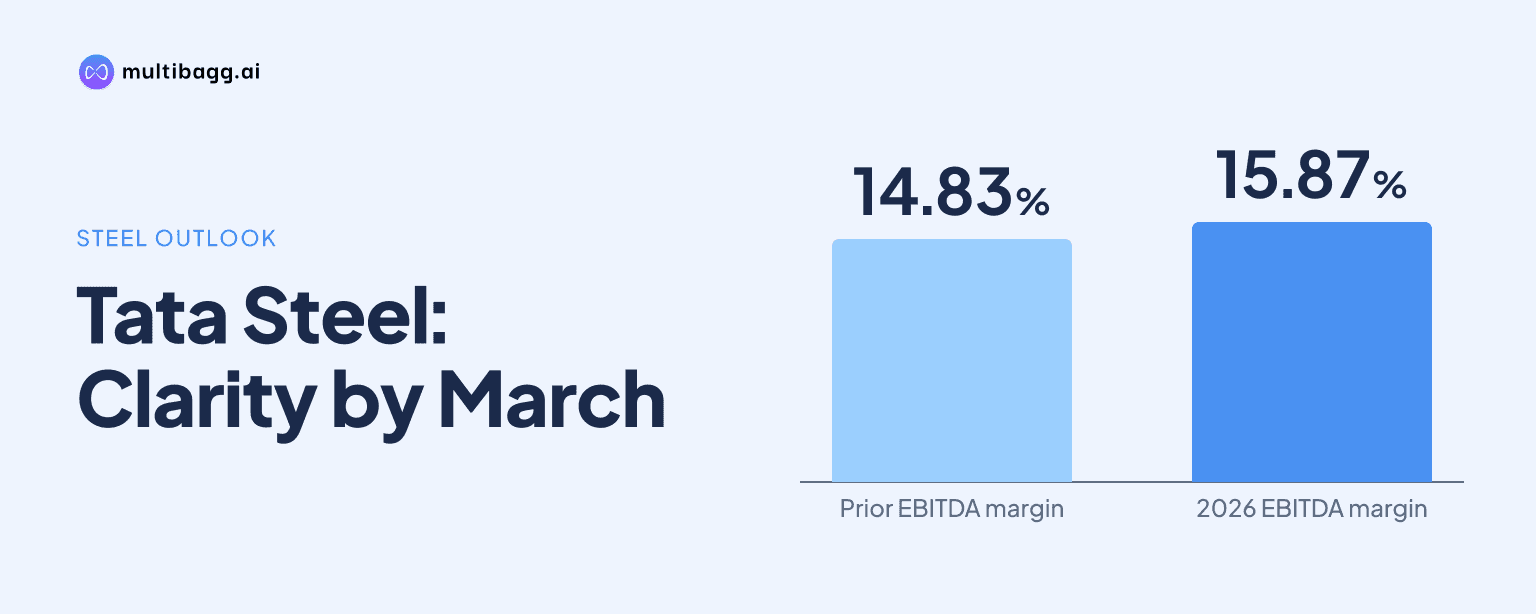
- Operating EBITDA margin was 15.87% in the six months ended September 30, 2026, compared with 14.83% a year earlier.
powered by IRIS
Tata Steel Limited expects significant clarity on the strategic future of Tata Steel Nederland around March 1, 2027, the revised deadline for talks with Dutch authorities. Tata Steel said sensitivity analysis of its current transition model could indicate material or substantive impairment against Rs 3,38,692.59 crore of Tata Steel Nederland property, plant, equipment and goodwill.
Know Tata Steel inside out
Results, valuation, peers and who's buying, in one view.
Why did Tata Steel extend Netherlands government talks?
Tata Steel extended the non-binding Joint Letter of Intent, or JLOI, by five months to March 1, 2027, to resolve matters needed for a tailored agreement and final investment decision. On September 25, 2026, the Government of the Netherlands, the province of North-Holland, Tata Steel and Tata Steel Nederland agreed to the extension.
The JLOI was originally executed on September 29, 2025. It set objectives for the first phase of a transition to low-carbon-dioxide steel production and for improving the healthy living environment around the IJmuiden site, while committing the parties to good-faith negotiations.
The five-month extension does not establish a final project or investment decision. Tata Steel said significant clarity should emerge around the March 1, 2027 maturity date and that it does not expect another extension without a determinate way forward.
What is holding back Tata Steel Nederland's strategy?
Tata Steel Nederland's operating economics and decarbonisation case depend on rules for steel slag, the timing of coke-oven closures and long-term energy costs. Tata Steel said these matters are outside Tata Steel Nederland's control and depend on legislative, executive and judicial processes with limited precedent.
On April 23, 2026, the local Environment Agency and the province of North-Holland indicated an intention to revoke operating permits and trigger an early closure of Coke and Gas Plant 1 and 2. Tata Steel Nederland provided a timeline that it considers necessary for a safe, responsible and controlled closure, but said the timing decision remains unclear.
Tata Steel Nederland retains options including legal recourse over the proposed closure process. Technical information has been exchanged and independently validated, but the company said this work has not yet produced a clear decision from the two authorities.
The removal of steel slag from IJmuiden is also temporarily disrupted while regulators develop standards on its classification as a material and disposal. This has created excess stockpiling, and Tata Steel Nederland is pursuing regulatory engagement, legal and technical assessments, plus alternative storage and disposal options.
Why could Tata Steel Nederland face an impairment?
Tata Steel said its existing direct reduced iron-electric arc furnace, or DRI-EAF, model could indicate material or substantive impairment under sensitivity analysis against Rs 3,38,692.59 crore of property, plant, equipment and goodwill. The result changes with assumptions including the discount rate, cost estimates and other key inputs.
Indian Accounting Standard 36, or Ind AS 36, requires the recoverable amount to be the higher of fair value less costs of disposal and value in use. Tata Steel said it cannot reliably determine either the value or probability of every potential strategic outcome, so any probability weighting would rely largely on judgement rather than observable evidence.
Management has therefore used the DRI-EAF model submitted for the JLOI, adjusted to cash-flow estimates as at September 30, 2026. The broader business case remains unsettled because required capital expenditure has increased, permitting is complex, timelines are evolving and the European Union regime for free EU Emissions Trading System allowances is changing.
Tata Steel has not identified one optimal strategic path for Tata Steel Nederland. It said that, after evaluation and board approval, alternative strategic options could become available to management and could produce materially different future cash flows.
Got a follow-up? Ask IRIS
How does the Netherlands review affect Tata Steel's accounts?
Tata Steel measures its Tata Steel Holdings Pte. Ltd. investment at fair value through other comprehensive income, or FVTOCI, in its standalone results. The investment was stated at Rs 3,59,078.13 crore and is largely dependent on Tata Steel Europe's operating and financial performance, including models for Tata Steel UK and Tata Steel Nederland.
Management and the board said recognising a further reduction in fair value at this stage would not faithfully represent Tata Steel's financial position. They made the same assessment on recognising material impairment under the current DRI-EAF model because of uncertainty over the eventual Netherlands outcome.
Tata Steel disclosed that its statutory auditors modified their review conclusion and audit opinion on the consolidated and standalone financial results, respectively, for the quarter and six months ended September 30, 2026. The company linked the modification to the unresolved strategic and valuation circumstances described for Tata Steel Nederland and related investments.
The wider group reported closing cash and cash equivalents of Rs 7,530.01 crore on September 30, 2026, compared with Rs 6,694.80 crore a year earlier. Net cash from operating activities fell to Rs 7,760.79 crore in the six months ended September 30, 2026 from Rs 13,073.80 crore in the corresponding 2025 period.
Tata Steel said it assessed the group's ability to meet liquidity requirements, including those at Tata Steel Nederland and Tata Steel UK, and concluded that cash-flow and liquidity positions remain adequate. The company also reported operating earnings before interest, depreciation, tax and amortisation margin of 15.87% for the September 2026 half-year, up from 14.83% a year earlier.
What could happen before March 1, 2027?
Tata Steel will reassess Tata Steel Nederland's recoverable amount at each reporting date and earlier if significant developments occur. A decision on the April 23, 2026 permit action, progress on slag disposal rules or clarity on energy costs could therefore trigger reassessment before March 1, 2027.
The final pathway must address the JLOI's low-carbon steel objective alongside capital expenditure, permits and the changing European Union emissions-allowance framework. As of the November 7, 2026 results announcement, Tata Steel had not disclosed a final investment decision, government agreement, coke-oven closure date or selected alternative strategy.
Conclusion
The extended JLOI gives Tata Steel and Dutch public authorities until March 1, 2027 to resolve the conditions underpinning the Netherlands transition plan. The outcome matters for Tata Steel Nederland's future cash flows, the Rs 3,38,692.59 crore carrying value tested through the DRI-EAF model and the Rs 3,59,078.13 crore standalone valuation of Tata Steel Holdings Pte. Ltd.
The next disclosed milestone is the March 1, 2027 JLOI maturity, when management expects significant clarity. Before then, the matters to watch are decisions on the proposed closure of Coke and Gas Plant 1 and 2, steel-slag regulation, long-term energy costs, permits and any earlier recoverable-amount reassessment by Tata Steel.