










TD Power Systems Limited Q2 revenue rises 85% to ₹841 crore
Key highlights
- TD Power Systems Limited reported Q2 FY27 consolidated revenue of ₹841.32 crore, up 85.9% year-on-year.
- Q2 FY27 net profit was ₹123.75 crore, up 106% year-on-year.
- Q2 FY27 order inflow was ₹824.4 crore, with exports contributing 88% of inflows.
- TD Power Systems raised FY27 revenue guidance to ₹2,900 crore-₹3,000 crore.
powered by IRIS
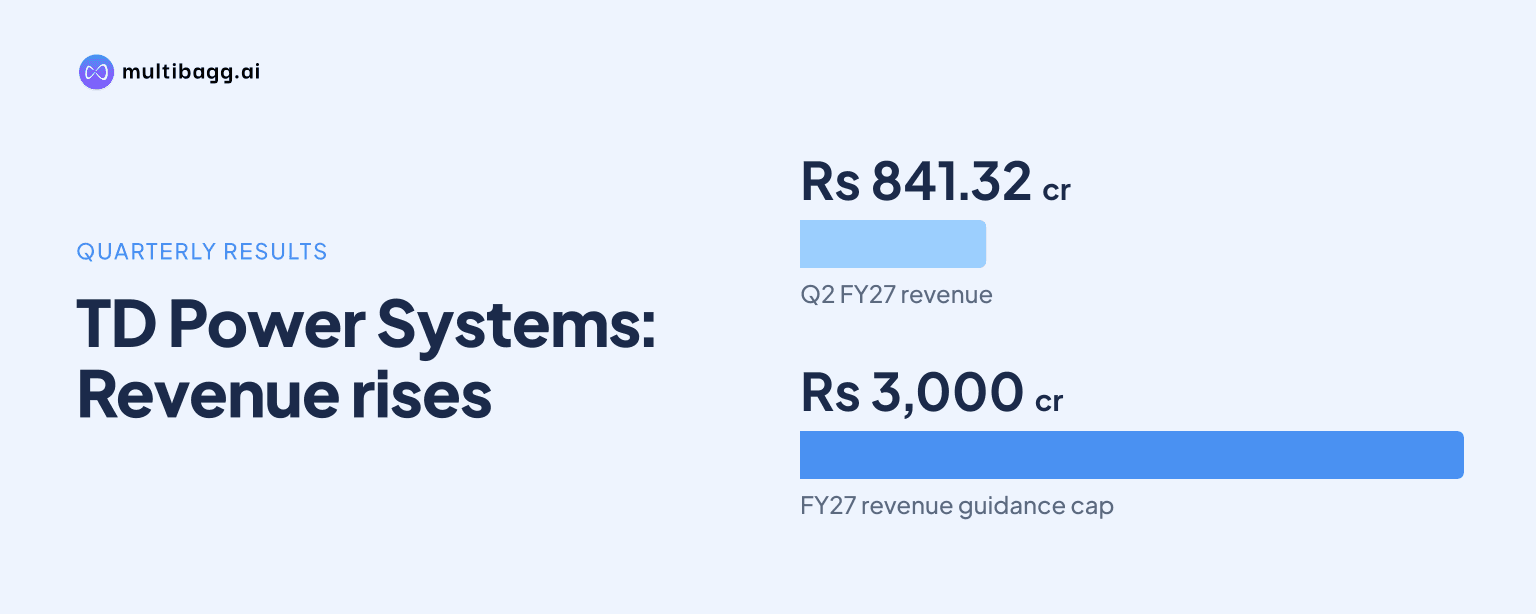
TD Power Systems Limited reported consolidated revenue of ₹841.32 crore in Q2 FY27, up 85.9% year-on-year, while net profit increased 106% to ₹123.75 crore. The September-quarter performance reflects record quarterly sales and order inflow, prompting management to raise its FY27 revenue guidance to ₹2,900 crore-₹3,000 crore.
Know TD Power Systems inside out
Results, valuation, peers and who's buying, in one view.
What did TD Power Systems report for Q2 FY27?
TD Power Systems reported strong growth in consolidated revenue and profit for the quarter ended September 30, 2026. Revenue from operations was ₹841.32 crore, compared with ₹452.47 crore in the corresponding quarter a year earlier. EBITDA was ₹173.59 crore, and profit after tax stood at ₹123.75 crore.
The company described the quarter as one of record sales and order inflow. Consolidated profit before tax was ₹167.75 crore, compared with ₹81.82 crore in the year-ago period. For the first half of FY27, consolidated revenue from operations reached ₹1,481.37 crore and profit after tax was ₹210.04 crore.
The reported figures underline the scale of the improvement during the first six months of the financial year. Management linked the business momentum to demand across several markets rather than a single customer segment or geography.
What drove the quarter's sales and order momentum?
TD Power Systems said demand was broad based across export and domestic opportunities, supporting both sales and new order inflow. Its management highlighted India’s steel industry and Europe’s grid-stabilisation requirements as important contributors to the order book, indicating that the demand base was not limited to data-centre-related projects.
Order inflow in Q2 FY27 was ₹824.4 crore, up 57% year-on-year, according to the earnings-call summary. Export markets accounted for 88% of the quarter’s order inflow. For H1 FY27, order inflow reached ₹1,558.5 crore, up 70%, with exports representing 90% of inflows.
The manufacturing order book stood at ₹2,318.7 crore at September 30, 2026. Generators accounted for ₹2,088 crore of this amount, while railways accounted for ₹170 crore, spares and aftermarket for ₹16 crore, and Turkey-related orders for ₹45 crore. These figures show that generators remained the company’s largest booked business category.
The company held its post-results earnings conference call on November 13, 2026, covering its unaudited results for the quarter and half year ended September 30. It subsequently disclosed that the recording was available on its investor-relations webpage, allowing shareholders and analysts to review management’s commentary.
Got a follow-up? Ask IRIS
Why did management raise FY27 revenue guidance?
TD Power Systems raised its final FY27 revenue guidance to ₹2,900 crore-₹3,000 crore after the first-half performance and order momentum. Management indicated that H2 sales were expected to be broadly split between the two remaining quarters, with Q3 and Q4 revenue each expected in the ₹725 crore-₹750 crore range.
The updated range is significant because the company had already reported ₹1,481.37 crore of consolidated revenue in the first half. The guidance implies that management expects H2 execution to remain substantial, supported by the existing order book and inflows recorded during the September quarter.
Management also provided initial FY28 revenue guidance of ₹3,400 crore-₹3,500 crore, describing it as conservative and stating that there was a high likelihood of an upward revision. This is a management outlook, not a reported financial result, and depends on execution, order conversion, and conditions in the markets served by the company.
The guidance came after a period of rapid growth in the first half. Standalone total income for H1 FY27 was reported at ₹1,455 crore, up 91% year-on-year, while standalone EBITDA margin was 20.02%. The consolidated and standalone measures are different reporting bases and should not be compared as identical metrics.
How do the results affect investors and the power-equipment industry?
The results place investor attention on order conversion, export exposure and margins. Revenue growth of 85.9% and net-profit growth of 106% demonstrate a sharp improvement over the previous year’s September quarter, while the ₹2,318.7 crore manufacturing order book provides visibility into contracted work at the end of the period.
Export demand is particularly relevant because exports represented 88% of Q2 order inflow and 90% of H1 inflow. This makes overseas industrial investment and grid-related requirements important factors for the company’s operating performance. The management commentary specifically identified European grid stabilisation and Indian steel-sector demand as supporting areas.
For the industry, the results point to active demand for generators and associated power equipment across industrial and grid applications. However, the disclosed information does not establish how demand will develop beyond the company’s stated guidance. Investors will therefore assess subsequent order inflows, sales execution and profitability against management’s quarterly revenue expectations.
The company’s disclosure of its earnings-call recording also improves access to management commentary for market participants who did not attend the live call. The filing was made under Regulation 30 of the SEBI Listing Obligations and Disclosure Requirements Regulations, 2015.
Conclusion
TD Power Systems delivered a substantial increase in Q2 FY27 revenue, EBITDA and net profit, supported by record sales and order inflow. The quarter’s ₹841.32 crore consolidated revenue, ₹123.75 crore net profit and ₹2,318.7 crore manufacturing order book provide the central financial context for the company’s upgraded FY27 outlook.
The next key measure will be execution against management’s stated H2 sales expectation of ₹725 crore-₹750 crore in each of Q3 and Q4. Investors will also watch fresh order inflows, the export mix and progress toward the company’s initial FY28 revenue guidance of ₹3,400 crore-₹3,500 crore.