










TD Power Systems Limited lifts FY27 outlook to ₹3,000 crore
Key highlights
- TD Power Systems revised FY27 revenue guidance to ₹2,900-3,000 crore on November 13, 2026.
- Standalone H1 FY27 total income rose 91% year on year to ₹1,455 crore.
- H1 FY27 manufacturing order booking was ₹2,319 crore, including ₹2,088 crore for generators.
- Management said more than ₹1,200 crore of FY28 revenue must be booked and delivered within FY28.
powered by IRIS
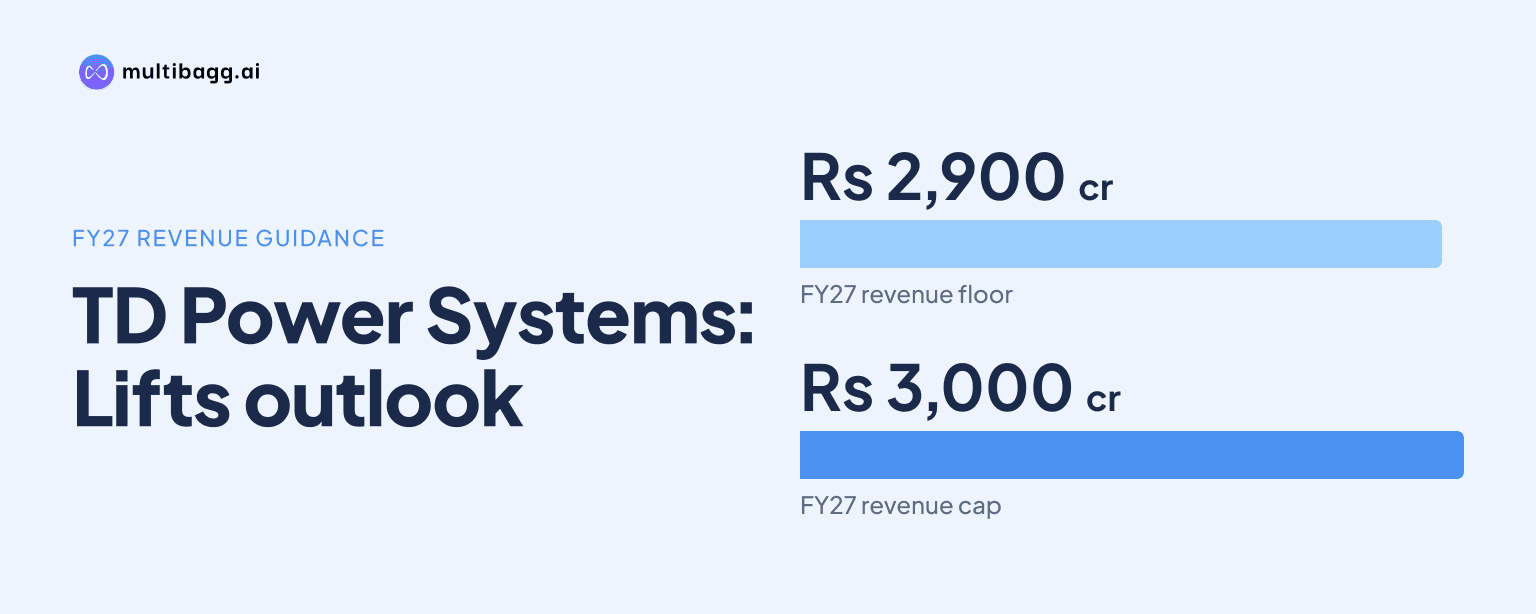
TD Power Systems Limited revised FY27 revenue guidance to ₹2,900-3,000 crore after standalone H1 FY27 total income rose 91% year on year to ₹1,455 crore, and management set initial FY28 guidance of ₹3,400-3,500 crore. Management said on November 13, 2026 that FY28 will require more than ₹1,200 crore of orders to be booked and delivered within the year.
Know TD Power Systems inside out
Results, valuation, peers and who's buying, in one view.
Why did TD Power Systems revise its FY27 revenue guidance?
TD Power Systems revised its final FY27 revenue guidance to ₹2,900-3,000 crore after reporting standalone H1 FY27 total income of ₹1,455 crore, compared with ₹764 crore in H1 FY26. The company reported the 91% increase for the six months ended September 30, 2026.
Management said H2 FY27 sales should be broadly divided equally between Q3 and Q4, at ₹725-750 crore in each quarter. The quarterly indication sets out the execution path for the revised target in the year ending March 2027.
Management identified data centres, grid stabilisation, conventional power generation and renewables-linked applications as demand drivers. It specifically cited geothermal, hydro and waste-to-energy among the renewable applications, while saying its original equipment manufacturer, or OEM, customers sell turbines and engines to several end-markets rather than data centres alone.
How did TD Power Systems perform in H1 FY27?
TD Power Systems reported higher standalone income, profit and margin in H1 FY27, with total income up 91% and profit after tax and comprehensive income up 110%. Earnings before interest, tax, depreciation and amortisation, or EBITDA, margin was 20.02%, including other income but excluding exceptional and treasury income, compared with 18.42% in H1 FY26.
On a consolidated basis, TD Power Systems reported H1 FY27 total income of ₹1,486 crore, against ₹833 crore in H1 FY26, an increase of 78%. Consolidated profit after tax rose 89% to ₹209.6 crore from ₹110 crore.
TD Power Systems also reported cash of ₹419 crore at the end of H1 FY27, including customer advances and money from the preferential share issue. The consolidated income increase of 78% was lower than the 91% standalone increase, while consolidated profit after tax reached ₹209.6 crore versus standalone profit after tax and comprehensive income of ₹207.4 crore.
Does TD Power Systems have enough orders for FY28 guidance?
TD Power Systems said it had about ₹2,300 crore of pending orders and will need fresh book-and-bill business to achieve its FY28 revenue guidance of ₹3,400-3,500 crore. Management said more than ₹1,200 crore of FY28 revenue would need to be booked and delivered within FY28.
Management said most of the existing order book was executable over the next 12 months. During the discussion, it also referred to an initial FY28 guidance figure of ₹3,435 crore, which falls within the ₹3,400-3,500 crore range, and said orders can continue to be received from November 2026 to March 2027.
Manufacturing-segment order booking was ₹2,319 crore in H1 FY27, of which generators accounted for ₹2,088 crore. Railways contributed ₹170 crore, spares and aftermarket ₹16 crore, and the Turkey business ₹45 crore, making generators the largest reported booking segment.
Q2 FY27 order inflow was ₹824 crore, up 57% sequentially and about 70% from the previous year, according to management. Direct and deemed export order inflow was ₹1,406 crore in H1 FY27, compared with ₹695 crore a year earlier, while exports represented 92% of H1 inflows and domestic orders 8%.
Got a follow-up? Ask IRIS
What demand and pricing conditions did TD Power Systems describe?
TD Power Systems said it has visibility on data-centre-related projects and demand through around 2030, based on discussions with OEM customers. Management also said its turbine and engine customers continued to receive production-slot bookings beyond 2030, though this was market commentary rather than company revenue guidance.
The company cited demand from India’s steel industry for equipment in the 40-megawatt to 100-megawatt range, and from Europe for grid stabilisation and waste-to-energy. These markets sit alongside export-linked H1 order inflows of ₹1,406 crore, nearly double the ₹695 crore reported in H1 FY26.
Management said pricing was stable as of the November 13, 2026 call and was not expected to increase sharply outside contractual price-variation formulas. It said certain FY28, FY29 and FY30 orders contain clauses that adjust pricing for raw-material-cost movements.
Management said generator waiting periods had not come down. It expects OEM capacity additions to come online in 2028 and 2029, but said customers had not yet increased capacity drastically and that higher generator volumes would begin to emerge from 2028 onward.
What is the Siemens Energy project’s role in TD Power Systems’ plans?
TD Power Systems confirmed it had started booking orders to manufacture and supply two-pole generators on a build-to-print basis for Siemens Energy’s gas-turbine group. Management did not disclose order values or order scalability.
The company said construction for the related project had begun and that it had ordered most major equipment. Its Bhoomi Puja was scheduled for November 19, 2026, while management said Siemens Energy’s forecasts and commitments were progressing according to plan.
TD Power Systems said it was discussing capacity, planning and execution with customers almost monthly for 2028, 2029 and 2030 deliveries. Management did not provide revenue targets for those years, but said the company and customers go to market together and plan capacity to meet demand.
In response to an analyst question, management said a US$1 billion top line was possible but declined to attach a timeline. That statement was separate from the disclosed FY27 revenue range of ₹2,900-3,000 crore and the FY28 range of ₹3,400-3,500 crore.
Conclusion
TD Power Systems’ FY27 guidance revision follows H1 standalone income growth of 91% to ₹1,455 crore, manufacturing order bookings of ₹2,319 crore and management’s plan for ₹725-750 crore of sales in each remaining FY27 quarter. The FY28 range of ₹3,400-3,500 crore indicates further planned growth, while requiring more than ₹1,200 crore of in-year booking and delivery, according to management.
The next disclosed milestones are FY27 Q3 and Q4 execution, changes in the ₹2,300 crore pending order book, and the November 19, 2026 Bhoomi Puja for the Siemens Energy-related project. Management also identified 2028 and 2029 as the expected period for additional OEM capacity to come online, which may affect the timing of higher generator volumes.