










TD Power Systems sees conservative 20%-25% annual growth
Key highlights
- TDPS management described 20%-25% annual growth potential as conservative.
- TDPS said its customer-qualification work has taken more than 10 years.
- TDPS is targeting calendar Q1 2028 for fourth-plant readiness, with June 2028 as the outer limit.
- Management expects the fourth plant to reach about 70%-80% utilisation by FY30.
powered by IRIS
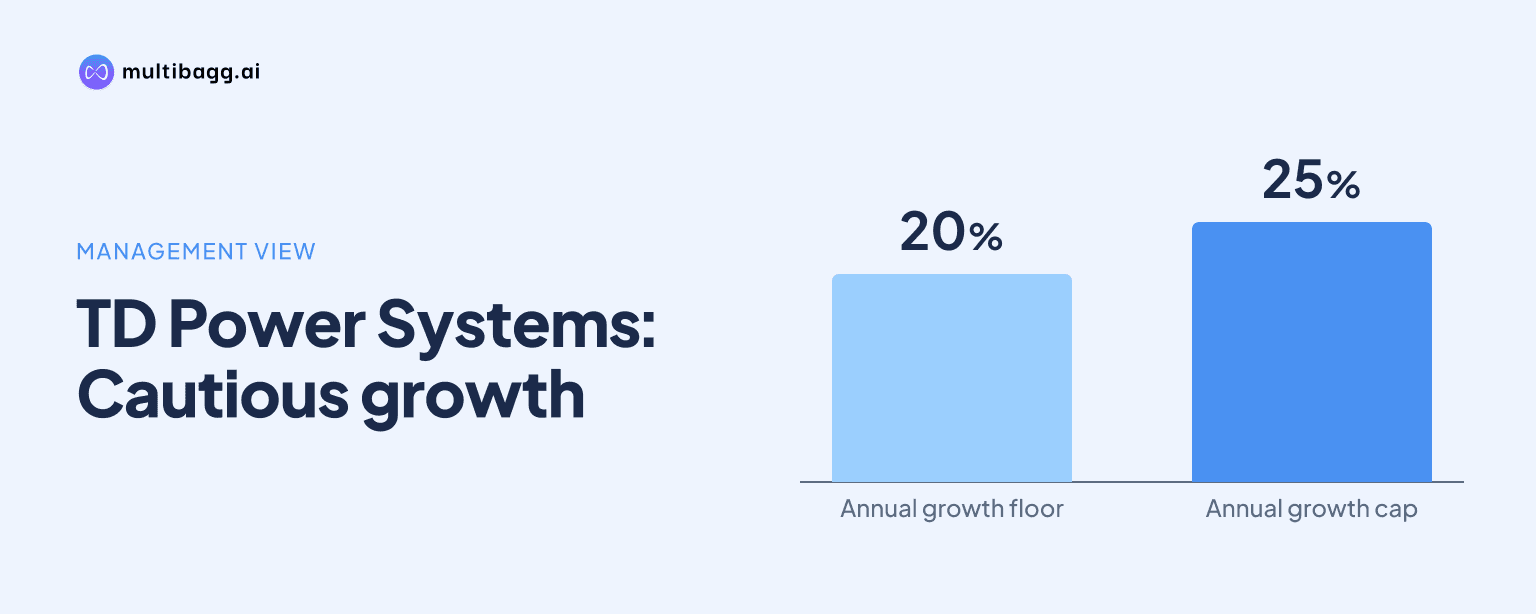
In its earnings call, TD Power Systems said more than 10 years of customer qualification supports conservative annual growth potential of 20%-25%, as wider acceptance is opening markets it could not previously access. Management said discussions with original equipment manufacturers, or OEMs, for 2029 and 2030 are forecasts rather than booked orders.
Know TD Power Systems inside out
Results, valuation, peers and who's buying, in one view.
Why does TDPS see 20%-25% annual growth potential?
TDPS sees conservative annual growth potential of 20%-25% because management expects its accessible market to expand alongside demand for power-generation equipment. When an analyst asked whether the company could grow at 25%-30% annually, Nikhil Kumar answered 20%-25% and called that range conservative. He separately identified a billion-dollar revenue scale as a medium- to long-term potential, not as a dated target or a minimum outcome.
Management said the opportunity reflects both elevated demand and TDPS's expanding customer acceptance. Kumar said the market demand for power equipment had gone up exponentially, while TDPS has become able to participate in areas where it was previously absent or not accepted. When asked whether new demand drivers explained order bookings, he instead highlighted wider market access created by the company's installed machines, customer references and growing recognition.
TDPS has not issued formal long-term financial guidance despite discussing the 20%-25% potential. Management said it will communicate higher numbers only when they are realistic and visible, because its policy is to give figures it believes it can achieve. This distinction is material for the 2029 and 2030 period: TDPS said it is discussing potential orders for those years but has not booked them.
How has customer qualification expanded TDPS's market access?
TDPS says a qualification effort lasting more than a decade is making it an accepted and recognised generator supplier. Kumar said more machines at prestigious projects and with prestigious customers have given TDPS access to markets where it had not been present or had not gained acceptance. The company now wins some opportunities and loses some, while management said the underlying business was available in the past but TDPS lacked access to it.
The more than 10-year process has included diversifying the product range, establishing machine references in different parts of the world and working with customers globally. Kumar said that work is now paying off, rather than being an overnight effect of the present demand cycle. The mechanism is qualification through operating references: as more customers accept TDPS products, management expects the company to gain access to additional business opportunities.
The current OEM work remains primarily focused on legacy turbine and engine models. TDPS said it is deeply involved in product development for upgrades to those legacy platforms, but management stated that none of its customers has developed exclusively new products for the market at present. Its growth route therefore includes upgrades and broader supply roles on established models, rather than a disclosed wave of completely new OEM products.
Can TDPS win more business from existing OEM customers?
TDPS says it can seek more business within its existing OEM base through other turbine models, engine models, machine sizes and supplier positions. Management said it is actively pursuing opportunities to become a second supplier or a primary supplier for more equipment types. Kumar described this process as step by step, but said these avenues are needed if TDPS is to sustain growth at the indicated 20%-25% annual potential.
The arrangement depends on OEM forecasts for 2027, 2028 and 2029 rather than firm orders years before execution. Management said OEM customers provide detailed forecasts, while TDPS makes capacity available and guarantees a certain amount of capacity for them. Customers release orders closer to the execution cycle, creating mutual dependency between the OEMs' projected demand and TDPS's manufacturing allocation.
That model explains management's correction on the 2029 and 2030 order discussion. TDPS said those years were being discussed but were not part of the booked order position. Kumar also said OEM customer capacity additions planned for 2028 and 2029 remain in the pipeline, with no customer having increased capacity drastically yet, while generator waiting periods had not come down.
Got a follow-up? Ask IRIS
What capacity plan supports TDPS's growth strategy?
TDPS's capacity plan centres on its Siemens Energy project, its own 100-megawatt two-pole generator design and more efficient use of assets for machines below 50 megawatts or 60 megawatts. Management said it is investing substantially in the design and manufacturing capability for 100-megawatt two-pole generators, identifying that product segment as a significant source of future growth.
The fourth plant is targeted to be ready in calendar Q1 2028, ahead of what management called an absolute outer limit of June 2028. TDPS plans to ramp production after the plant is ready during calendar 2028, described on the call as FY28 or FY29. Management expects the facility to reach about 70%-80% utilisation by FY30, an operational goal rather than a revenue forecast.
For products below 50 megawatts or 60 megawatts, TDPS has not decided the timing, size or location of incremental capacity. Kumar said the company may need to consider an additional expansion in 2029 if customer forecasts develop as expected. Until then, TDPS is seeking further output from existing assets and said traditionally in-house activities will remain in-house, with more automation and higher technology.
How could data-centre power demand affect TDPS?
TDPS sees data-centre power requirements as supportive of generator demand if regulation requires more captive generation. Kumar said such regulation would make captive power the primary supply for data centres, with grid power potentially acting as backup. He said this configuration could require almost double the captive capacity because both primary supply and backup arrangements would be needed, but presented this as a possible regulatory outcome.
Management also said efficiency rules could eventually raise the role of combined-cycle systems, although Kumar said that would not happen immediately. The nearer-term capacity signal remains the 2028 and 2029 OEM expansion outlook. TDPS also said pricing with almost all OEM customers includes raw-material variation clauses, under which prices are revised when input costs move beyond agreed thresholds.
The company described current order growth as demand-driven when asked whether it reflected supply additions. TDPS said it is producing more units because it has more demand and more capacity, with a mix of larger and smaller machines. Management cited 92 megawatts in response to a question on average output, but said it does not use that average internally as a decision measure.
Conclusion
TDPS's stated 20%-25% annual growth potential rests on management's view that more than 10 years of qualification, product diversification and OEM relationships are widening the markets it can serve. The company links that widening access to elevated power-equipment demand, but distinguishes clearly between detailed OEM forecasts for 2027 through 2029 and orders actually released for execution.
The next disclosed milestones are the calendar Q1 2028 target for fourth-plant readiness, the expected emergence of larger OEM capacity additions from 2028, and the aim for 70%-80% utilisation at the new plant by FY30. Management has not resolved whether smaller-machine production below 50 megawatts or 60 megawatts will require incremental capacity in 2029.