










TDPS cites broad generator demand and protected pricing
Key highlights
- TDPS said Indian steel demand is concentrated in 40 MW to 100 MW generator machines.
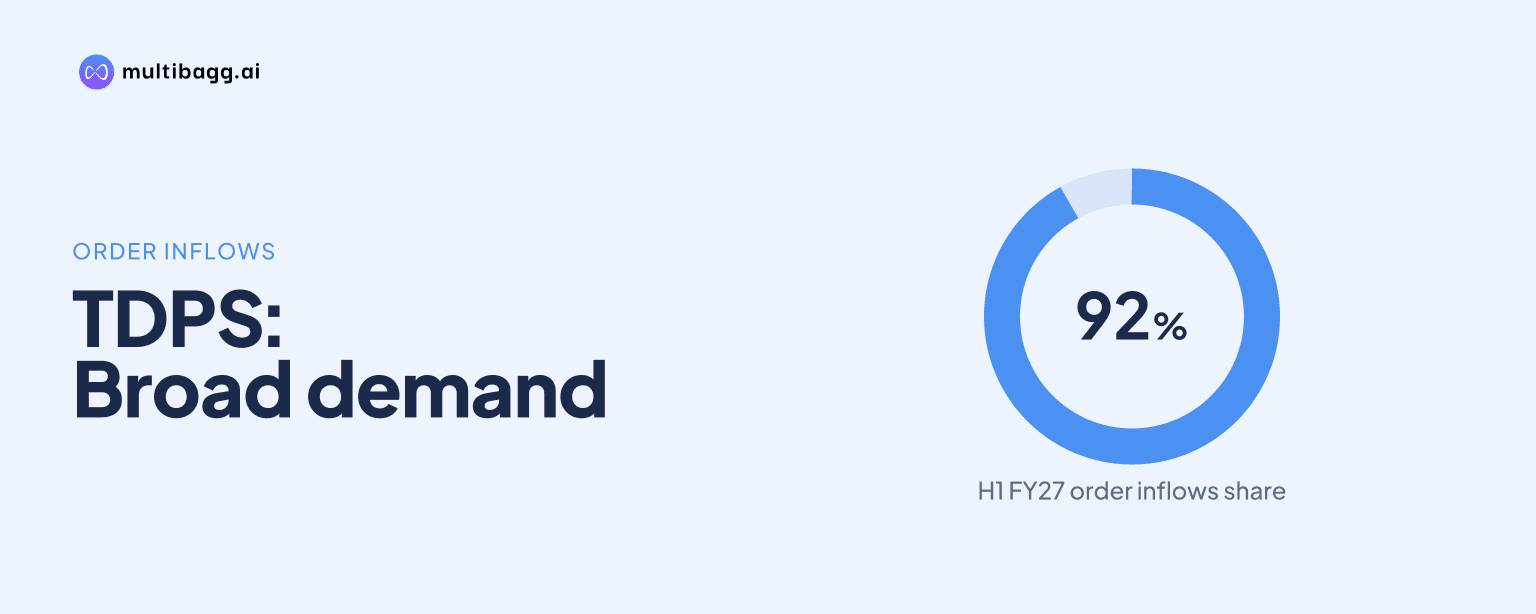
- Direct and deemed exports were Rs 1,406 crore, or 92% of TDPS H1 FY27 order inflows.
- Generator bookings were Rs 2,088 crore within Rs 2,319 crore of H1 FY27 manufacturing bookings.
- TDPS targets calendar Q1 2028 readiness for its Siemens-related plant and 70% to 80% utilisation by FY30.
powered by IRIS
TD Power Systems Limited said in H1 FY27 that its generator demand extended from India’s 40 MW to 100 MW steel segment to European grid-stabilisation and waste-to-energy projects, while management said raw-material price-variation clauses would protect margins on orders discussed for FY28 through FY30.
Know TD Power Systems inside out
Results, valuation, peers and who's buying, in one view.
What is driving TDPS generator demand beyond data centres?
TDPS said generator demand is supported by data centres, grid stabilisation, basic power generation and renewable-linked applications. Management specifically cited geothermal, hydro and waste-to-energy as renewable-related applications, and said all four demand sectors were active during the six months ended September 30, 2026.
TDPS said data centres are an important but not exclusive market because its original equipment manufacturer, or OEM, customers sell turbines and engines across several end markets. Management said those customers reported visibility on data-centre projects through about 2030 and continuing production-slot bookings beyond 2030, while turbine and engine capacity is expected to enter the market from 2028 onward.
The company linked its own planning to those OEM forecasts rather than presenting a disclosed data-centre share of generator orders. Management said it was coordinating capacity, planning and execution with customers monthly, and that higher generator volumes should start to emerge from 2028 as OEM capacity additions come online.
Which markets and regions are supporting TDPS orders?
India and Europe are supporting orders in different generator applications, according to TDPS. The company’s global sales and marketing head said Indian steel producers were generating strong demand for larger 40 MW to 100 MW machines, while Europe was producing orders for grid-stabilisation and waste-to-energy projects.
The geographic demand comments sit alongside an export-heavy order-inflow mix. Direct and deemed export inflows were Rs 1,406 crore in H1 FY27, compared with Rs 695 crore in the prior-year period, an increase of 102%. Exports represented 92% of H1 order inflows, leaving domestic orders at 8%, even as Indian steel was identified as a specific domestic demand source.
Generator orders were the largest disclosed part of manufacturing bookings. TDPS reported manufacturing-segment order bookings of Rs 2,319 crore in H1 FY27, comprising Rs 2,088 crore for generators, Rs 170 crore for railways, Rs 45 crore for Turkey business and Rs 16 crore for spares and aftermarket. This mix places generators at roughly nine-tenths of the disclosed manufacturing total.
How does TDPS protect pricing from raw-material changes?
TDPS said relevant customer contracts use raw-material price-variation clauses intended to protect margins. Management said selling prices rise under the agreed formula if raw-material costs rise and fall if those costs decline, rather than remaining fixed throughout a multi-year delivery period.
Management described pricing as stable at the time of the call and did not forecast a sharp price increase. Its stated mechanism is instead a pass-through: raw-material movements affect the order price to the extent specified in the contractual formula. TDPS said such clauses apply with some customers for orders associated with FY28, FY29 and FY30 delivery periods.
The call did not disclose a raw-material benchmark, the proportion of orders covered or a margin target. TDPS reported standalone earnings before interest, tax, depreciation and amortisation, or EBITDA, of 20.02% in H1 FY27, including other income and excluding exceptional and treasury income, versus 18.42% a year earlier. That 1.60-percentage-point improvement is reported performance, while margin protection from price clauses is management’s assessment of the contracts.
Got a follow-up? Ask IRIS
What does TDPS’s order book say about execution?
Most of TDPS’s Rs 2,300 crore pending order book was executable within the next 12 months, management said. The company also expects book-and-bill activity, or orders received and delivered in the same financial year, to supplement this backlog as it executes its sales plans.
For FY27, TDPS revised final sales guidance to Rs 2,900 crore to Rs 3,000 crore and said second-half sales should be broadly evenly divided between Q3 and Q4. Management put expected quarterly second-half sales at Rs 725 crore to Rs 750 crore. These are management forecasts rather than booked revenue.
For the following year, management gave initial sales guidance of Rs 3,400 crore to Rs 3,500 crore and separately referred to Rs 3,435 crore while discussing book-and-bill requirements. It said more than Rs 1,200 crore of book-and-bill business would be needed against that Rs 3,435 crore reference. Management later clarified that FY29 and FY30 orders were under discussion, rather than already booked.
TDPS’s reported financial performance also rose in H1 FY27. Standalone total income reached Rs 1,455 crore, up 91% from Rs 764 crore in the prior-year half, while standalone profit after tax and comprehensive income rose 110% to Rs 207.4 crore from Rs 98.9 crore. Quarterly order inflow was Rs 824 crore, up 57% sequentially and about 70% year on year.
When will TDPS add generator capacity?
TDPS is targeting calendar Q1 2028 for readiness of its new Siemens-related plant, with June 2028 described as the absolute outer limit. Management said construction had started, most major equipment had been ordered, and a November 19 ground-breaking ceremony was scheduled for the project.
TDPS confirmed it had begun booking build-to-print orders with Siemens Energy’s gas-turbine group for two-pole generators, but did not disclose their value. The company said it was not working with Siemens Energy’s Transformation of Industry group on these orders. Management also said it was investing in its own design and manufacturing capacity for 100 MW two-pole generators.
Management plans to ramp production after the plant is ready during calendar 2028 and expects utilisation to reach about 70% to 80% by FY30. For generator machines below 50 MW or 60 MW, TDPS said it was improving utilisation of existing assets and may consider additional capacity in 2029 if customer forecasts develop as indicated.
Conclusion
TDPS described a generator market supported by several applications rather than data centres alone. Indian demand is concentrated in 40 MW to 100 MW steel-sector machines, while European orders include grid stabilisation and waste-to-energy. Generator bookings of Rs 2,088 crore within Rs 2,319 crore of manufacturing bookings, together with exports accounting for 92% of H1 inflows, show the scale of the company’s generator-led and internationally oriented order activity.
The next points to watch are execution of the Rs 2,300 crore pending order book, delivery against FY27 sales guidance of Rs 2,900 crore to Rs 3,000 crore, and progress on the Siemens-related plant. Management is targeting calendar Q1 2028 readiness, a production ramp during 2028 and 70% to 80% utilisation by FY30, while leaving a potential 2029 expansion for smaller machines dependent on customer forecasts.