










TD Power Systems Guides for 19% Margin in Siemens Ramp-Up
Key highlights
- TD Power Systems said around 19% is its sustainable EBITDA margin range.
- Management expects 19% to 20% EBITDA margins over the next few quarters.
- The Siemens plant could take margins above 20% at 50% to 60% utilisation.
- TD Power Systems cited about Rs 2,400 crore of orders for the next 12-month cycle.
powered by IRIS
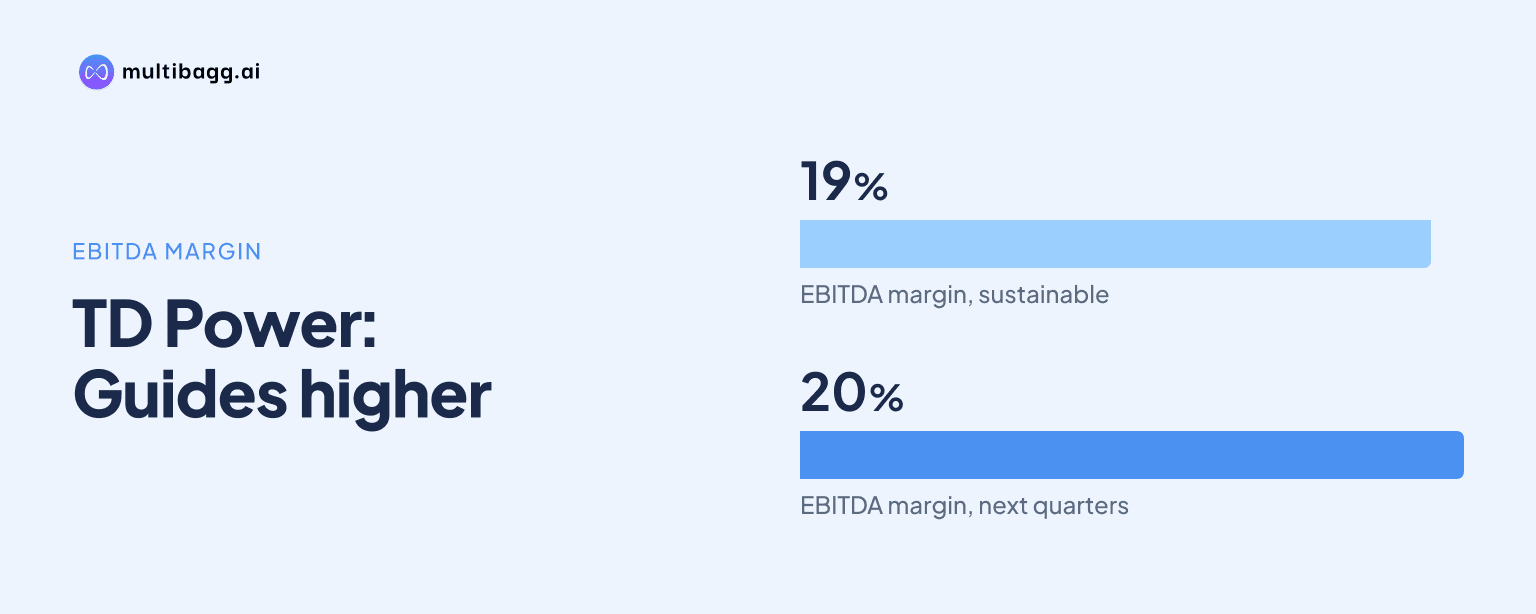
TD Power Systems Limited said it views an earnings before interest, tax, depreciation and amortisation (EBITDA) margin of about 19% as sustainable while its new Siemens plant begins operations in roughly a year, because costs will precede revenue. Management said margins could move above 20% once the facility reaches 50% to 60% utilisation.
Know TD Power Systems inside out
Results, valuation, peers and who's buying, in one view.
What margin range did TD Power Systems set out?
TD Power Systems set out a sustainable EBITDA margin range of around 19%, while indicating that the next few quarters could remain in a 19% to 20% band. Management made that comment in response to a question about whether the current quarter's all-time-high EBITDA margin could be sustained alongside an analyst's reference to Rs 3,500 crore of revenue for the following year.
The stated outlook is a range rather than a fixed quarterly commitment. Management said there could first be a small drop after the new Siemens plant starts, followed by a pickup as output rises. This sequence separates the near-term 19% to 20% range from the longer-term potential to exceed 20% after utilisation reaches 50% to 60%.
Management did not provide a date for reaching 50% to 60% utilisation, a plant-level revenue forecast or a precise size for the temporary margin reduction. Its disclosed timetable was that the Siemens plant would start “somewhere in about a year,” making the ramp-up path, rather than the current peak margin, the key disclosed factor in profitability over subsequent quarters.
Why could the Siemens plant startup reduce margins?
TD Power Systems said the Siemens plant will carry costs before it begins generating revenue, which is the direct reason management expects a possible temporary margin decline. Management described the investment as large and linked this pre-revenue cost period specifically to the new Siemens facility, rather than to a change in its stated pricing approach.
This creates a staged profitability profile. In the short term, expenses associated with opening and operating the plant can be incurred before corresponding sales are recognised. At 50% to 60% utilisation, management expects the facility to offer upside beyond 20%, meaning production and revenue would support a greater share of the plant's operating base.
TD Power Systems also said its traditional activities remain in-house but are now being performed at a larger scale with more automation and better technology. In a separate discussion, management agreed that this in-house expansion produces operating leverage. Management did not quantify cost savings, the plant's fixed-cost base or the margin contribution from automation.
Got a follow-up? Ask IRIS
When does TD Power Systems expect margin upside?
TD Power Systems expects margin upside only after the Siemens plant becomes sufficiently utilised, with management identifying 50% to 60% utilisation as the point from which EBITDA margins could go past 20%. Management did not say that this level would be achieved immediately on commissioning, nor did it provide a quarter-by-quarter profitability bridge for the ramp-up.
Management's sequence was explicit: 19% to 20% over the next few quarters, then a small drop associated with startup costs, followed by another pickup. That differs from treating the current quarter's all-time-high margin as a straight-line benchmark. The disclosed sustainable level is around 19%, while the above-20% outcome depends on reaching 50% to 60% utilisation.
On revenue visibility, TD Power Systems said it had orders of about Rs 2,400 crore for the next 12-month cycle. Management also said it would communicate upside only when an increase is realistic and likely to happen, rather than issue broad longer-term annual or medium-term guidance. This policy limits the extent to which revenue growth can be inferred from the plant plan before orders move closer to execution.
TD Power Systems said original equipment manufacturer (OEM) customers provide detailed forecasts for 2027, 2028 and 2029, while orders are released closer to the execution cycle. Management also clarified that discussions about orders for 2029 and 2030 did not mean those orders had already been booked. These forecasts may support capacity planning, but they are not equivalent to a reported order book.
How are pricing and volume affecting TD Power Systems margins?
TD Power Systems said pricing is stable and that almost all OEM customer arrangements include a price-variation clause when raw-material prices rise beyond an agreed threshold. Under that formula, prices are revised if the threshold is crossed. Management therefore described a mechanism intended to address input-cost movements, but did not disclose the threshold, formula or resulting margin effect.
The company connected higher production primarily to demand and capacity, not to a disclosed price increase. Management said quarterly order intake had risen to roughly Rs 750 crore from about Rs 700 crore in the prior quarter because of demand, and said it was producing more units because it had more capacity. TD Power Systems declined to specify whether year-on-year growth was split between volume and price.
TD Power Systems also described demand as coming from all market segments, with a mix of larger generators and two-pole machines. Management cited 92 megawatt as an average statistic during the discussion but said it does not track average megawatt internally because it sees limited value in that measure. The transcript therefore does not establish that margins are being driven by a shift toward a particular generator size.
For the second half, management said approximately Rs 1,500 crore of business was expected, with first-half and second-half performance anticipated to be broadly similar. It attributed a higher second-quarter delivery level to customer schedules and cautioned against reading too much into monthly or quarterly movements. The comparison indicates that delivery timing can affect reported quarterly outcomes.
Conclusion
TD Power Systems has framed its margin outlook around a transition: around 19% is the sustainable EBITDA level it identifies, 19% to 20% is the range for the next few quarters, and a temporary startup-cost effect may intervene before the Siemens plant scales. The opportunity to move above 20% is tied to reaching 50% to 60% utilisation, not presented as an immediate consequence of commissioning.
The next item to watch is the plant's start in roughly a year and management's subsequent disclosure on revenue generation and utilisation. Management's Rs 2,400 crore next-12-month order cycle, approximately Rs 1,500 crore second-half expectation and OEM price-variation clauses will also indicate whether volume ramps in line with the stated plan without a larger startup-cost effect.