










TeamLease exits negative-margin mandate, underlying adds 1,500
Key highlights
- TeamLease exited a negative-margin client mandate with more than 7,000 associates in Q2 FY27.
- Reported associates fell by about 5,500 to 2.85 lakh, but the underlying book added about 1,500.
- Gross hiring reached about 62,500 associates, TeamLease’s highest level in three quarters.
- Operating EBITDA was Rs 44 crore in Q2 FY27, up 17% sequentially.
powered by IRIS
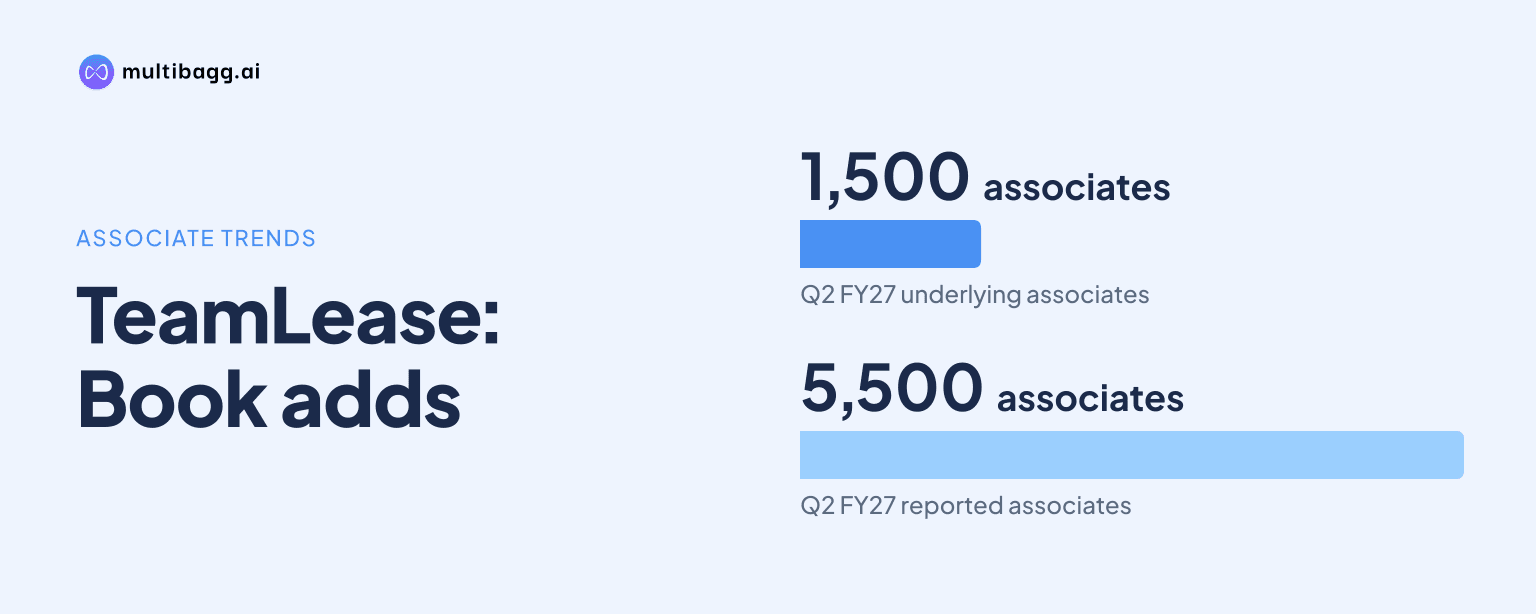
TeamLease Services Limited said its Q2 FY27 associate count declined by about 5,500 to 2.85 lakh because a negative-margin client mandate with more than 7,000 associates exited; excluding that mandate, the underlying general staffing business added about 1,500 associates. Management said the exit improved profitability rather than merely reducing volume.
Know Team Lease Services inside out
Results, valuation, peers and who's buying, in one view.
Why did TeamLease's associate count fall in Q2 FY27?
TeamLease’s reported associate base fell because it deliberately completed a planned reduction in low-margin work, culminating in one loss-making client exit during Q2 FY27. The company had guided on its Q4 call that roughly 10,000 associates would exit low-margin mandates through Q1 and Q2. At the September 30, 2026 quarter-end, its associate base was approximately 2.85 lakh, down by about 5,500 associates on a net basis.
The main event was a client mandate with more than 7,000 associates that had been operating at a negative margin. TeamLease said this mandate exited in Q2 FY27 and that, after adjusting for it, the remaining business added about 1,500 associates. That distinction means the headline associate decline does not describe the direction of the continuing portfolio, although the underlying addition remained limited.
Gross hiring reached about 62,500 associates, TeamLease’s highest level in three quarters, indicating that hiring fulfilment was not identified as the main constraint. Management instead described the net underlying addition as thin, with changes in banking, financial services and insurance, or BFSI, accounts offsetting gains elsewhere. The company added 32 new general-staffing client logos, and about 75% used variable-markup or outcome-based pricing.
How does the mandate exit change TeamLease's profitability profile?
The exit improves TeamLease’s portfolio economics because management said the more than 7,000-associate mandate was margin dilutive and its removal was accretive rather than neutral. This was part of a stated FY27 focus on higher-margin businesses and disciplined portfolio management, under which each business and investment is to be assessed for returns and strategic fit. The company did not quantify the profit contribution of the exited mandate.
At the consolidated level, Q2 FY27 revenue was Rs 3,086 crore, up 1% sequentially and 2% year on year, while operating earnings before interest, tax, depreciation and amortisation, or EBITDA, rose 17% sequentially and 5% year on year to Rs 44 crore. Management said operating EBITDA, which excludes corporate and unallocated costs, better represented underlying operating progress. Reported EBITDA was Rs 36 crore, or a 1.2% margin.
The difference between operating and reported EBITDA reflected unallocated expenses rather than a disclosed cost from the associate exit. Corporate EBITDA was a Rs 8 crore cost in Q2 FY27, compared with a Rs 4 crore cost a year earlier, owing to buyback-related expenses and planned spending on brand, technology and people. TeamLease’s core team rose to about 2,790 from about 2,500 in March 2026, an investment management said would modestly weigh on near-term margins and productivity per core employee.
Got a follow-up? Ask IRIS
Which staffing sectors offset the BFSI decline?
Consumer staffing offset the BFSI reduction, with durables performing ahead of the prior year during the summer and festive build, and retail and e-commerce volumes growing through quick commerce. TeamLease said these gains were sufficient to absorb the BFSI decline and leave the underlying book positive after excluding the negative-margin mandate. No sector-specific associate counts or revenue figures were disclosed.
BFSI declined in aggregate because several large accounts ran their own productivity and cost-optimisation programmes, according to management. TeamLease said it nevertheless gained wallet share in selected private banks, small finance banks and mid-sized non-banking financial companies, or NBFCs, while shifting into tier 2 and tier 3 markets. This commercial progress was outweighed by client-level reductions, which management said were visible across the industry.
The September 30 closing associate count also fell between festive-demand clusters. Management said Diwali occurred almost three weeks later than in the previous year, producing a quieter stretch at the end of September rather than a continuous seasonal build-up. It expects the lower peak and longer deployment window to increase billable days per associate in Q3 FY27, with festive demand extending deeper into the quarter than it did a year earlier.
What operating changes is TeamLease making in general staffing?
TeamLease is changing sourcing, pricing and technology to improve general-staffing economics while retaining growth capacity. Its own hiring efforts accounted for more than 19,000 joinees, or about 31% of gross joinees, up from 28% in Q1 FY27. Management had identified rebuilding direct sourcing as an H1 FY27 priority, and the increase is intended to reduce cost to hire.
The company also continued moving toward non-metro locations, where it said average salaries are 20% to 30% below urban-market levels. New client pricing is increasingly variable or linked to outcomes, as shown by the approximately 75% share of the 32 new logos added in Q2 FY27. TeamLease said the GST 2.0-related exits flagged in the preceding quarter occurred as expected, with no additional exits from that factor.
Technology investment is another part of the reset. TeamLease is overhauling its associate-lifecycle system, with some elements already live, further releases planned in Q3 FY27 and a full rollout expected in Q4 FY27. It is also integrating client and associate databases so commercial and workforce information can be accessed on demand, while applying artificial intelligence and automation to process-heavy workflows.
Regulatory changes are not expected to create a profit-and-loss effect on the associate book, according to management. The Employees’ Provident Fund wage ceiling rose in September 2026 and state Labour Code rules continue to be notified, increasing statutory employer cost that TeamLease says is contractually recoverable from clients. Management identified lower associate take-home pay and potential retention pressure, assessed account by account, as the relevant operating exposure.
Conclusion
TeamLease’s Q2 FY27 reported decline of about 5,500 associates principally reflects a planned portfolio reset, not solely reduced demand in its continuing general-staffing book. The exit of a more than 7,000-associate negative-margin mandate left an underlying addition of about 1,500 associates, while consumer-sector gains offset reductions in BFSI accounts. The company’s Rs 44 crore operating EBITDA, up 17% sequentially, provides the financial context for management’s emphasis on profitability over unadjusted associate volume.
The next measures to watch are the Q3 FY27 effect of the longer festive deployment period, progress against more than 16,000 open positions and the planned further release of the associate-lifecycle system. TeamLease expects a full system rollout in Q4 FY27, while management has said client planning remains on shorter cycles. Whether direct sourcing, variable pricing and portfolio discipline convert into sustained associate additions and earnings growth remains the central unresolved issue.