










TeamLease cuts hiring costs 40% in specialised staffing
Key highlights
- TeamLease reduced average cost per hire by almost 30% in general staffing over the last 18 months.
- TeamLease reduced average cost per hire by almost 40% in specialised staffing over the last 18 months.
- TeamLease sourced about 19,000 Q2 gross additions itself, or 31%, versus 28% in Q1.
- Manufacturing profiles cost almost Rs 3,000 per hire, compared with as little as Rs 1,000 for consumer-goods roles.
powered by IRIS
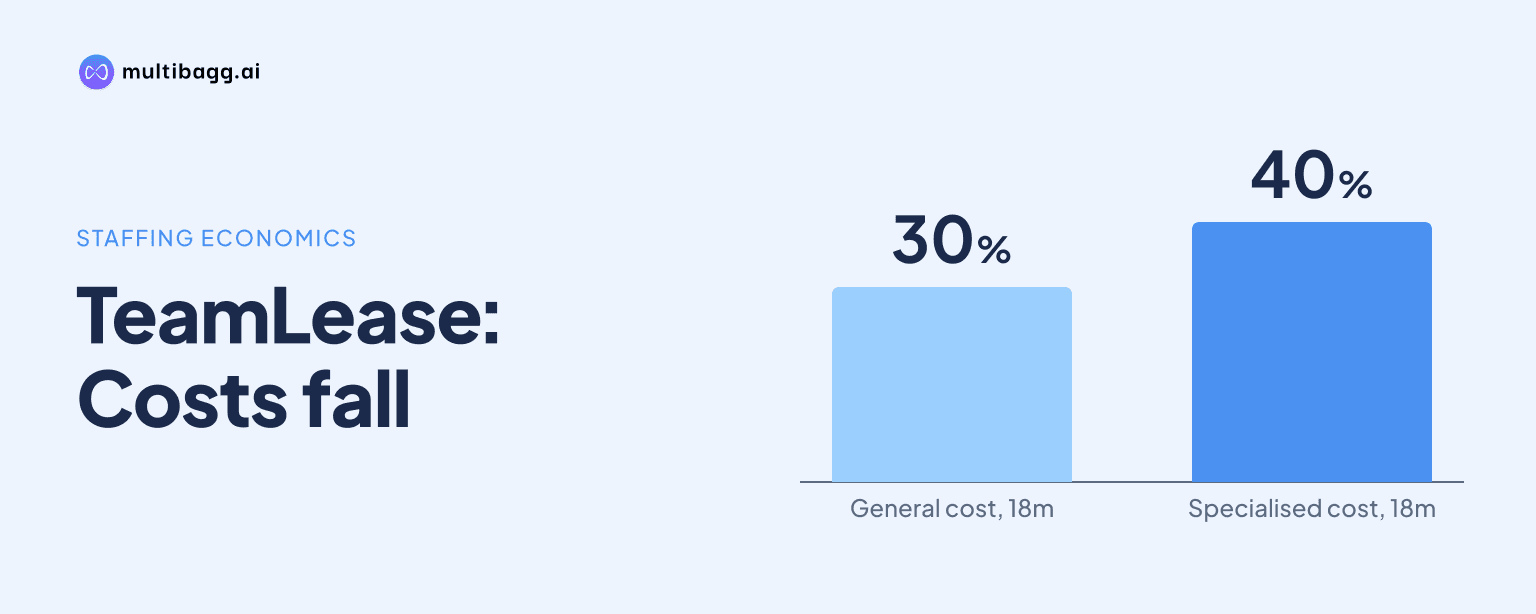
TeamLease reduced average cost per hire by almost 40% in specialised staffing and almost 30% in general staffing over the last 18 months through HireTech investments, management said on its Q2 call. Management said the savings can support staffing operating leverage when hiring volumes recover, rather than independently determining margins.
Know Team Lease Services inside out
Results, valuation, peers and who's buying, in one view.
How much has TeamLease reduced cost per hire?
TeamLease reduced average cost per hire by almost 30% in general staffing and almost 40% in specialised staffing during the last 18 months. Ramani Dathi attributed the reduction to HireTech investments and multiple sourcing channels, while saying that the eventual cost still varies by industry, profile, location and client requirements.
The larger reduction was reported in specialised staffing, which management expects to be among the verticals contributing to group margin expansion. For general staffing, management said the benefit depends on volumes returning. TeamLease must increase direct-sourcing capacity for larger mandates while managing the cost of each hire.
Which TeamLease roles cost the most to hire?
TeamLease said manufacturing profiles currently cost almost Rs 3,000 per hire, the highest example management gave, while fast-moving consumer goods and fast-moving consumer durables roles can cost as little as Rs 1,000 per hire. The Rs 2,000 difference shows why the reported average reductions do not represent a uniform rupee saving across all staffing assignments.
TeamLease has focused on manufacturing and logistics for two years, reporting significant traction in logistics. Manufacturing has been stronger in white-collar roles than in mass-market, entry-level blue-collar hiring. Management said neither manufacturing nor logistics automatically provides higher margins because parts of both markets remain informal, requiring selectivity in client choice.
Is TeamLease increasing direct sourcing of candidates?
TeamLease sourced about 19,000 of Q2 gross additions through its own channels, equal to 31% of additions, compared with 28% in the first quarter (Q1). Management said mandates with significant growth potential increasingly require TeamLease to recruit through its own means, making sourcing capacity and cost control linked operating priorities.
Management said the Q2 rate was about 30% because rebadging opportunities at some clients increased client-led sourcing. Across the last few quarters, TeamLease said its own sourcing has averaged above 40%. The Q2 share was therefore below that recent average despite rising 3 percentage points from Q1.
Got a follow-up? Ask IRIS
How could lower hiring costs affect TeamLease margins?
TeamLease expects staffing operating leverage as volumes return, with lower hiring costs supporting that outcome. Management did not quantify the margin expansion this could produce in general staffing, but said it was confident of maintaining double-digit year-on-year growth in the vertical's absolute profits, supported by its pipeline and open positions.
At group level, management said margin expansion should be led by higher-margin verticals including specialised staffing and human resources (HR) services. TeamLease expects at least another 20 basis points of specialised-staffing earnings before interest, tax, depreciation and amortisation (EBITDA) margin improvement by Q4 of this year, but did not provide a timetable for reaching an 8% or 9% margin.
What hiring volume must TeamLease regain for operating leverage?
TeamLease reported about 16,000 open positions. Management also described a 35,000-associate impact over the last five quarters, including about 28,000 associates absorbed by its then-largest non-banking financial company client following a regulatory issue and about 7,000 associates lost with a low-margin or negative-margin account. The impact was just over 27,000 associates in the last 12 months.
Management said festive hiring was more selective and start-stop this year, partly because Diwali falls in the second week of November rather than mid-October in the prior year. Temporary staffing and apprenticeship hiring reduced full-time-equivalent (FTE) productivity to 289. Management expects headcount to normalise by year-end and FTE levels to return to close to 350.
Conclusion
HireTech gives TeamLease a measurable cost lever, with average cost per hire down almost 30% in general staffing and almost 40% in specialised staffing over 18 months. The earnings effect remains tied to hiring volumes and mix: manufacturing can cost almost Rs 3,000 per hire, while consumer-goods roles can cost as little as Rs 1,000.
The next measures to watch are conversion of the 16,000 open positions, the mix of own sourcing against the above-40% recent average, and the return of FTE levels toward 350 by year-end. Management also targets at least 20 basis points of further specialised-staffing EBITDA margin improvement by Q4 of this year.