










TeamLease GCCs generate 69% of specialised staffing revenue
Key highlights
- GCCs generated about 69% of TeamLease specialised staffing net revenue in Q2 FY 2027.
- TeamLease served more than 130 GCC clients, up from 110 at the end of the last financial year.
- Global operating margin rose to 5% in Q2 FY 2027 from 3% in Q1 FY 2027.
- Specialised staffing EBITDA rose 15% quarter on quarter to Rs 13 crore.
powered by IRIS
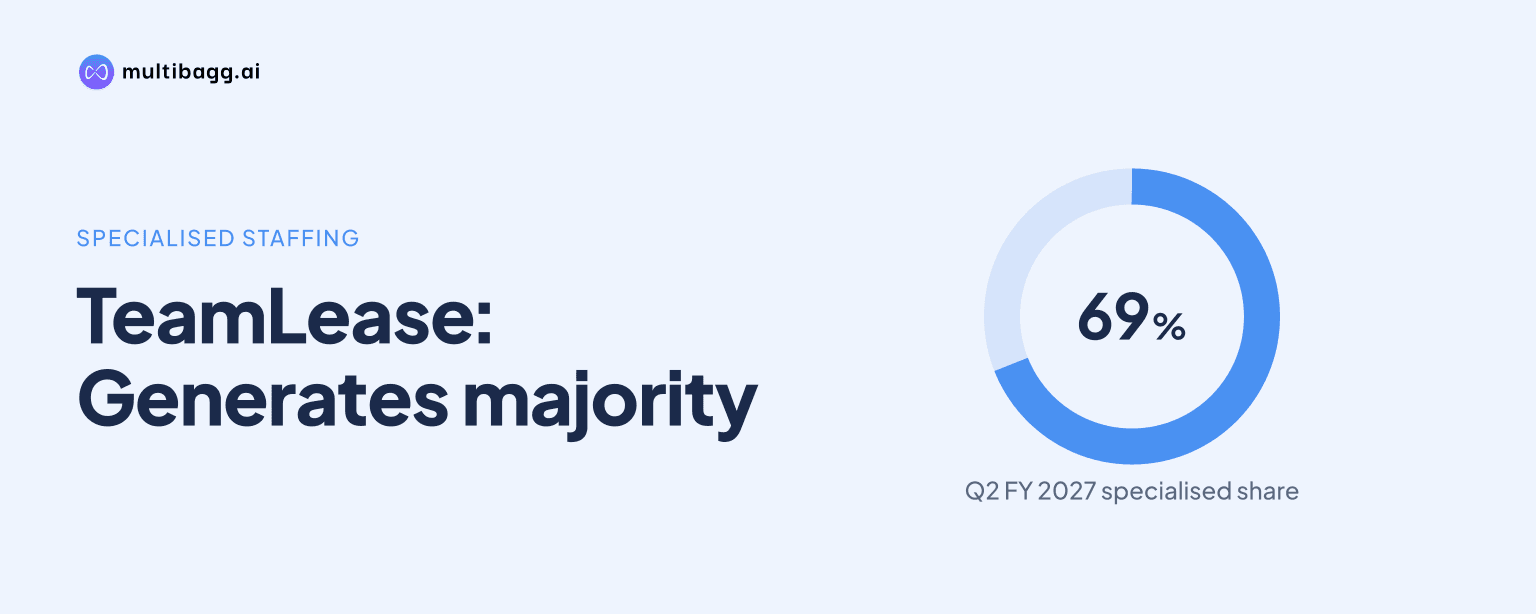
TeamLease said global capability centres, or GCCs, generated about 69% of specialised staffing net revenue in the second quarter of financial year 2027, making them the segment’s dominant demand source as its global business grew about 51% year on year and global operating margin reached 5%, up from 3% in the prior quarter.
Know Team Lease Services inside out
Results, valuation, peers and who's buying, in one view.
How important are GCCs to TeamLease specialised staffing?
GCCs are TeamLease’s largest specialised staffing customer group, accounting for about 69% of net revenue and roughly 60% of associate headcount in Q2 FY 2027. TeamLease said it worked with more than 130 GCCs across industries, compared with 110 at the end of the last financial year, indicating that client additions accompanied the expansion in revenue contribution.
The segment’s overall financial progress also points to the importance of this mix. Specialised staffing generated Rs 190 crore of revenue in Q2 FY 2027, while segment EBITDA, or earnings before interest, tax, depreciation and amortisation, increased 15% quarter on quarter to Rs 13 crore. Management said operating margin rose by 90 basis points, or 0.9 percentage points, during the quarter.
TeamLease’s GCC focus is supported by its CapCube offering, which management described as a full-stack service for these clients. At launch, CapCube covers hiring strategy, compliance, legal and infrastructure requirements; as a GCC develops, TeamLease offers support for scaling, retention and capability building. This approach is intended to establish relationships earlier in a client’s lifecycle and broaden the work performed as the operation grows.
What is driving TeamLease specialised staffing profitability?
Better pricing, a richer skill mix and improved team productivity drove specialised staffing profitability in Q2 FY 2027, according to management. EBITDA rose 15% sequentially and operating margin improved by 90 basis points, even as hiring by IT services companies remained cautious and was mostly replacement hiring rather than net new-role creation.
Demand was concentrated in higher-value technical roles, including artificial intelligence and machine learning, data engineering, cloud, DevOps, cybersecurity and SAP. TeamLease said its PAPM metric increased about 10% over the past year, which management attributed largely to the hiring profile and rate cards for artificial intelligence and data-engineering positions rather than broad-based growth in legacy or generalist technology roles.
The company ended the quarter with 7,670 associates in IT and specialised skill sets. It added about 60 customer logos in the latest two quarters, including about 16 GCCs, while also expanding wallet share through multi-product deployments with existing customers. The change in mix matters because management linked the 90-basis-point operating-margin improvement specifically to pricing, skills and productivity rather than to a reported acceleration in IT-services industry hiring.
TeamLease also reported activity through ATLIS, its AI Talent Learning Advisory and Services programme. In H1 FY 2027, ATLIS placed more than 800 artificial-intelligence professionals and worked with more than 25 clients on AI learning, advisory and transformation programmes. Management said companies moving from AI trials to use at scale would require more AI-ready specialised talent, but did not provide a revenue target for ATLIS.
Got a follow-up? Ask IRIS
How is TeamLease improving its global business margins?
TeamLease lifted global operating margin to 5% in Q2 FY 2027 from 3% in the preceding quarter by stepping away from some low-margin global mandates. The global business simultaneously reported revenue growth of about 51% over the previous year, showing that management’s disclosed portfolio action occurred alongside year-on-year expansion rather than a reported exit from international growth.
The 2-percentage-point sequential improvement in global operating margin contrasts with the 4.3% global EBITDA margin cited in the CEO’s opening remarks for specialised staffing. In the specialised staffing business, management also reported a 7.6% EBITDA margin for India. The transcript does not provide a reconciled revenue base for the India and global margin figures, so the disclosed numbers establish the direction of improvement but not each geography’s absolute profit contribution.
TeamLease said it had more than 100 people outside India and was strengthening delivery from India for global requirements. Management’s second-half plan is to build depth in AI, GCCs, specialist domains and global business while pursuing pricing, skills-and-product mix and employee-productivity improvements. The company did not quantify how many additional overseas mandates it expects to exit or specify a future global-margin target.
What does TeamLease plan for specialised staffing in H2 FY 2027?
TeamLease plans to prioritise high-value AI, GCC, specialist-domain and global work in the second half of FY 2027, while management expects Q3 furloughs and said they are already included in its plan for the year. This makes the company’s stated outlook focused on mix, pricing and productivity rather than on a numerical revenue or associate-growth forecast.
The specialised staffing strategy sits within a broader company focus on higher-return businesses. TeamLease said it would direct capital, talent and leadership attention toward businesses with stronger returns, including international geographies, while assessing investments for returns and strategic fit. In Q2 FY 2027, it completed the divestment of its 30% Crystal HR stake with no loss of invested capital, an example management cited of portfolio management.
At the consolidated level, TeamLease reported Q2 FY 2027 revenue of Rs 3,086 crore, up 1% sequentially and 2% year on year, while operating EBITDA was Rs 44 crore, up 17% sequentially and 5% year on year. Management said specialised staffing and seasonal EdTech demand led operating-line improvement, though reported EBITDA was Rs 36 crore after corporate and unallocated costs including buyback expenses and planned investments in brand, technology and people.
Conclusion
TeamLease’s specialised staffing mix is increasingly shaped by GCC clients: more than 130 GCCs represented about 69% of net revenue and about 60% of segment associates in Q2 FY 2027. Alongside a 15% sequential rise in specialised staffing EBITDA to Rs 13 crore, the company reported higher-value technical demand, a 10% annual rise in its PAPM metric and global revenue growth of about 51% year on year.
The next disclosed test is H2 FY 2027 execution. Management plans to deepen AI, GCC, specialist-domain and global capabilities, while Q3 furloughs are included in annual planning and the global business continues to move away from low-margin mandates. Investors can watch whether improved pricing, skill mix and productivity sustain the 5% global operating margin and the segment’s sequential profit progress.