










Tega cuts equipment growth guidance to 15% on approval delays
Key highlights
- Tega reduced equipment-business growth guidance to 15% from 25%, a cut of 10 percentage points.
- Management said customer approvals delayed equipment shipments despite a healthy order book.
- Tega said second-quarter equipment revenue was higher than first-quarter revenue and expects Q3 and Q4 recovery.
- Chile is on track for a January startup and March 2027 commercial production, with no separately expected financial year 2028 revenue addition.
powered by IRIS
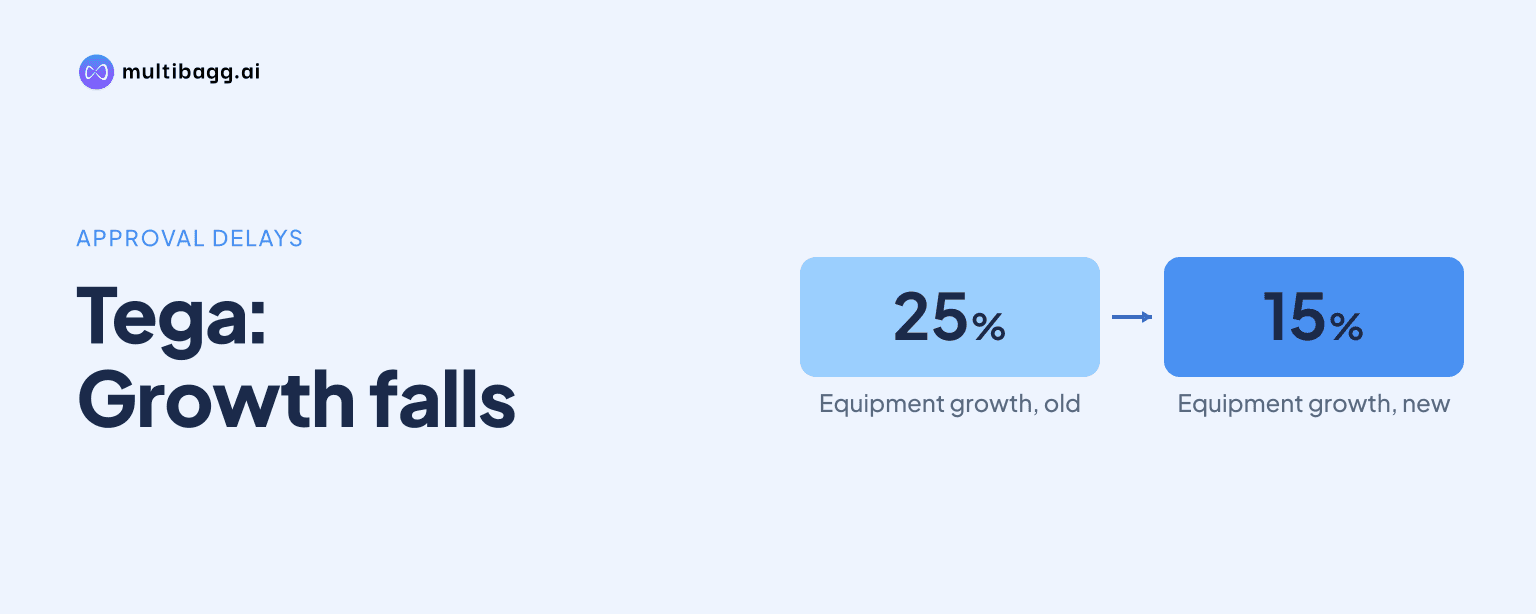
Tega Group cut equipment-business growth guidance to 15% from 25% during its second-quarter discussion after customer approvals delayed shipments, leaving a healthy order book unconverted into revenue on schedule. Management said orders had moved into the next quarter and expects more executions in the second half, though it gave no quarterly target.
Know Tega Industries inside out
Results, valuation, peers and who's buying, in one view.
Why did Tega cut equipment-business growth guidance?
Tega cut its guidance because customers pushed equipment orders into the next quarter and approvals were still needed before products could be shipped. Himanshu Raijada said these were uncontrollable factors and that the reduction from 25% to 15% was necessary based on first-half projections and second-quarter performance.
The issue described was shipment timing rather than a stated decline in demand. Mehul Mohanka said the order book was quite healthy, but equipment is a project-intensive business and Tega had not yet secured the customer approvals required to ship products. Until that confirmation is received, an order does not convert into reported revenue.
How much did Tega reduce its equipment growth outlook?
Tega reduced equipment-business growth guidance by 10 percentage points, to 15% from the previous 25% target. An analyst said retaining the 25% target would require a 79% run rate in the second half, and management responded that delayed orders required a reduction.
The cut followed two quarters of subdued reported equipment revenue and Earnings Before Interest, Taxes, Depreciation and Amortisation, or EBITDA, according to an analyst on the call. Tega did not disclose equipment-segment revenue, EBITDA or the value of its order book during the discussion.
Raijada specifically tied the revision to first-half projections and second-quarter performance. The revised 15% figure is therefore management's growth guidance based on currently expected execution, rather than a forecast of the value or growth of the order book.
Can Tega recover equipment revenue in the second half?
Tega expects equipment revenue to improve in the second half if customer approvals allow the existing order book to be executed, with the third and fourth quarters, or Q3 and Q4, identified as the expected recovery period. Mohanka said the company expected the second half to come back strongly and recover much of the weaker first-half performance.
Ravi Joshi said second-quarter equipment revenue was higher than first-quarter revenue, indicating a sequential improvement. However, he did not quantify either quarter's equipment revenue, and the comparison does not establish that all delayed shipments had been approved by the end of the second quarter.
Customer confirmation remains the key constraint identified by management. Tega said it was awaiting confirmation to convert orders into revenue, so the Q3 and Q4 outcome depends on approvals and shipment execution. Management did not provide quarterly revenue guidance or quantify the orders awaiting approval.
Got a follow-up? Ask IRIS
What does the revised outlook mean for equipment margins?
Tega did not provide a new standalone equipment-margin target when it cut growth guidance to 15%, although management said operating leverage could expand margins as revenue increases. An analyst cited equipment margins of about 2% in the current quarter and negative 4% in the previous quarter; management did not challenge those figures.
In response to a question about the equipment business reaching higher quarterly revenue run rates, Raijada said the 20% margin being earned today should remain and operating leverage should increase or expand margins. Management did not give a time frame, a segment-specific target, or an equipment revenue threshold for that outcome.
Management also said Tega's 22% margin guidance could uplift with operating leverage, while declining to give more specific guidance. The reduced growth outlook therefore does not include a quantified equipment-margin revision, even though management expects a greater volume of approved execution to improve fixed-cost absorption.
How do Tega's other plans relate to the equipment outlook?
Tega said its Chile facility remained on track for a January startup and commercial production in March 2027, but management does not expect additional revenue specifically from the new plant in financial year 2028. The company said the capacity is intended to sustain plant requirements for the next four to five years and is included within its expected 15% compound annual growth rate.
The Chile timetable is separate from the customer-approval delays affecting equipment shipments. The January startup and March 2027 commercial-production milestones concern manufacturing capacity, while the equipment guidance cut reflects first-half project execution and approvals.
Tega also outlined four cost and efficiency initiatives: establishing a global capability centre, moving its headquarters to a lower-cost location, reducing selling, general and administrative costs, and improving operating yields. Management said these actions were intended to expand margins by 100 basis points in the coming year, but did not allocate that target specifically to equipment.
Conclusion
Tega's revised equipment outlook shows that project orders alone are insufficient to support reported revenue when customer approvals delay shipments. Management reduced guidance from 25% to 15% after first-half projections and second-quarter performance indicated that deferred orders could not support the earlier target, despite a healthy order book and higher revenue in the second quarter than in the first.
The next issue to watch is whether customer approvals enable the Q3 and Q4 recovery that management expects. Investors can also monitor Tega's January Chile startup and March 2027 commercial-production target, along with the planned 100-basis-point margin expansion from its cost, location and operating-efficiency initiatives.