










Tega’s Molycop trial signals 20,000-30,000 tonne annual potential
Key highlights
- Tega secured a 500-tonne grinding-media trial from an existing mill-lining customer within four months of the Molycop transaction.
- Management said the 500-tonne trial could scale to 20,000-30,000 tonnes a year if it passes the trial stage.
- The potential annual opportunity is 40-60 times the initial 500-tonne trial volume.
- Tega reported a 14% Molycop margin in the second quarter and plans a 100-basis-point increase in the coming year.
powered by IRIS
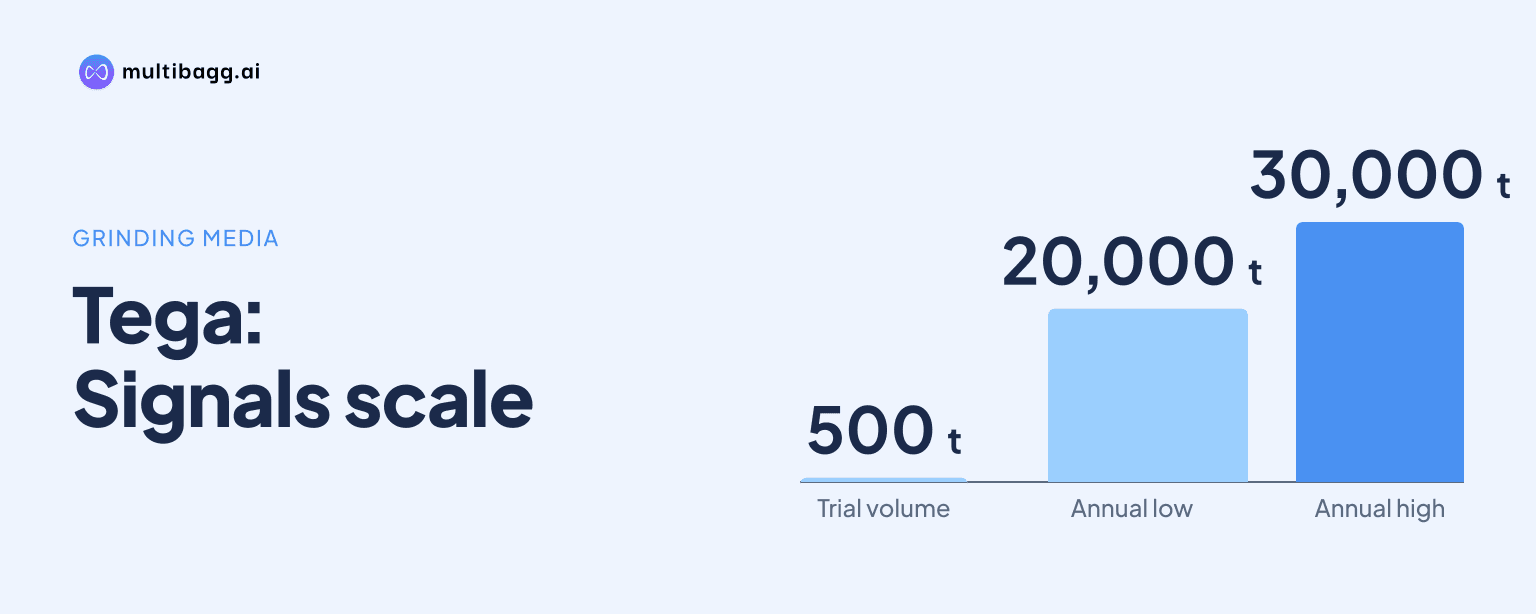
Four months after the Molycop transaction, Tega Industries secured a 500-tonne grinding-media trial that management said could become 20,000-30,000 tonnes of annual supply if it passes the trial. The order came from an existing mill-lining customer and is the first cross-sell initiative disclosed on the call.
Know Tega Industries inside out
Results, valuation, peers and who's buying, in one view.
What Molycop cross-sell order has Tega secured?
Tega has secured a 500-tonne trial order for grinding media from an existing mill-lining customer. Managing Director Mehul Mohanka said the order was won within four months of the Molycop transaction, making it an early disclosed commercial outcome from combining Tega’s mill-lining relationships with Molycop’s grinding-media offering.
The trial starts with an existing Tega customer rather than a new account. The call did not identify the customer, mine, country, order value, price, contract period or delivery schedule. It also did not disclose whether the 500 tonnes will be supplied in one shipment or in several deliveries, so the confirmed order is limited to the stated trial quantity.
Grinding media and mill linings are both supplied to mining mills, but the disclosed order is specifically for grinding media. That distinction matters because it shows the cross-sell mechanism: Tega can approach a customer already buying mill linings with Molycop’s grinding-media product. Management said other initiatives are in the pipeline across multiple geographies, without disclosing their number or size.
How large could Tega’s trial opportunity become?
Management said the 500-tonne trial could scale to 20,000-30,000 tonnes a year after it moves beyond the trial stage. The low end of that range is 40 times the initial trial volume, while the high end is 60 times the trial volume, illustrating the difference between the confirmed initial order and the potential regular supply arrangement.
The 20,000-30,000-tonne range is management’s indication of a possible opportunity, not a disclosed signed annual contract. Mohanka said the larger volume could arise “once it goes past the trial,” which makes conversion dependent on the customer moving beyond the testing phase. Tega did not disclose the technical, commercial or procurement conditions needed for that decision.
Management also gave no timetable for the trial’s conclusion or for a scaled contract. The order therefore provides a specific measure of initial execution, while the annual range remains conditional. There was no revenue forecast, margin contribution or overall cross-selling volume guidance attached to either the 500-tonne trial or the potential 20,000-30,000-tonne supply opportunity.
Why is the existing mill-lining customer important?
The existing customer relationship is important because Tega’s first disclosed trial uses an account already buying mill linings. Rather than relying on a new customer win, the 500-tonne order tests whether a customer can add grinding media to its purchases from the combined platform, linking two mining consumable categories in one commercial relationship.
Tega described the opportunity as one of many initiatives under development across multiple geographies. However, management did not provide customer names, mine locations, numbers of active trials, expected conversion rates or annual targets for accounts buying both products. The disclosed evidence is consequently one trial order secured during the first four months following the transaction.
The trial also gives management a specific customer-level route to test cross-selling before discussing broader opportunity size. A 500-tonne order can establish whether the existing mill-lining customer proceeds with Molycop grinding media, but the call did not disclose product-performance measures, comparative supply terms or the customer’s purchasing process. Those omissions leave the conversion path unresolved.
For Tega, the potential scale is tied to the same customer opportunity rather than to an aggregate market forecast. Management did not say that all mill-lining customers would be candidates for grinding media, nor did it quantify the addressable base. The 20,000-30,000-tonne indication should therefore be read as a potential outcome for the disclosed trial, not as a group-wide annual target.
Got a follow-up? Ask IRIS
How does Tega separate cross-selling from cost optimisation?
Tega separates cross-selling from its cost-optimisation programme, with management describing cross-selling as an additional top-up rather than part of the cost target. The two initiatives use different mechanisms: the 500-tonne trial seeks additional customer sales, while cost optimisation focuses on reducing fixed costs and improving operating efficiency over a stated two-to-two-and-a-half-year period.
Management identified four cost actions: setting up a global capability centre, relocating a headquarters to a lower-cost base, reducing selling, general and administrative expenses, or SG&A, and tracking operating efficiencies to improve yield. It said these actions are intended to expand margin by 100 basis points, with 100 basis points equal to one percentage point.
This distinction means a converted 20,000-30,000-tonne supply arrangement would sit alongside, rather than within, the cost programme. Management did not quantify revenue, EBITDA, or earnings before interest, tax, depreciation and amortisation, from cross-selling. It also did not say how much of the planned 100-basis-point margin expansion could come from higher utilisation or sales volumes.
The call’s wording limits the conclusions available from the disclosed trial. Tega has confirmed an initial 500-tonne order and has identified potential annual scale, but it has not attached financial guidance to the opportunity. Cost actions have a stated operational framework, whereas cross-selling is presented as commercial upside that will depend on individual customer conversions.
What does Molycop’s wider outlook show about execution?
Tega reported a 14% Molycop margin in the second quarter and said it intends to increase that margin by 100 basis points in the coming year. Management linked the prospective improvement to cost measures and operating efficiencies, while presenting cross-selling as a separate route for additional business rather than as a quantified margin assumption.
Management maintained its 5% Molycop volume-growth guidance despite the ramp-up of Grasberg and Cobre Panamá. It said Cobre Panamá still did not have mining permits, while Grasberg had not returned to full volume and EBITDA margins. Management said it did not expect contingent payments linked to Grasberg until FY 2028.
The 5% guidance provides a separate operating benchmark from the 500-tonne trial. Tega did not revise that guidance after disclosing the cross-sell order and did not quantify whether a later conversion to 20,000-30,000 tonnes would alter Molycop’s volume-growth rate. The company therefore retains its existing outlook while the trial develops.
At the consolidated level, management said Tega had delivered about 14% margins and described 17%-18% as its longer-term vision. It did not set a fixed delivery date, saying the timing could be two years or five years. The trial is one commercial initiative within that wider integration plan, but it is not a disclosed basis for the margin vision.
Conclusion
The disclosed trial establishes that Tega has begun selling Molycop grinding media through an existing mill-lining relationship. Its potential scale is far larger than the initial order, but the commercial outcome remains conditional on a customer conversion and has not been translated into revenue, profitability or group volume guidance.
The next point to watch is whether Tega says the 500-tonne trial has progressed to a recurring supply contract or discloses further orders from its global pipeline. Management’s planned 100-basis-point Molycop margin increase in the coming year and unchanged 5% volume-growth guidance are the other stated benchmarks for assessing the combined platform’s execution.