










Tega targets deleveraging after Molycop lifts net debt
Key highlights
- Tega reported net debt of about Rs 10,461.2 crore at September 30, 2026, against gross borrowings of Rs 11,492.3 crore.
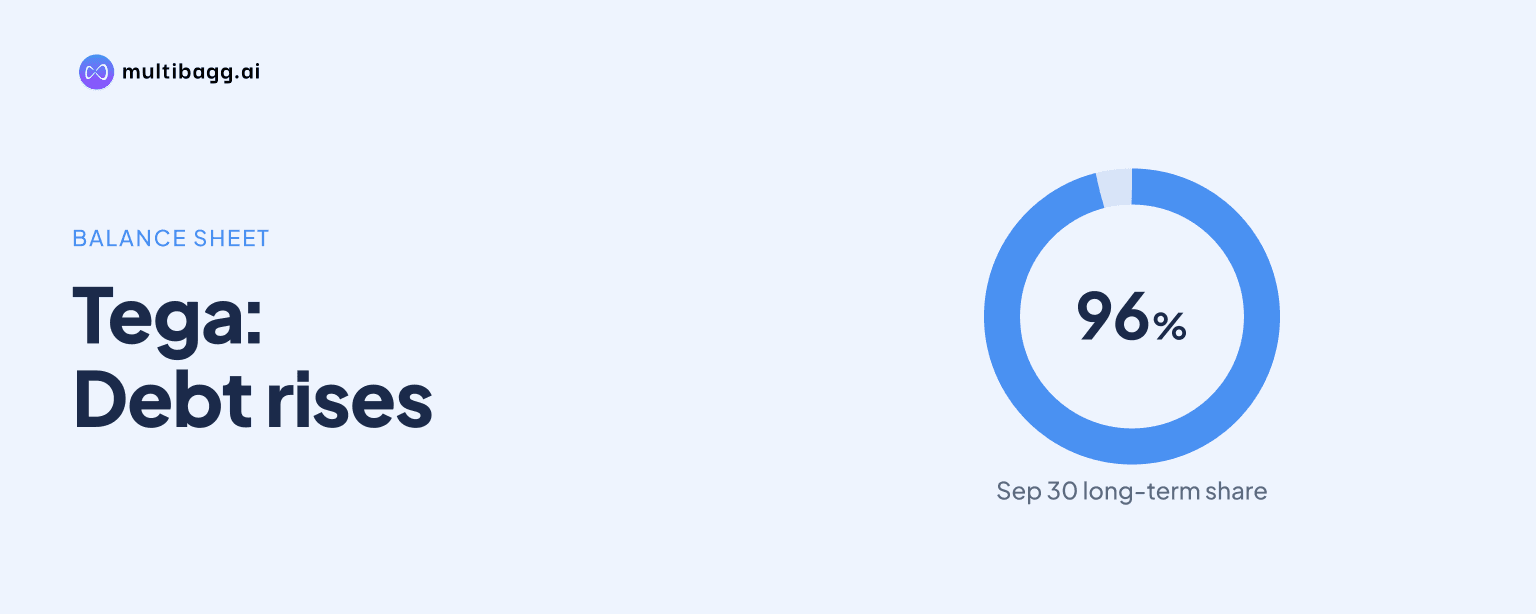
- Almost 96% of Tega’s Rs 11,492.3 crore of gross borrowings, or Rs 11,034.6 crore, was long term.
- Tega prepaid Rs 100 crore of term loan in October 2026 from preferential-issue proceeds.
- Tega reported H1 FY27 consolidated revenue of Rs 5,977.5 crore and EBITDA before one-time expenses of Rs 872 crore.
powered by IRIS
Tega Industries Limited reported net debt of Rs 10,461.2 crore at September 30, 2026, following its Molycop acquisition, and management said operating cash flow should cover immediate debt repayments without refinancing. Tega’s plan is to reduce leverage through internal accruals, working-capital release, disciplined capital expenditure and non-core asset monetisation.
Know Tega Industries inside out
Results, valuation, peers and who's buying, in one view.
Why did Tega’s net debt rise to Rs 10,461.2 crore?
Tega’s net debt rose because the June 1, 2026 acquisition of Molycop materially increased the group’s balance-sheet scale and borrowings. Consolidated gross borrowings were Rs 11,492.3 crore at September 30, 2026, of which Rs 11,034.6 crore, or almost 96%, was long-term. Cash, bank balances and liquid investments were Rs 1,031.1 crore, leaving net debt of about Rs 10,461.2 crore.
The transaction lifted total assets to Rs 22,706.6 crore at September 30 from Rs 4,314.5 crore in March 2026. Molycop added about Rs 20,404.2 crore of assets and Rs 16,789.5 crore of liabilities. The purchase consideration was Rs 4,242.2 crore, while the provisional purchase-price allocation included Rs 3,471.8 crore of identifiable intangible assets and Rs 5,057.1 crore of goodwill.
Tega also disclosed a Rs 100 crore term-loan prepayment in October 2026, funded by proceeds from a preferential issue. Because that payment followed the September 30 balance-sheet date, it was not included in the reported Rs 10,461.2 crore net-debt figure. Management described steadily reducing leverage as its top financial priority after the acquisition.
Does Tega need to refinance its borrowings immediately?
Tega does not expect an immediate refinancing requirement because management said operating cash flow would be adequate to cover immediate debt repayments. The long-term structure of the borrowings supports that position: almost 96% of the Rs 11,492.3 crore gross debt was long dated at September 30, 2026. Management also said it would keep short-term liquidity comfortable while deleveraging through internal accruals.
Finance cost was Rs 408.6 crore in H1 FY27, including dividends on redeemable preference shares at Molycop under Indian Accounting Standards, or Ind AS. Tega reported a loss after tax of Rs 167 crore for the half year, but said adjusted profit after tax was positive at Rs 45.2 crore after excluding acquisition-related items. These included Rs 257.6 crore of transaction costs and a Rs 11.7 crore non-cash inventory step-up charge under the purchase-price allocation.
Transaction costs declined during H1 FY27, according to management. The Chief Financial Officer cited costs of Rs 191 crore in Q1 and Rs 66.6 crore in Q2, while the earlier operating update referred to Rs 185.3 crore in Q1 and Rs 65 crore in Q2. Tega said the costs were largely non-recurring and that the bulk was behind it, but it did not provide line-by-line finance-cost guidance for subsequent quarters.
Got a follow-up? Ask IRIS
How does Tega plan to reduce leverage after acquiring Molycop?
Tega plans to deleverage through internal accruals, working-capital efficiencies, integration synergies, non-core asset monetisation and disciplined capital expenditure. Management identified inventory across the combined group as a particular working-capital focus for H2 FY27. It also said capital expenditure would remain focused on maintenance and high-return projects.
Net trade working capital was Rs 3,323.6 crore at September 30, equivalent to roughly 71 days when Q2 revenue is annualised. In Tega’s legacy business, trade receivables declined almost 15% from March despite higher sales volumes. Management cited that collection progress as a mechanism for releasing cash and improving consolidated working capital.
Non-core asset monetisation is part of the deleveraging plan, but its value and asset list were not disclosed. In the earnings-call question-and-answer session, Managing Director and Group Chief Executive Officer Mehul Mohanka said the initiative was under way and that Tega hoped to see some proceeds in FY27. He described it as a 12-to-18-month exercise and said any cash raised would be used only for deleveraging.
What operating performance supports Tega’s deleveraging plan?
Tega’s operating results are the basis for management’s expectation of internal cash generation, although the call did not disclose a consolidated operating-cash-flow figure. Consolidated revenue was Rs 5,977.5 crore in H1 FY27, compared with Rs 761.4 crore in H1 FY26, reflecting Molycop’s consolidation from June 1, 2026. Earnings before interest, tax, depreciation and amortisation, or EBITDA, before one-time expenses were Rs 872 crore, at a 14.4% margin.
The legacy consumables and equipment business grew at a different rate from the newly consolidated group. Legacy H1 FY27 revenue increased 20% to Rs 914.3 crore, and EBITDA before one-time expenses rose 25% to Rs 194.9 crore. Its EBITDA margin increased to 20.4% from 19.7%, while consumables revenue rose 30% to Rs 811.7 crore and equipment revenue was Rs 97.3 crore because of project-execution timing.
Molycop contributed Rs 3,771.6 crore of revenue and Rs 514.4 crore of EBITDA in Q2 FY27, its first full quarter within Tega, for a 14% margin. For the June-to-September four-month period, Molycop reported Rs 5,063.2 crore of revenue and Rs 677.2 crore of EBITDA. Volume was up 2.2% for the four-month period versus the prior-year period, while the three months ended September were described as relatively flat year on year.
Tega’s order book excluding grinding media was Rs 1,397.6 crore at September 30, up 14% from Rs 1,231.3 crore at the end of Q1 FY27. Of this backlog, Rs 1,157.6 crore was executable within the following 12 months. Tega also started a 500-ton trial supply of Molycop grinding media to an existing customer, which management said could create an annualised opportunity exceeding 30,000 tons.
Conclusion
Tega’s Molycop acquisition increased revenue, assets and debt simultaneously, leaving reported net debt at Rs 10,461.2 crore at September 30, 2026. Management’s response is internally funded deleveraging rather than immediate refinancing, supported by Rs 11,034.6 crore of long-term borrowings, working-capital initiatives and operating contributions from both the legacy business and Molycop.
The next measures to watch are the release of inventory and receivables, further debt prepayments after the Rs 100 crore October payment, and progress on non-core asset monetisation. Management hopes that some monetisation proceeds will arrive in FY27, but has set no value target and described the process as a 12-to-18-month exercise.