










Tega Industries Q2 FY27 Revenue Reaches ₹4,254 Crore on Molycop
Key highlights
- Tega Industries reported Q2 FY27 consolidated revenue of ₹4,254 crore and pre-one-time EBITDA of ₹608.1 crore.
- Molycop contributed ₹3,771.6 crore of Q2 revenue, with a 14% EBITDA margin.
- H1 FY27 transaction costs were ₹257.6 crore, while reported net loss after tax was ₹167 crore.
- FY27 equipment revenue-growth guidance was reduced to 15% from 25% because of delayed customer approvals.
powered by IRIS
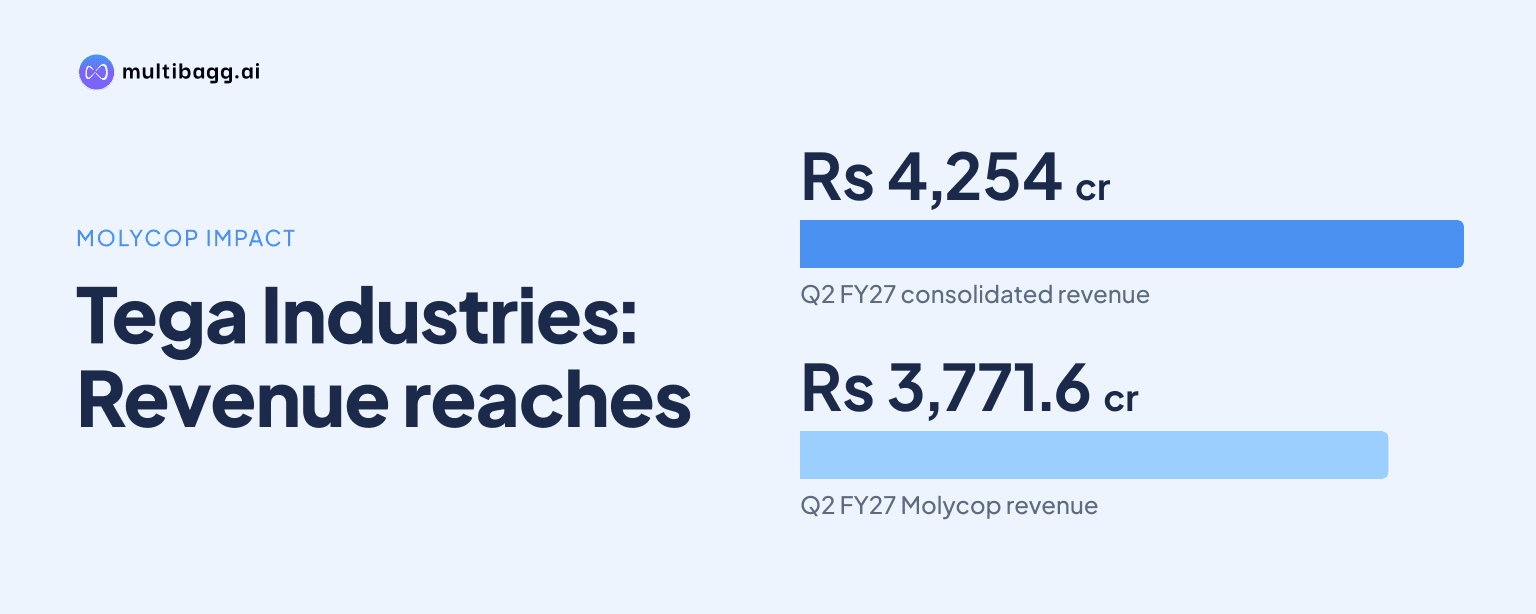
Tega Industries Limited reported Q2 FY27 consolidated revenue of ₹4,254 crore, led by the first full-quarter consolidation of Molycop, while EBITDA before one-time expenses stood at ₹608.1 crore and the margin was 14.2%. The results show the immediate scale added by the acquisition alongside integration costs and a slower equipment order conversion cycle.
Know Tega Industries inside out
Results, valuation, peers and who's buying, in one view.
What did Tega Industries report for Q2 FY27?
Tega Industries reported consolidated revenue of ₹4,254 crore for Q2 FY27, with EBITDA before one-time expenses of ₹608.1 crore. The resulting 14.2% EBITDA margin reflected the contribution of Molycop, which was consolidated for its first full quarter during the period.
Molycop generated revenue of ₹3,771.6 crore in Q2, EBITDA of ₹514.4 crore and a 14% margin. The acquisition has materially changed the consolidated revenue base, making direct comparison with the legacy business less straightforward. Management said Molycop's Q2 adjusted EBITDA was $54.1 million, while its adjusted EBITDA for the four-month consolidated period was $71.2 million.
For the first half of FY27, consolidated revenue was ₹5,977.5 crore and total income was ₹6,035.6 crore. EBITDA before one-time expenses was ₹872 crore, representing a 14.4% margin. The company recorded a reported net loss after tax of ₹167 crore for the half year, although adjusted profit after tax, excluding one-time items, was ₹45.2 crore.
How did the Molycop acquisition shape the quarter?
Molycop shaped the quarter by providing most of Tega Industries' consolidated Q2 revenue following its consolidation from June 1, 2026. Its inclusion expanded the group's mining consumables and equipment exposure, but also brought acquisition-related costs into the reported half-year earnings.
Management indicated that Molycop's volume grew 2.2% year-on-year in the reported period. It retained volume-growth guidance of 5% and said it expects synergies to support a 100-basis-point margin improvement in the coming year. The company also reiterated a longer-term consolidated margin aspiration of 17% to 18%, while noting that the timing remains uncertain.
One-time transaction costs were ₹257.6 crore in H1 FY27. These costs reduced from ₹185.3 crore in Q1 to ₹65 crore in Q2, according to management's opening remarks. The reported H1 loss therefore needs to be read alongside the positive adjusted profit after tax and the stated reduction in quarterly transaction costs.
The earnings call also focused on integration execution, including the conversion of Tega's order book, Molycop's mine-ramp economics, acquisition expenses and the Apollo liability. No detailed financial quantification of the Apollo liability was provided in the supplied call summary.
How did Tega Industries' legacy business perform?
Tega Industries' legacy consumables and equipment business delivered record H1 revenue of ₹914.3 crore, up 20% year-on-year. EBITDA before one-time expenses rose 25% to ₹194.9 crore, lifting the segment's margin by 70 basis points to 20.4%.
The consumables business was the principal driver within the legacy operations. Its H1 revenue increased 30% to ₹811.7 crore, while EBITDA rose 42% to ₹191.6 crore. The consumables EBITDA margin was 22.4%, and legacy gross margin improved to 61% from 59% a year earlier.
These figures indicate that the pre-acquisition business continued to expand even as management worked through the Molycop integration. The improvement in gross margin and consumables profitability is relevant because consumables are a recurring part of mining operations, while equipment revenue can be more dependent on project timelines and customer approvals.
Legacy Tega's Q2 revenue rose 19% year-on-year, according to the earnings-call summary. However, the supplied material does not provide an absolute Q2 legacy revenue figure, so the quarter's underlying business mix cannot be calculated precisely from the available disclosures.
Got a follow-up? Ask IRIS
Why did management cut its equipment growth guidance?
Management cut FY27 equipment revenue-growth guidance to 15% from 25% because customer approvals were delayed and some expected orders shifted into later quarters. The revision points to order-conversion slippage rather than a change in the company's disclosed expectations for eventual demand recovery.
Management said it expects a stronger Q3 and Q4 for the equipment business as delayed approvals progress. This expectation was presented as management guidance, not as a booked revenue figure. Investors will therefore need to track subsequent disclosures for evidence that the deferred orders are converted into revenue.
The distinction between consumables and equipment is important for understanding the period. Consumables recorded strong H1 revenue and profitability growth, while equipment became the area where the company moderated its outlook. The revised guidance introduces a specific operational item for investors to monitor during the second half.
The company also said its Chile plant remains on track for a January 2027 startup and March 2027 commercial production. This timetable is another disclosed operational milestone, although the supplied material does not state the project's capital cost, revenue contribution or capacity.
What does the quarter mean for investors and operations?
The quarter means Tega Industries is now reporting on a substantially larger consolidated base, with Molycop accounting for ₹3,771.6 crore of Q2 revenue. For investors, the central measures are the pace of integration, the movement in one-time costs, Molycop's volume performance and delivery against the stated synergy plans.
The 14.2% Q2 pre-one-time EBITDA margin is below management's longer-term 17% to 18% consolidated margin vision. But management has not given a firm timeline for reaching that range. The near-term 100-basis-point synergy-margin target provides a more specific benchmark for assessing progress over the coming year.
For mining customers and industry operations, the transaction brings Tega's legacy consumables and equipment activities together with Molycop's larger operating base. The disclosed results do not identify customer-price changes, mine-site disruptions or regional operating impacts, so these should not be inferred from the reported financial data.
The H1 reported loss of ₹167 crore also highlights the accounting impact of acquisition-related items. The adjusted H1 profit of ₹45.2 crore, together with the decline in transaction costs between Q1 and Q2, provides context, but does not remove the need to assess future integration expenses and operating performance separately.
Conclusion
Tega Industries' Q2 FY27 results show the scale effect of Molycop consolidation, with consolidated revenue reaching ₹4,254 crore and pre-one-time EBITDA of ₹608.1 crore. The legacy business remained profitable and grew strongly in H1, especially in consumables, while transaction costs and the first stages of integration weighed on reported earnings.
The next disclosures should clarify whether equipment approvals convert into the expected Q3 and Q4 recovery, whether Molycop volume meets the 5% growth guidance, and whether synergies begin to deliver the targeted 100-basis-point margin uplift. The January 2027 Chile plant startup and planned March 2027 commercial production are also scheduled operating milestones to watch.